Guides
How a working factory visit maintenance plan keeps tours accurate
Working factory visit maintenance plan for 2027 helps U.S. teams keep guest messages, route descriptions, signs, host materials, and alternatives accurate over time.
What to take away
- The plan covers guest-facing assets onlybooking page, confirmation, directions, signs, host brief and route description.
- Four checkpoints keep them currenta pre-session check, an out-of-cycle review after any change, a quarterly materials review and an annual audit.
- A visitor program coordinator owns guest language. A site operations lead confirms what is true on the floor.
- One correction queue with five fields replaces scattered emails and duplicate logs.
- Typical upkeep runs two to four hours a month for a single-site program, plus about one day for the annual audit.
What the visitor program maintains
The plan covers what a guest can see, read or hear. That means the booking page, confirmation email, directions, arrival sign, check-in instruction, host brief, route description and follow-up message.
It does not cover machinery, building systems, emergency equipment or controlled site procedures. Those stay with the site operations lead and the facility's own maintenance system.
Two roles carry the plan. The visitor program coordinator owns guest language and the correction queue. The site operations lead confirms whether an entry, route or condition is available today.
When a host reports a misleading sign, the coordinator drafts the fix and the operations lead confirms the fact. For how access and cost claims drift, see factory tour content upkeep.
The review calendar: four fixed checkpoints
| Checkpoint | Trigger or frequency | What it confirms |
|---|---|---|
| Pre-session check | Before every booked session | Arrival path, route version, escalation contact |
| Out-of-cycle review | Any route, staffing or seasonal change | Corrected guest messages and host brief |
| Quarterly materials review | Four times a year | Print and digital material matches operations |
| Annual audit | Once a year | Whole guest journey against the host brief |
The pre-session check takes a few minutes. Walk the arrival path, read the sign, confirm the route version in the host brief, then test that the escalation number answers.
The quarterly review compares print and digital material with current operations. Replace worn handouts, correct dated figures and retire wording that no longer matches the site. Seasonal planning mistakes shows how a July shutdown breaks a message written in April.
The annual audit repeats the first-time guest walkthrough. Book a slot as an outsider would, follow the directions, and compare what arrives with what the host brief promises.
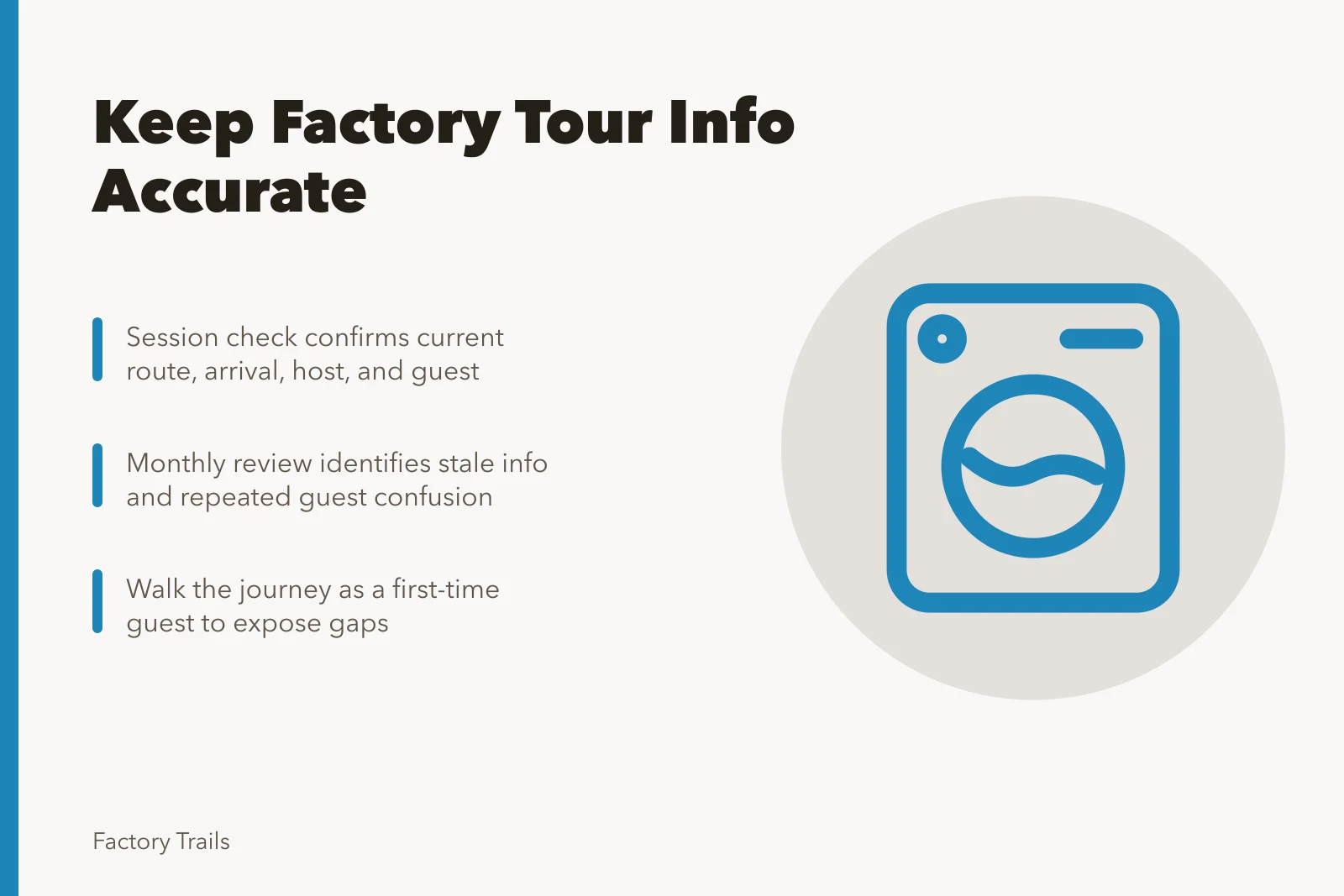
Visitor Program Review Rhythms
- Before a sessionConfirm current route, arrival, host, guest message
- Monthly or periodicIdentify stale information and repeated confusion
- Before a seasonTest directions, materials, signs, alternatives
- After a material changeAlign public description with new condition
How to set the plan up
- Name the visitor program coordinator and the site operations lead in writing.
- List every guest-facing asset with an owner and a review interval.
- Open one correction queue and one change log.
- Put the quarterly and annual dates in the same calendar as session bookings.
Example: a route change from report to closure
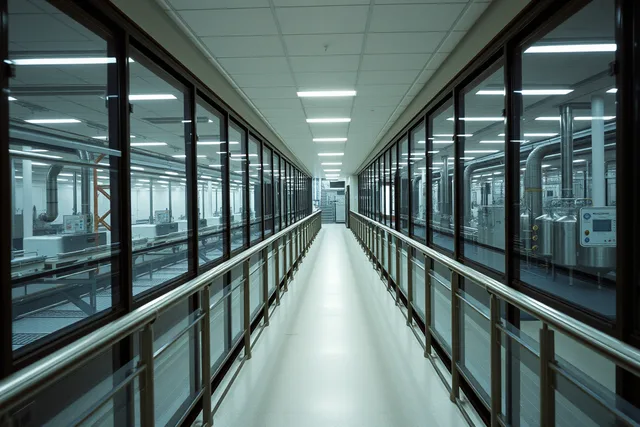
Suppose the finishing line sits behind glass on the normal route, and scheduled work closes the gallery for two weeks.
Day one. A host reports that the arrival sign still sends guests to the gallery door, so the coordinator logs the item as immediate. The site operations lead confirms the closure dates the same afternoon.
Day one. The coordinator pauses bookings that name the gallery and sends a correction to organizers already booked.
Day two. The host lead issues a revised brief with the mezzanine viewpoint as the approved alternative.
Day fifteen. The operations lead confirms the gallery reopened. The coordinator restores the original wording and closes the item.
| Date | Guest-facing change | Confirmed by | Copies updated | Closed |
|---|---|---|---|---|
| March 3 | Gallery closed two weeks | Site operations lead | Booking page, confirmation, arrival sign | March 17 |
The correction queue and its fields
Every item carries five fields: date raised, guest impact, source, named owner and closure date. The queue records what a guest would have been told wrongly, not a technical cause.
| Priority | Trigger | Response |
|---|---|---|
| Immediate | Unsafe or misleading arrival instruction | Confirm the fix and notify booked guests the same day |
| Before next session | Host brief misses a current restriction | Update the brief and brief the hosts |
| Next quarterly review | A repeated question points to a story gap | Revise approved material after review |
Equipment condition, machine guarding and protective gear belong in the site's own records. A plant that requires safety glasses or protective footwear tracks that itself. See factory tour safety records for keeping visitor copies separate from site records.
Signs, handouts and host briefs
Keep a compact asset list instead of a prose description of each item.
Visitor Journey Walkthrough Checks
- Is this instruction current and specific?
- Who can confirm it when a condition changes?
- Does the host brief say the same thing?
- Is there an approved alternative if the normal step cannot run?
| Asset | Check | Owner |
|---|---|---|
| Booking page | Route wording and contact details current | Visitor program coordinator |
| Arrival sign | Location, readability, correct instruction | Coordinator and site operations lead |
| Host brief | Route version, restriction, escalation contact | Host lead |
| Printed handout | Facts, date, approval status | Content owner |
| Alternative explanation | Matches what guests actually receive | Visitor program coordinator |
A dated version line on every handout answers the organizer who reports being told something different. Keep the wording that was sent, then issue the correction in writing.
Measuring whether the plan works
Count five things: recurring direction questions, outdated-message corrections, material replacements, route-change notices and items still open past their closure date.
Read the pattern, not the number. A rise in arrival questions can mean a landmark disappeared from the directions. Several host corrections can mean the brief never reached the session.
For visitor media that outlives a printed leaflet, industrial site interpretation upkeep covers exhibits, panels and audio.
Share findings with the site operations lead and set the next action with a date. Consistency matters more than paperwork.
Sources for visitor-facing upkeep
- The National Park Service wayside exhibit evaluation checklist asks about physical condition, readability, visitor use and purpose. Apply those four questions to arrival signs and handouts.
- The National Archives web-records guidance supports a dated record of what changed, why, who approved it and which copies were updated.
- The Department of Justice effective communication guidance notes that effective communication depends on context and a person's usual method. Send requests through the approved process and keep the confirmed reply.