Guides
How to plan factory tour budgets with a phased workflow
Planning factory tour budgets in 2027 gives U.S. teams a practical workflow for defining access, staffing, safety, visitor needs, costs, pilots, and reviews.
Plan a factory-tour budget as a workflow, not a shopping list. The useful question is not "What does a tour cost?" It is "What must this particular site do, every time it receives visitors, to make the experience safe, truthful, accessible, and worth repeating?"
This workflow is designed for an active manufacturer, a historic industrial property, or a business considering a public-facing production experience in the United States. It does not provide legal, safety, insurance, or accessibility advice for a particular facility. Use qualified local and organizational experts for those decisions.
What to take away
- Define the visitor promise before gathering estimates.
- Use decision gates so an attractive idea does not become a premature public commitment.
- Treat route access, operating conditions, and staff time as budget inputs.
- Pilot the experience before locking in a season, price, or expansion plan.
Phase 1: Write the visitor promise
Start with one sentence that someone outside the project can understand. For example: "A 45-minute guided introduction to how this facility makes its product, using a defined viewing route and one supervised demonstration." This is more useful than "launch factory tours," because it forces the team to state duration, format, subject, and access limits.
Then answer four questions:
| Question | Why it comes first |
|---|
Visitor promise questions
- Who is invited?
- What will they learn or do?
- What can they physically access?
- What is outside the promise?
Avoid a long list of goals. Choose one primary purpose and, at most, two secondary benefits. A community education program may measure attendance and understanding. A recruitment experience may prioritize accurate workplace information. Neither should be judged solely by ticket revenue if revenue was never the main reason to operate it.
Phase 2: Form the operating team
No single department owns all of a factory tour. Before a budget is approved, name people who can speak for operations, safety, security, maintenance, visitor communications, accessibility, and the person who will actually host the group. Ask each role to identify a condition that would make a normal tour impossible.
Do not assume existing staff can absorb the work. A production supervisor may know the story but have no time for reservations, visitor questions, or a 20-minute route reset. Record responsibilities in plain language:
Operating team responsibilities
- Operations approves tour windows and boundaries
- Safety and security define visitor conditions
- Visitor services owns bookings and arrival
- Host owns live program and group movement
- Program owner maintains budget and route
This meeting is a decision gate. If essential owners are not identified, the project is not ready to price.
Phase 3: Map the route under real conditions
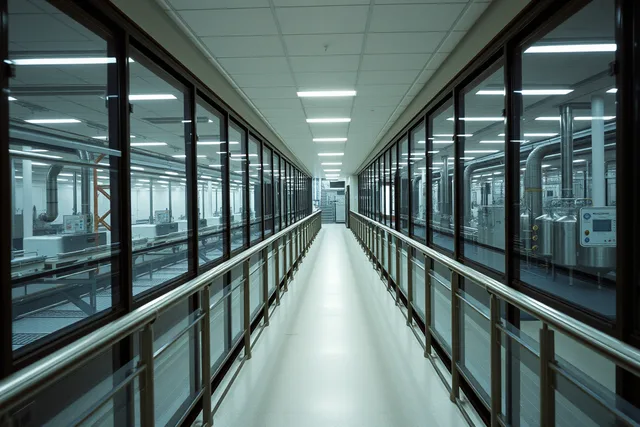
Walk the proposed visitor journey under normal operating conditions. Do not assess it only after hours or from a floor plan. Record the actual visitor-access boundaries, points where a host cannot deliver the planned message, delays that alter the sequence, and any condition that requires review by the responsible site role. This guide does not set safety controls or approve access.
Make a route sheet for every stop. It should list the message, maximum group size, required equipment, access limitation, and backup message. A route sheet turns vague enthusiasm into a usable operating specification.
The National Park Service's planning guidance for interpretation and visitor experience describes planning around visitor experience, access, and resource conditions. Its setting is public heritage work, but the planning principle travels well: decide what experience a site can genuinely provide before committing to the format that advertises it.
At the end of the walk, choose a preliminary group-size limit based on the most restrictive point. It is better to run a smaller, well-managed program than to launch a larger group that cannot move, hear, or receive consistent supervision.
Phase 4: Turn the route into a cost model
Now create three columns: setup, per-session, and periodic review. This prevents one-time work from disappearing into the first tour and recurring work from being treated as free.
Tour cost timing
Setup
- Work
- Route planning, signs, training
- Evidence
- Approved route, named owners
Per session
- Work
- Host time, check-in, reset
- Evidence
- Pilot timing, group-size limit
Periodic
- Work
- Safety review, content updates
- Evidence
- Review date, change log
| Cost timing | Typical work | Evidence needed |
|---|---|---|
| Setup | Route planning, signs, barriers, training, booking configuration, content production | Approved route and named owners |
| Per session | Host time, check-in, protective items, sanitation, setup, reset, visitor support | Pilot timing and group-size limit |
| Periodic | Safety review, content updates, equipment inspection, staff refreshers, public-page updates | Review date and change log |
Cost labor in full units of work. If a host leads a one-hour tour, include their preparation, arrival, briefing, route delivery, wrap-up, and reporting. If a booking system sends reminders automatically, include the staff work to correct an inaccurate reservation or answer an access question. These are not administrative leftovers. They are part of the visitor experience.
Phase 5: Design accessible and honest communications
Create the booking page and confirmation email before launch. This often reveals missing decisions. Visitors need to know the tour's duration, meeting point, arrival time, physical requirements, group rules, conditions that may change the route, available accommodations, photography policy, and cancellation procedure.
Booking page essentials
- Tour duration and meeting point
- Arrival time and physical requirements
- Group rules and route changes
- Available accommodations and photography policy
- Cancellation procedure
Do not use vague phrases such as "fully accessible" unless the organization has determined exactly what it can support. Describe the actual route and the available alternative. If a stop has stairs, limited seating, or high noise, say so in clear language. Honest information helps visitors choose and reduces disruption on the day.
Also decide which claims need maintenance. Opening hours, admission terms, age rules, protective equipment, and permitted spaces can change. Assign one person to update every public location, including the website, event listings, booking confirmation, group-sales script, and posted sign.
Phase 6: Create the live operating procedure
Write a short, usable procedure for a normal session. It should fit a host's real work, not read like a marketing brochure.
Live session procedure
- Confirm route and expected group
- Prepare equipment and meeting point
- Welcome group and state rules
- Lead approved route with backup message
- Close session and document issues
- Notify program owner of changes
Add an exception procedure for late groups, sudden production demands, equipment issues, heat, weather, staff absence, or a route closure. The best exception procedure does not force a host to invent a new policy while guests wait.
Phase 7: Pilot before marketing broadly
Run a small pilot that resembles the eventual visitor group. Include the actual booking message, arrival instructions, staff roles, route, equipment, and reset. Time every stage. Ask the host what was unclear, then ask visitors what they did not understand before arriving or while moving through the site.
Pilot observation sheet
- Planned versus actual group size and duration
- Staff and minutes used by role
- Route stops causing congestion or confusion
- Questions revealing weak instructions
- Supplies used and equipment failures
- Production or access changes
Do not market the pilot result as a permanent capacity promise. Repeat the test under more than one operating condition when possible.
Phase 8: Approve, pause, or narrow
Bring the pilot record back to the operating team. Approve a limited launch only when the team can answer these questions without guesswork:
| Approval question | Evidence to review |
|---|---|
| Is the route viable? | Real-condition walk and pilot notes |
| Is the group size defensible? | Bottleneck, route, and staffing observations |
| Is the cost model complete enough? | Setup, per-session, and review lines |
| Can visitors make an informed choice? | Current booking and arrival communication |
| Can staff adapt safely? | Defined exception and closure process |
If an answer is no, narrow the tour. A smaller program with a stable route is a success when it matches the site. Expansion should be earned by operating evidence, not by demand alone.
Phase 9: Review after launch
Set a review date before opening. At that review, compare planned and actual staffing, attendance, no-shows, cancellations, route changes, questions, equipment use, and any incidents. Then make one of four decisions: keep the program, adjust the procedure, increase only a proven capacity constraint, or pause the program while a risk or access issue is solved.
Keep previous versions of the route and visitor message. When someone asks why a limit exists, the program should be able to point to the operating decision instead of relying on memory.
The National Archives explains that web records should be managed through their life cycle. That policy does not govern a private visitor program. Its useful lesson is to keep the approved booking description, route sheet, and change note together. If a visitor promise changes, the program owner can identify every public message that needs review.
The Department of Justice describes effective communication as a fact-specific question shaped by the communication's nature, length, complexity, and context. It does not decide what this site must provide. It supports an honest planning practice: share essential details early, avoid broad claims that the team has not verified, and create a clear route for visitors to ask questions about the offered experience.
The Government Accountability Office's cost-estimating guide identifies a documented basis, assumptions, and updates as features of a dependable estimate. It is not a cost model for factory tours. It is a sound reason to retain the pilot evidence, explain uncertain numbers, and distinguish an initial test from a recurring public program.
Common questions
When should a factory-tour budget be created?
Create the first version after the visitor promise and route are defined, then revise it after a real-condition walk and a pilot.
Does a free tour need a budget?
Yes. A free ticket does not remove staff time, safety planning, visitor communication, or equipment costs.
What is the most useful pilot metric?
Actual staff time across the whole visitor journey is often the most useful starting metric because it reveals work that a route map cannot show.
Can a tour begin with a temporary route?
Yes, if the temporary route, restrictions, and visitor communication are clear and the team can safely operate it. Record the review date before launching.