Guides
How manufacturing museums should keep cost records for owner claims
Manufacturing museum cost records for 2027 help U.S. editors track fee sources, conditions, trip assumptions, group terms, listings, corrections, and refresh dates.
What to take away
- A fee record carries seven fieldsactivity, source, check and review dates, price, conditions, exclusions, correction log.
- The owner is the museum, park unit or operator that publishes the fee.
- An owner claim needs the exact sentence, the page URL, a dated copy of the source and the scope of the change.
- Group quotes, parking and travel stay outside the admission figure.
- Review each live fee twelve months after its check date, and again before a seasonal update.
The seven fields every fee record needs
Keep one record per public claim. A museum ticket, a timed workshop and a group rate expire on different schedules.
| Field | What goes in it |
|---|---|
| Activity | The named tour, gallery, demonstration or event. |
| Source | The page that publishes the term, with its title and URL. |
| Dates | Date checked, plus the next review date. |
| Price | The figure and the visitor category it applies to. |
| Conditions | Booking rule, season, group minimum, timed entry. |
| Exclusions | Travel, parking, food, separate ticketed attractions. |
| Correction log | The changed sentence, the evidence and the decision. |
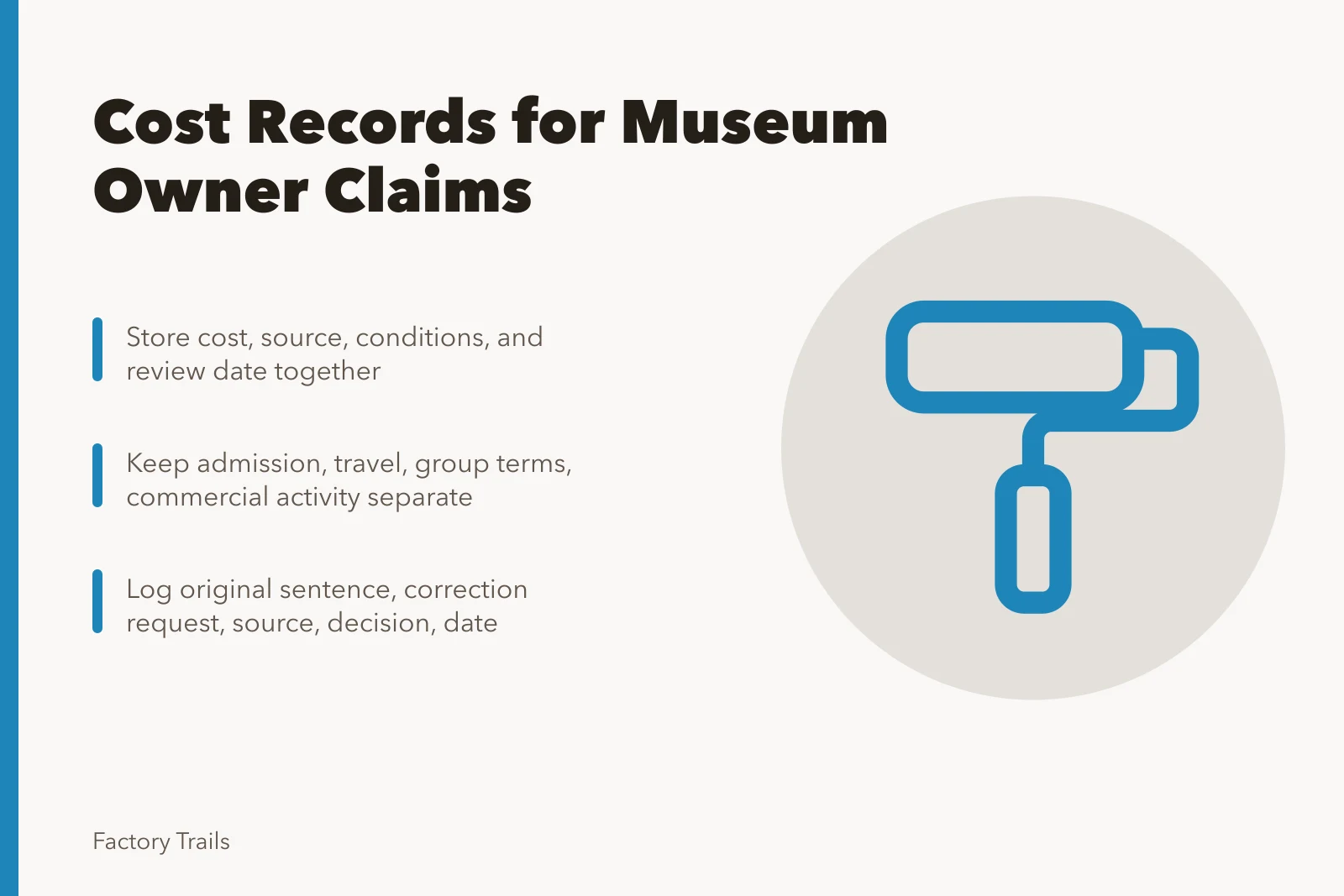
The seven fields tie each claim to a source, a condition and a review date.
Cost record fields
- Public activity names gallery or event
- Exact source lets editor check page
- Date checked shows review need
- Price conditions preserve limits
- Exclusions keep travel out
- Assumptions state route or party
- Correction log records change
The most useful field is the exclusion. A ticket page supports its own terms and little more, not a nearby garage rate or a restaurant budget.
Booking terms drive the record. A timed, ticketed tour is a different claim from walk-up admission, as the Britannia Mine Museum booking guide explains.
Example: a filled record for Hershey's Chocolate World
The Wikipedia page on Hershey's Chocolate World describes the site as a visitor center, so the price field reads as no general admission charge rather than a ticket.
| Field | Entry |
|---|---|
| Activity | General admission, Hershey's Chocolate World visitor center, Hershey, Pennsylvania |
| Source | Wikipedia, Hershey's Chocolate World; page saved on the check date |
| Dates | Checked 2 June 2025; next review 2 June 2026 |
| Price | No general admission charge |
| Conditions | Attractions inside the building are ticketed separately, at rates set on site |
| Exclusions | Travel to Hershey, parking, food, souvenirs |
| Correction log | Empty; first entry taken from a single source |
A zero charge is still a fee claim, so it keeps a date, a category and a condition. The same page notes that the working factory is not open to public tours.
Who owns a fee claim, and what a claim must include
The owner is the institution that sets the fee: a museum, a park unit, or the concessions company that runs ticketing. It is not the article's publisher or an advertising partner.
If a contractor keeps your records, how to run a manufacturing museums provider selection in 2027 covers what to ask about source storage and handover.
An owner claim arrives as a written request. Work it in this order:
- Confirm the sender's authority over the figure, such as a director, a communications office or a ticketing operator.
- Quote the exact sentence and give its URL, plus the download date.
- Attach the owner's own current source, such as a ticket page, a dated notice or a statement on letterhead.
- List the effective date, the activity and the booking channel the change covers.
- Set the new wording, add a next review date, and store the exchange in the correction log.
Records-management fundamentals from the National Archives explain why the evidence behind a published value is kept.
Blank record template to copy
Copy this table and fill the right column once per claim. One file per museum keeps the log short.
Field / Entry
- Activity
- Source
- Dates
- Price
- Conditions
- Exclusions
- Correction log
Keep personal travel sums in a separate budget file. Factory tour budgeting fundamentals: what to put in your 2027 scope checklist shows which costs belong in a trip budget rather than an admission record.
Refresh cadence: twelve months, or before each seasonal update
Start with a twelve-month cycle from the date checked. Bring the review forward when any of these happens:
- The owner changes a season, opening hours or a ticket channel.
- A rate rises, or a visitor category is added or withdrawn.
- The record supports a paid listing, a campaign or a printed guide.
- The figure is reused in a title, table or social caption.
Visitor conditions guidance from the National Park Service explains why time-sensitive visitor information needs a current check. It does not set any museum's fees.
If no current source supports a figure, drop the number and point readers to the institution. Keep the record internally so a later editor does not restore the old value.
Free sites and timed paid tours need different habits. A guide to Alabama's industrial heritage sites beyond Sloss Furnaces shows how wide that range runs.
Common questions
Who is the owner in an owner claim?
The institution that publishes the fee, or the operator it contracts to run ticketing. A claim from anyone else needs the owner's confirmation before a number changes.
What evidence does a claim need?
The exact sentence and its URL, the request with a date, and a current source controlled by the owner. Without that source, treat the message as a report to check, not a correction to apply.
Should a group quote be published as a museum price?
No. Keep the quote as a dated, scoped entry in the record until the museum publishes equivalent terms for the same activity.
How often should a fee record be refreshed?
Twelve months from the check date, sooner if a season, rate or ticket channel changes. Reuse in a paid listing or a campaign counts as a trigger.