Guides
How to run a manufacturing museum case study method without inventing facts
Manufacturing museum case study method for 2027 helps U.S. editors document a focused question, reliable evidence, decisions, limits, outcomes, and updates.
What to take away
- Write the answer to one narrow question before you write the narrative.
- Keep a source list that ties every factual sentence to a dated record or operator page.
- Put interpretation in its own sentences so readers can tell evidence from judgment.
- Date every live visitor claim and link it to the responsible operator.
The eight-step structure
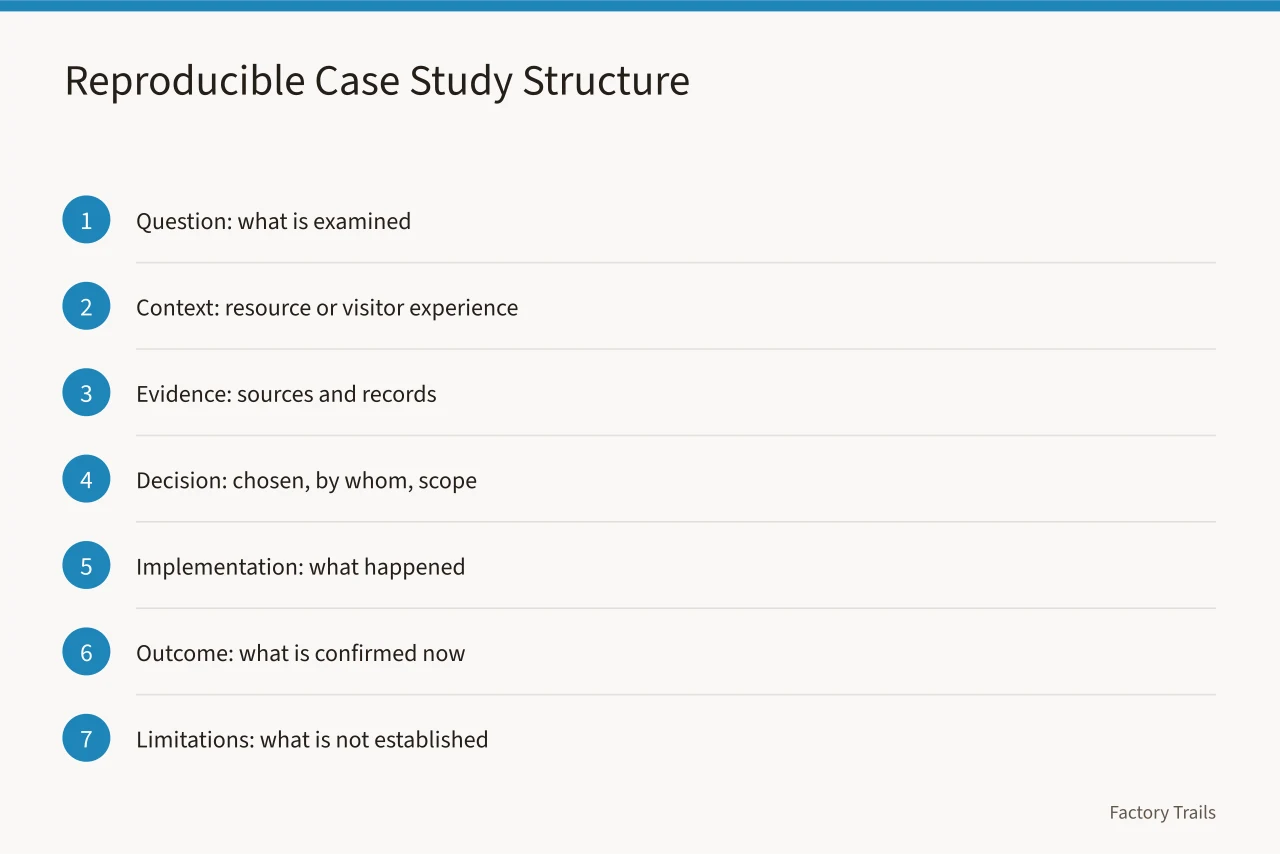
A reproducible case study follows eight steps in order.
- Question.What decision, condition or access change does the case examine?
- Context.Which site, building, exhibit or route is involved?
- Evidence.Which records, dates and pages support the account?
- Decision.What was chosen, by whom, within what approved scope?
- Implementation.What happened, including any documented scope change?
- Outcome.What can be confirmed today for readers or visitors?
- Limitations.What does this case not establish?
- Update trigger.Which source or condition forces a review?
Keep step eight active. The NPS Historic Property Project Documentation completion guidance tells teams to record discoveries or differing site conditions that changed treatment from the original scope. Log the change rather than rewriting the plan.
If the case covers several stops, keep each stop as its own evidence unit. Our regional industrial site interpretation checklist shows the order that works.
Write a question the records can answer
Broad questions invite invention. A usable question names a resource, a decision, a date range and an observable effect.
Weak vs Stronger Case Questions
Weak question
- Restoration
- Was it restored?
- Ranking
- Best industrial museum?
- Tourism
- Did route improve tourism?
- Machine
- How was machine saved?
Stronger question
- Restoration
- What evidence supported scope?
- Ranking
- What does program offer?
- Tourism
- What path was confirmed?
- Machine
- Which decisions are documented?
| Weak question | Stronger question |
|---|---|
| Was the museum restored successfully? | What evidence and approvals supported the documented scope? |
| Is this the best industrial museum? | What does the current public program offer, and what does it not offer? |
| How was a machine saved? | Which source-backed observations and decisions are documented for the object? |
Set the scope and evidence boundary
State what the case includes and what it excludes. Public interpretation work cannot assess technical condition or promise access to every room.
Build an evidence list with four columns: source, date, claim supported, limitation. Budget the reading time before you draft. The cost map in our case study budget notes covers records requests, image licensing and review hours.
| Evidence type | Appropriate use | Do not use it to prove |
|---|---|---|
| Current operator page | Hours, access, program, visitor conditions | Historical conclusions beyond the page |
| Project record | Scope, phases, discoveries, approved changes | A generic claim about other sites |
| Collections or research source | Object history, records, interpretation | Current opening status |
| Image record | Image identity and credit | Public access, a tour or a program |
Separate documented facts from interpretation
Write the timeline first, with dates and page references. Then write interpretation in separate sentences. A project record may show that a path changed. An interpretive sentence can explain why the revised route helps a visitor read the industrial setting.
Treat a before-and-after photograph as context, not proof.
Example: the question-to-evidence chain
The example below is hypothetical and the museum is unnamed on purpose.
A county museum in a former foundry hall wants to explain a new walkway past a preserved cupola. The first draft asked whether the walkway saved the foundry story. No source supported that claim.
The revised question was narrower: which documented condition findings led to rerouting the walkway in 2023? Evidence came from a condition report, a board minute approving the revised scope, the exhibit label text and the operator's current visitor page.
The chain has three parts. Question: what forced the reroute? Evidence: the condition report and the board minute. Limitation: no visitor counts exist, so higher attendance cannot be claimed. That limitation becomes the next research step.
Keep current visitor information dated
A project can be well documented while a room or program is closed today. Date every live claim and link it to the responsible operator page. Two facilities under one brand can differ, so the Royal Canadian Mint tour page separates the Winnipeg production tour from the Ottawa boutique mint.
When current conditions contradict the historical narrative, say so. Our guide to booking the Britannia Mine Museum underground tour shows how one visit claim can be pinned to a bookable slot.
Turn limitations into next steps
Write limitations as leads, not apologies.
Limitation / Better next step
- No current visitor source
- Confirm the operator page before publishing a visit claim.
- No technical assessment
- Consult a qualified professional or the project record.
- One site only
- Avoid a regional or national ranking.
- Incomplete cost information
- Describe the scope and omit a universal price.
Review before publication
Read the draft twice: once as a skeptical researcher, once as a prospective visitor.
- Every factual sentence cites a dated source or record.
- Interpretation sits in its own sentence and is labelled.
- Visitor claims carry a date and a responsible link.
- Image credits match the image record.
- Limitations and an update trigger are present.
A statewide claim needs its own evidence base. That is how our guide to Alabama's industrial heritage sites treats sites beyond one landmark.
Keep the source list, fact-check date and correction log with the file. The National Archives' records management basics explain why material documenting activity should stay identifiable and usable.