Costs
How to budget a manufacturing museum case study: notes before you start
Manufacturing museum case study budget notes for 2027 help U.S. editors scope research, records, review, images, and a useful final account.
A useful case-study budget pays for evidence before polish. Scope comes first: the question, the deliverable length, and the cutoff date. A shared cost map helps, and the factory visit case study budget guide sets out the categories this estimate assumes.
What to take away
- Budget five linesresearch, records, field verification, production, contingency.
- Price each line in units, so a sponsor can cut scope without cutting checking.
- A 1,500-word case study typically runs $4,900 to $6,000 when access and permissions are ordinary.
- Hold contingency at 10 to 15 percent, and log every draw against it.
- Close the file with the sources checked and the questions left open.
The five cost lines
| Line item | Typical rate or unit | What drives it |
|---|---|---|
| Research | $65 to $120 per hour | Interview count and archive distance |
| Records | $0.50 to $2.00 per page, $0 to $500 per permission | Reproduction fees and rights holders |
| Field verification | $250 to $600 per day | Travel, escort time and whether the plant is running |
| Production | $60 to $150 per hour | Drafting, editing and accessibility checks |
| Contingency | 10 to 15 percent of the total | A closed archive, a corrected date or a re-shoot |
Budget Work Items
- Researchdefine the change or decision
- Recordsarchives, reports, photos, interviews
- Field worktravel, permission, safety
- Productiondrafting, fact review, image rights
- Contingencyclosed archive, revised interview
Rates vary by market and by who does the work of the research. Treat those numbers as typical ranges for North American editorial and heritage work, not a national standard. The factory tour budget checklist is worth reading before you fix hours, because it names the scope items sponsors tend to add late.
Rule of thumb: fund 20 to 30 hours of research for a 1,500-word case study. More hours than that usually means the question is too wide.
Example: a 1,500-word case study
| Line item | Basis | Sample budget |
|---|---|---|
| Research and interviews | 24 hours at $85 per hour | $2,040 |
| Records and reproductions | 60 pages, two permissions | $450 |
| Field verification | Two days, travel and PPE | $700 |
| Drafting and editing | 14 hours at $90 per hour | $1,260 |
| Image licensing | Three images | $450 |
| Contingency at 12 percent | On $4,900 | $588 |
| Total | $5,488 |
Every rate behind those lines sits inside the ranges above. Swap in your own hourly rates and the structure still holds.
Match research depth to the decision
pdf) separates documentation levels and allows lighter work where a site is simple or the budget is tight. Buy the level the reader's decision needs. A narrow question with a stated limit beats a broad survey with thin sourcing.
Where a site will carry visitor interpretation, the industrial site interpretation provider guide explains what that extra layer usually adds to the bill.
Field work and access costs
Field verification is the line most often underfunded. Add a travel day for each site, an escort or staff hour, and any protective equipment the plant specifies. Confirm who pays for reproduction and shipping before you sign the brief. A second visit usually costs less than the first because the paperwork is already done.
Contingency, approvals and change control
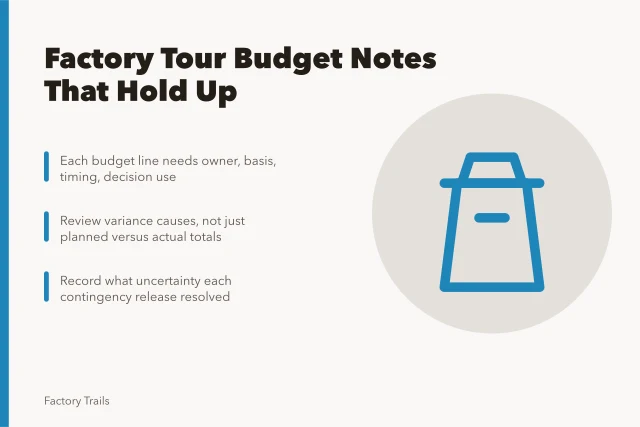
Hold contingency at 10 to 15 percent. Draw it only for verifiable changes, such as a record request, a corrected date, or a second review.
The Government Accountability Office's cost-estimating guide treats a reliable estimate as documented and updated when facts change. Apply that habit to editorial work. Write the basis for each hour, then revise when a fact moves.
Run every change through four steps:
- Note the new information and where it came from.
- Say whether it touches the approved question.
- Estimate the added hours and the added cost.
- Record what happens if that work is not funded.
The factory tour budget notes and capacity guide covers how capacity limits reset a schedule, which matters when the only tour slot falls inside your field window.
Records to keep with the final file
The National Archives' records-management basics explain why records that document work should stay identifiable and usable. Keep the assignment brief, the source log, permission records, invoices, and any correction note with the case-study file.
Close with the evidence obtained rather than a claim of completeness. List the sources checked, the work not performed, and any point still outside scope.
Common questions
Should a case-study budget include a contingency?
Yes. Hold 10 to 15 percent and draw it only for verifiable changes, such as a record request or a corrected date.
Can a short article use a small research budget?
Yes, if the question is narrow and the limits are stated. A short article should not imply comprehensive coverage.
What is the first expense to cut?
Cut scope before you cut checking. Narrow the question or drop a site visit, and keep fact review funded.
How many images should I license?
Two or three per 1,500 words is typical. Confirm rights and credit lines before the draft goes to review.