Guides
How industrial tour providers should build a budget that survives review
Industrial tour provider budget notes for 2027 help U.S. operators define scope, separate fixed and variable costs, document assumptions, and compare proposals.
What to take away
- Price a defined assignment, rather than a vague promise to "support the tour."
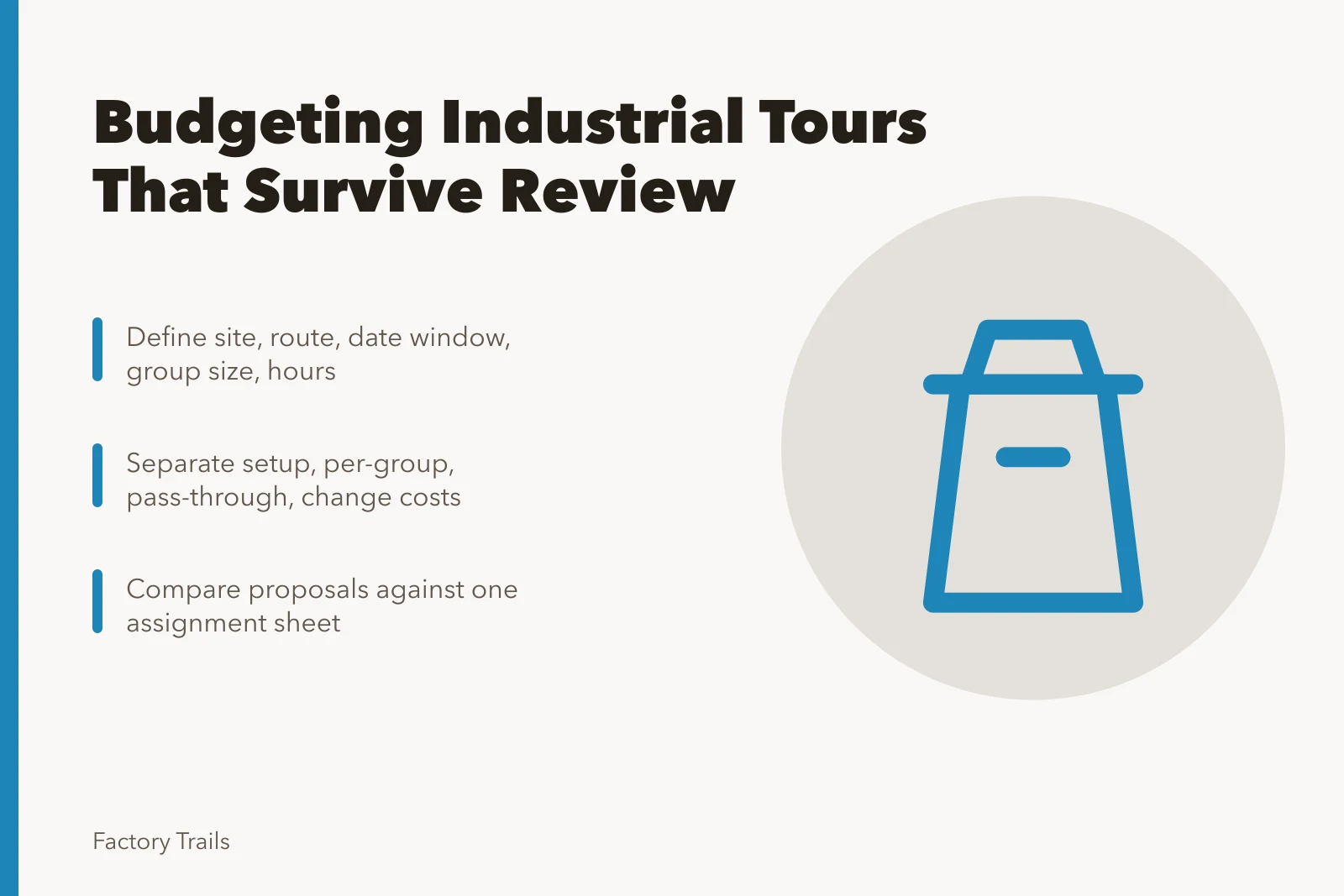
- Separate setup work, per-group costs, pass-through costs, and change costs.
Define the assignment before pricing it
The budget should begin with the tour that is actually being planned. Write the site, route, date window, expected group size, group profile, operating hours, provider role, and host responsibilities. Without that information, a low price may simply exclude route preparation, extra coverage, visitor notices, transportation coordination, or a changed itinerary.
Cost layers and key questions
Cost layer
- Preparation
- Route review, planning call, script
- Fixed delivery
- Lead provider, equipment, minimum time
- Variable delivery
- Additional guides, vehicles, translations
- Pass-through
- Admission, parking, printing, transport
- Change cost
- Rescheduling, route revision, coordination
Typical content
- Preparation
- Included before first date?
- Fixed delivery
- Applies even for small group?
- Variable delivery
- Changes with size or duration?
- Pass-through
- Who approves these costs?
- Change cost
- When and who authorizes?
Question to ask
- Preparation
- Fixed delivery
- Variable delivery
- Pass-through
- Change cost
Ask every candidate to identify assumptions in writing. If the route is not final, state that. If a guide quote assumes one group but the operator may split arrivals, state that too. Assumptions are not a weakness. They make a budget easier to update without pretending the unknown does not exist.
| Cost layer | Typical content | Question to ask |
|---|---|---|
| Preparation | Route review, planning call, script, materials | Is this included before the first date? |
| Fixed delivery | Lead provider, required equipment, minimum time | Does it apply even for a small group? |
| Variable delivery | Additional guides, vehicles, translated materials | What changes with group size or duration? |
| Pass-through | Admission, parking, printing, third-party transport | Who approves these costs? |
| Change cost | Rescheduling, route revision, extra coordination | When does it apply and who can authorize it? |
This structure makes a proposal readable. It also keeps a provider from carrying an unspoken responsibility that the host expects it to absorb.
| Budget line | Typical range | What drives the number |
|---|---|---|
| Preparation | $500 to $2,500 per assignment | Route review, script, materials, planning calls |
| Per-group delivery | $1,200 to $4,000 per group | Guide count, duration, equipment, travel distance |
| Pass-through | $8 to $35 per guest | Admission, parking, printing, third-party transport |
| Change fee | $150 to $750 per change | Notice period, route revision, extra coordination |
Typical planning ranges for a mid-size U.S. industrial tour, not quotes. Use a spreadsheet such as Microsoft Excel or Google Sheets for the assignment sheet, and a small business accounting tool such as QuickBooks or Xero to compare actual costs with the approved budget.
Compare scope before comparing totals
Two totals may look far apart because one provider has included planning, route learning, staff briefing, visitor communication, and post-visit reporting while another has listed only the live tour. Put each proposal against the same assignment sheet. Mark each item included, excluded, optional, unknown, or provided by the host.
The Small Business Administration business-plan guidance explains the value of organizing operations and financial planning. For an industrial-tour operator, the same discipline means connecting provider cost to the service plan: who does the work, what it produces, when it happens, and what changes the estimate.
Scope comparison checklist
- Mark each item included, excluded, optional, unknown, or host-provided
- Check route walk and alternate route support
- Check number of guides and arrival briefing
- Check post-visit reporting for changed tours
- Use one comparison table, not email threads
Keep tax and expense records separate from selection claims
The budget is not a tax opinion. However, operators need complete records of business spending and the facts behind the expense. The Internal Revenue Service business-expense guidance describes that deductible business expenses must generally be ordinary and necessary, so consult a qualified adviser for a specific tax treatment.
For the tour file, retain the scope, proposal, approvals, invoice, payment record, and notes about material changes. That folder is the evidence for any later review.
The IRS recordkeeping guidance explains that good records help monitor progress, prepare financial statements, identify receipts, and track deductible expenses, which are practical reasons to keep the operational record next to the financial one.
Price changes honestly
Change costs become contentious when the original scope is vague. State what happens if the route closes, a production schedule changes, a group arrives late, more guests attend, a vehicle is needed, or an outdoor segment moves indoors. The provider should say whether a change requires approval, whether it triggers an additional charge, and what notice it needs.
Use a simple decision rule:
- A host-directed change is recorded with the person who approved it.
- A provider request identifies the reason, cost effect, and deadline.
- The operator confirms the decision in a durable message.
- The final invoice matches the approved record or explains the difference.
This is fair to the provider and gives the operator a defensible basis for a later review.
2027 assumptions to write into the budget
For 2027, use planning ranges and replace them with your own quotes. Typical assumptions include wage inflation of 3 to 5 percent for guides and coordination staff. Fuel and transport rates may rise 2 to 6 percent. Insurance renewals may change by 5 to 12 percent, and admission prices by 3 to 8 percent.
Write each assumption on the estimate. State the date you checked it. If a provider will not separate these lines, ask for the base rate and the adjustment.
Budget for management time
The operator's own work has a cost even when no invoice is issued. Include time for route review, selection calls, guest lists, site coordination, approval of visitor notices, and post-visit follow-up. Leaving this out can make an external proposal look more expensive than it is, because the alternative may require more internal labor.
The Small Business Administration management guidance describes support for managing a business, and its practical lesson here is that selection and delivery require ongoing management.
Reconcile the budget with delivered work
After the tour, compare the approved budget with the delivered service. Did the provider complete preparation? Did staffing match the group? Were pass-through charges authorized? Did the alternate plan work as quoted? Capture the answer in a short closeout note.
Do not treat a problem as proof that the provider was wrong for the job. First ask whether the assignment, site information, or authority path changed. That distinction improves the next budget and helps separate a genuine scope issue from a one-time disruption.
Common questions
Should a small operator request multiple quotes?
When practical, yes. A shared assignment sheet makes multiple proposals useful because each provider prices the same core facts.
What is the most common budget omission?
Preparation and coordination are often omitted. Ask specifically about route review, communication, staffing, materials, and changed-route work.
When should a change order be approved?
Approve it before extra work begins when circumstances allow. If an immediate operational change is necessary, record the authority, reason, and cost effect as soon as possible.