Guides
How to compare industrial tour option budgets before you commit
Industrial tour option budget notes for 2027 help U.S. teams compare staffing, route, vehicle, signage, booking, access, and disruption costs by format.
What to take away
- Compare the whole operating cost of an option, not only guide hours.
- Self-guided and coach formats shift costs rather than removing them.
- Record the route and capacity assumed in every option estimate.
Different tour formats put costs in different places. A guided walk uses live staff time. A self-guided route may require signs, maintenance, visitor support, and accessible information.
Compare guided, timed entry, private, coach, self-guided and hybrid costs
Main cost pressure
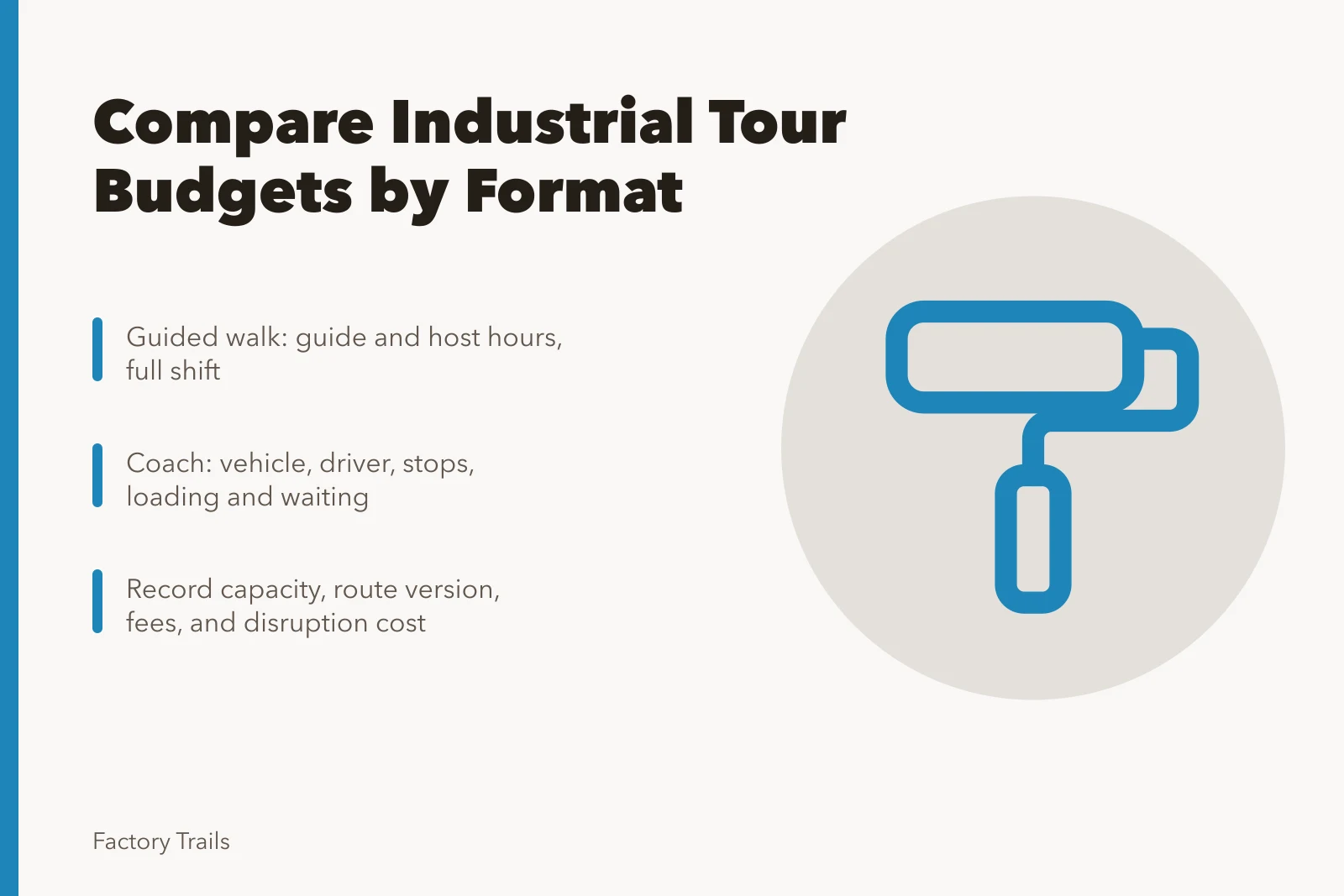
- Guided walk
- Guide and host hours
- Timed entry
- Booking and arrival control
- Private tour
- Custom staffing and terms
- Coach
- Vehicle, driver, stops
- Self-guided
- Signage, support, maintenance
- Hybrid
- Handoffs and duplicated work
Check before choosing
- Guided walk
- Full shift, not tour minutes
- Timed entry
- Missed-entry and wait policy
- Private tour
- Minimum booking and approval
- Coach
- Loading and waiting conditions
- Self-guided
- First-time visitor navigation
- Hybrid
- Owner at every transition
The IRS publication on travel and transportation expenses explains which records substantiate vehicle and travel costs, a recordkeeping habit rather than a pricing rule.
Tour format cost pressures
Format
- Guided walk
- Guide and host hours
- Timed entry
- Booking and arrival control
- Private tour
- Custom staffing and terms
- Coach
- Vehicle, driver, stops
- Self-guided
- Signage, support, maintenance
- Hybrid
- Handoffs and duplicated work
Main cost pressure
- Guided walk
- Full shift, not tour minutes
- Timed entry
- Missed-entry and wait policy
- Private tour
- Minimum booking and approval
- Coach
- Loading and waiting conditions
- Self-guided
- First-time visitor navigation
- Hybrid
- Owner at every transition
Check before choosing
- Guided walk
- Timed entry
- Private tour
- Coach
- Self-guided
- Hybrid
The Small Business Administration's financial-management guidance helps an operator separate a cost paid once from a cost that repeats at every departure.
Sample budget for one departure
Figures are mid-2020s planning numbers for one 24-visitor Saturday departure, not quotes. Wages, fuel, insurance and site fees decide the real amounts.
| Format | Sample cost, one departure | Per visitor |
|---|---|---|
| Guided walk | 2 guides, 4 hours at $45 an hour, plus $60 host: $420 | $18 |
| Timed entry | $2.50 booking fee per ticket, plus $120 door staff: $180 | $8 |
| Private tour | $650 minimum booking, 2 staff | $27 |
| Coach | $450 base, 60 miles at $2.10, $80 loading staff: $656 | $27 |
| Self-guided | $1,800 signage and access setup, spread over 12 departures, plus $45 monthly upkeep: $195 | $8 |
| Hybrid | $300 guide time, $180 transition support: $480 | $20 |
The samples use a $45 hourly guide rate, a $450 coach base and a per-ticket booking fee.
Guide rates commonly sit in a typical range of $40 to $90 an hour. Coach mileage commonly sits in a typical range of $1.50 to $3.50 a mile.
For 2027, apply your own wage and fuel index. A typical uplift of three to five percent a year is a common planning convention.
Keep assumptions beside the table
Record group capacity, route version, staff roles, site fees, vehicle terms, booking commission, and alternate-plan cost. If an option needs a special access arrangement, include it in that option. Do not assume the arrangement is free because it serves a visitor need.
Add an assumption column for time. A price is not comparable if one format includes fifteen minutes of guide preparation and another needs ninety. Record check-in, setup, route time, reset, and closeout separately. A small amount of detail here prevents a popular format from appearing cheaper simply because work was left out of the estimate.
Test the weak point
Run the estimate at three volumes: six visitors, an ordinary group of 24, and one plausible disruption such as a closed stop.
| Scenario | Guided walk | Coach | Self-guided |
|---|---|---|---|
| Low, 6 visitors | $420, $70 each | $656, $109 each | $195, $33 each |
| Typical, 24 visitors | $420, $18 each | $656, $27 each | $195, $8 each |
| One stop closed | add $23 | add $120 | add $250 |
A closed stop costs a different amount in each format. The guided walk adds about $23 for thirty guide minutes. The coach adds about $120 for waiting and a longer route. Replacing one sign costs about $250.
An option that works only at peak capacity may be fragile. A cheaper option that fails when one stop closes is also fragile.
For each scenario, write the operational response beside the financial result. A private format may cover its cost at a small group size only when the site can provide an escort. A coach format may look efficient only when the loading area is available. This keeps the comparison grounded in conditions the operator can actually deliver.
The U.S. Access Board's accessible-route guide explains what an accessible arrival route requires, so the estimate should price that route instead of assuming a visitor will solve a gap after booking.
Read the estimate with the operating plan
For each option, put the cost sheet next to the route map and staffing plan. Ask whether the departure can happen at the stated price if a group arrives late, a guide is absent, or a stop is unavailable.
The Occupational Safety and Health Administration's exit-route guidance requires unobstructed exit routes in covered workplaces, so an approved alternate route carries a cost rather than arriving as a free last-minute change.
Keep the original estimate after the pilot. Then add what actually occurred: guide hours, vehicle time, replacement signs, host support, refunds, and costs caused by a route change. The gap between estimate and result is the useful part of the record. It tells the team whether to revise price, format, schedule, or group limit.
Common questions
Does self-guided always cost less?
No. The sample above puts $1,800 of setup on the operator before the first visitor arrives, and the $45 upkeep repeats every month. Someone must also answer questions when a sign is missing or a panel is damaged.
What cost should be compared first?
Start with the staffed hours and the route the visitor actually walks. Add booking commission, signage, access work and vehicle terms after that, because those lines move with volume while the format name does not change.
Should a pilot budget be separate?
Yes. A pilot carries training, extra supervision and one-off printing that a steady schedule spreads over many departures. Mixing the two can make a sound format look expensive or hide a cost that never goes away.