Features
Industrial site interpretation records: how U.S. trails keep source notes that survive review
How U.S. industrial heritage trails log claim sources, evidence tiers, reviewers and review dates, and keep correction records that hold up under review.
What to take away
- An interpretation record is a small, dated file that ties one public claim to its source, its reviewer and its current status.
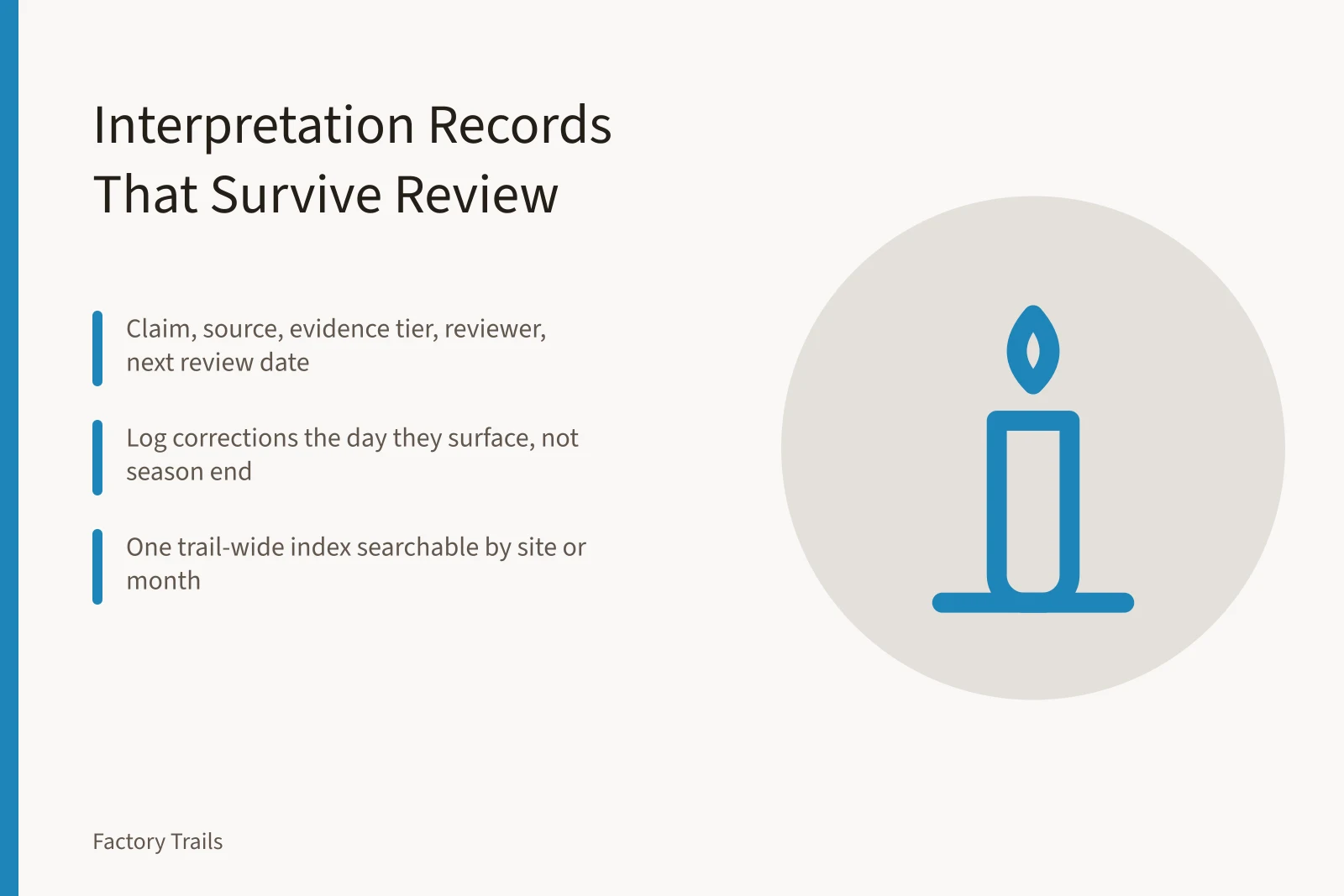
- Each entry needs the claim text, an evidence tier, the affected channels and a next review date.
- Corrections get logged the day they surface, not at the end of the season.
- One trail-wide index lets staff search by site, claim type or review month.
- Records feed planning, because thin evidence shows up in the file before it shows up on a sign.
The fields every interpretation record carries
A record is only useful if every entry answers the same questions in the same order. That makes two records from different sites comparable, and it makes a review fast.
| Field | What goes in it | Why it matters |
|---|---|---|
| Claim | The exact sentence a visitor reads or hears | Corrections compare like with like |
| Source | Document, interview or agency page, with its date | Reviewers can recheck the original |
| Evidence tier | Plant record, staff interview, agency page or reference work | Sets how much weight the claim carries |
| Reviewer | Name and role of the person who checked it | Gives each entry one named owner |
| Channels | Sign, script, audio stop, website, app | Tells staff where a fix must land |
| Fix date | The day the corrected wording went live | Closes the loop for reviewers |
| Next review | A calendar date, usually within 12 months | Stops stale claims from surviving |
Four tiers cover most factory trail work. Tier one is plant records, engineering drawings and recorded staff interviews. Tier two is agency material from sites such as the National Park Service. Tier three is published histories and news archives. Tier four is general reference writing.
Version history matters as much as the fields. Keep superseded wording visible so a reviewer can see what changed and when, instead of overwriting text in place.
The Wikipedia definition of industrial heritage is a reasonable starting pointer for tier four. It is not final evidence for a claim about a specific mill, furnace or bottling line.
Naming sources and setting review dates
- Write the claim exactly as it appears in the script, panel, app screen or audio stop.
- Attach the strongest source you have and note the date it was published or recorded.
- Assign the evidence tier and record who assigned it.
- Name the reviewer, the date checked and any open questions.
- Set the next review date, normally before the next season opens.
A short checklist keeps the file tidy across a whole trail:
- Every claim has at least one source with a date.
- Every source has a tier and a named reviewer.
- Every entry has a next review date that has not passed.
- Retired wording stays in the file with a note on why it changed.
Example: correcting a claim about a factory tour
Visitors in Hershey, Pennsylvania often arrive expecting to walk a working chocolate line. The attraction is a visitor center, not a factory tour, and the plant stays closed to the public. A useful entry records the original wording, that source, the reviewer and every channel where the wrong claim appeared.
That single correction shows why channel lists matter. A fix on a website does nothing for a printed rack card, a recorded audio stop or a guide's spoken script. Records that name channels turn one correction into four small tasks with owners.
Lowell National Historical Park shows the other direction. Its history pages and the working textile mill tours there describe machinery that still runs, so staff can verify a claim on site instead of in an archive.
Keeping records aligned across a trail
Thin evidence and shifting scope appear early, and warning signs in interpretation planning cost far less than a public correction later. An index makes those signs visible months before a sign is printed.
Small sites rarely need software at first. A shared spreadsheet with the fields above works, and recording the people who did the work is the cheapest step with the largest accuracy payoff.
The index itself needs three searchable columns: site, claim type and next review month. A staff member can then pull every claim due this quarter in one pass.
A record without a review date is a claim waiting to become a correction.
Over time the file becomes the trail's memory of its own wording. When a reviewer asks why a furnace date changed, the mistake records that survive review show the claim, the source, the reviewer, the channels and the day the fix went live.
Guest-facing details also shift with the seasons. Regional adaptation matters because arrival patterns, winter closures and local tour arrangements change what a record should cover and when it needs checking.