Guides
Part of How to prevent industrial site interpretation mistakes before you publish
How to keep industrial site interpretation mistake records that survive review
A mistake record survives review when it names the claim, the source, the reviewer, the affected channels, the approval thread, and the date the fix went live.
A mistake record is not a log of errors. It is the file that lets a second editor, years later, see what a sign or a page claimed. It shows where the claim came from and who approved the wording. It also shows which public channels repeated it.
Records that survive review share one habit: every field points at a person or a document, never at a memory.
What to take away
- One entry per public itempage, sign, audio stop, map label, or caption.
- Write the claim in its published wording, not a summary of it.
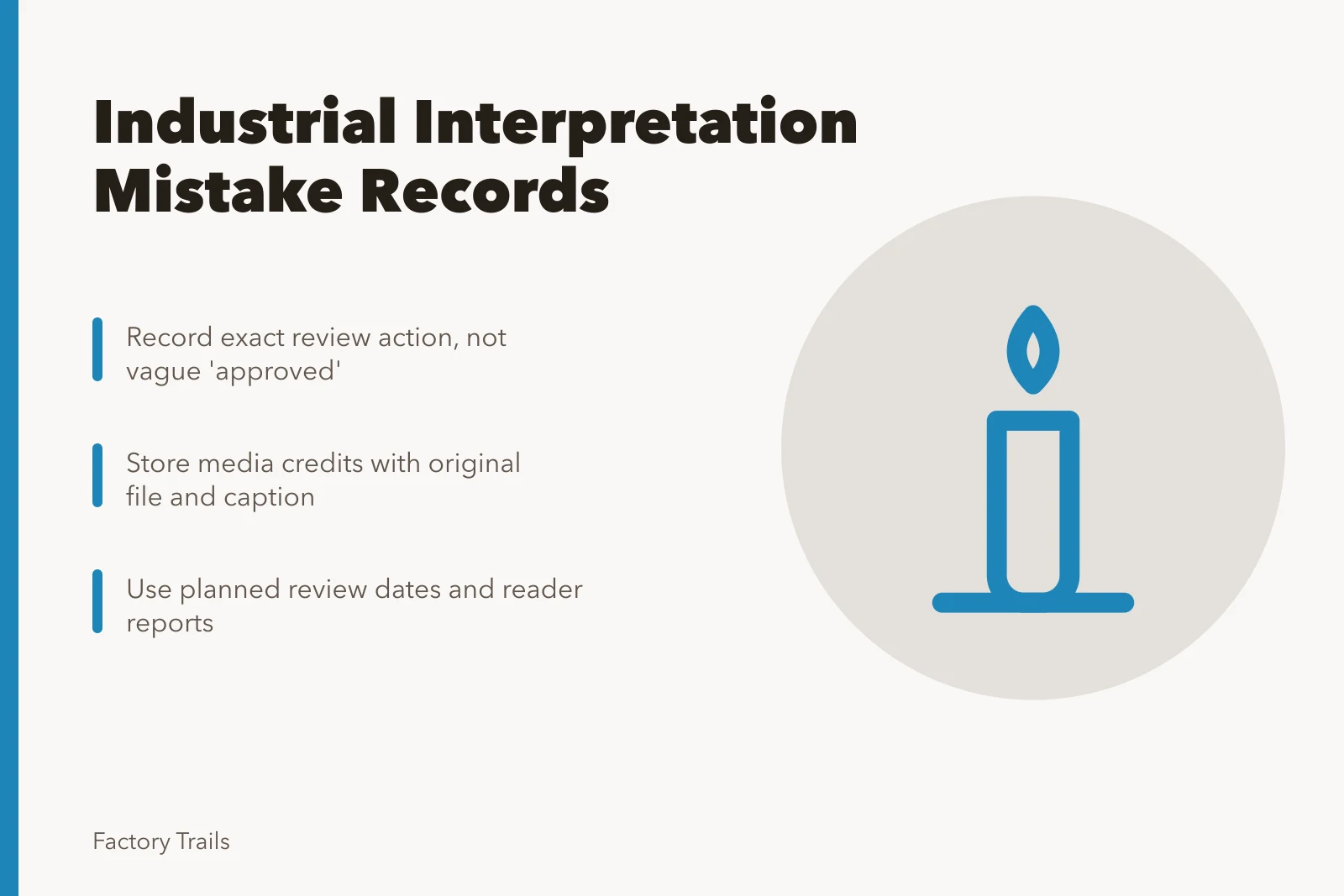
- Record the exact review task a partner performed, not the word "approved."
- Give every image a credit, license note, caption, and alt text in the same row.
- List every channel that repeated the claim, so a correction reaches all of them.
The field table
| Field | What to record | Why review fails without it |
|---|---|---|
| Item | Page title, sign number, map label, media identifier | Nobody can find the thing being corrected |
| Claim as published | The exact public wording, quoted | A paraphrase hides what visitors actually read |
| Source | Creator, date, purpose, and what the source does not cover | An inference gets filed as a fact |
| Review task | The specific thing a partner checked: a name, a photograph, an arrival detail | "Approved" implies endorsement of the whole page |
| Visitor facts | Site contact, date confirmed, next review date | Last season's hours get read as current |
| Media | File source, credit, rights note, caption, alt text | A credit or alt text is lost when the file moves |
| Affected channels | Every page, sign, map, confirmation email, and listing that repeats the claim | A fix lands on one page and the error survives elsewhere |
| Revision | Old wording, new wording, reason, date, who made the change | The next editor cannot tell what changed or why |
Alt text belongs in this table, not in the content system alone. It is published wording, it describes a specific image, and it is the field most often left blank when a file is swapped. Write it as a description of what the image shows, then check it against the credit line.
Mistake record fields
- Itempage, sign, map, media ID
- Claim as publishedexact public wording
- Sourcecreator, date, purpose, gaps
- Review taskwhat a partner checked
- Visitor factscontact, date, next review
- Mediasource, credit, rights, caption, alt
- Affected channelsevery repeat of claim
- Revisionold, new, reason, date, editor
Separate observation from interpretation
The Library of Congress primary-source analysis guide uses observe, reflect, and question prompts, and the same three columns work inside a mistake record. Note what the item shows, note the interpretation placed on it, and write the open question. See the Library of Congress primary-source analysis guide for the cited prompts.
The National Archives document-analysis worksheets draw the same line between observed detail and the use of an item as evidence. A working note that mixes the two is how an untested inference reaches a public sign.
Scope the review in the reviewer's words
Ask the reviewer what they checked, then write that sentence into the record. A partner who confirmed a public arrival detail has not endorsed a historical paragraph, and the record should not suggest otherwise. Keep historical claims and current visitor facts in separate rows with separate owners.
Visitor facts age. The National Archives visit-planning guidance tells researchers to contact a facility before travelling because holdings and local arrangements differ. Copy that habit into the record: source, contact, date checked, next review date.
Treat a reader report as a dated entry
A reported confusion, a broken source reference, or a mislabeled current fact opens an entry with a date and a decision. The Visitor Use Management Framework uses monitoring information to assess conditions and guide adjustments, which is the same loop at editorial scale.
Then walk the affected-channels column. A corrected date on an event page usually also sits in a confirmation email, a printed map, and a third-party listing.
Reusing research notes
A research note can serve several articles. The mistake record cannot. Each public item gets its own row. The row covers wording, media, alt text, visitor facts, and review date. This applies even when two articles share an interview. It also applies when two articles share a photograph.
Keep private material, controlled details, and operational documents out of the record. This covers public editorial material only.
Common questions
How long should a source note be?
Long enough to find the source again and to state its limits. One or two sentences usually does it.
Who owns the record?
One named content owner. That person coordinates with source reviewers, site contacts, and media-rights contacts when a public item changes.
What triggers a review?
Two things: a scheduled date for time-sensitive visitor facts, and a report from a partner, source owner, or reader.
Can one record cover a page and its sign?
No. They are separate public items with separate wording and separate review dates, even when the text matches.