Guides
Part of How to prevent industrial site interpretation mistakes before you publish
Industrial site interpretation mistakes checklist: what to review before the prose
An industrial site interpretation mistakes checklist for heritage teams: trace every claim to a source, confirm visitor facts, and log the review.
Most bad industrial interpretation fails before anyone writes a word. The fault sits in the research: a claim with no record behind it, a caption copied from a dead brochure, a date nobody checked.
This checklist covers the editorial work behind a page, sign, route stop, audio script or guide. It does not approve access, operations, safety, preservation or legal decisions.
What to take away
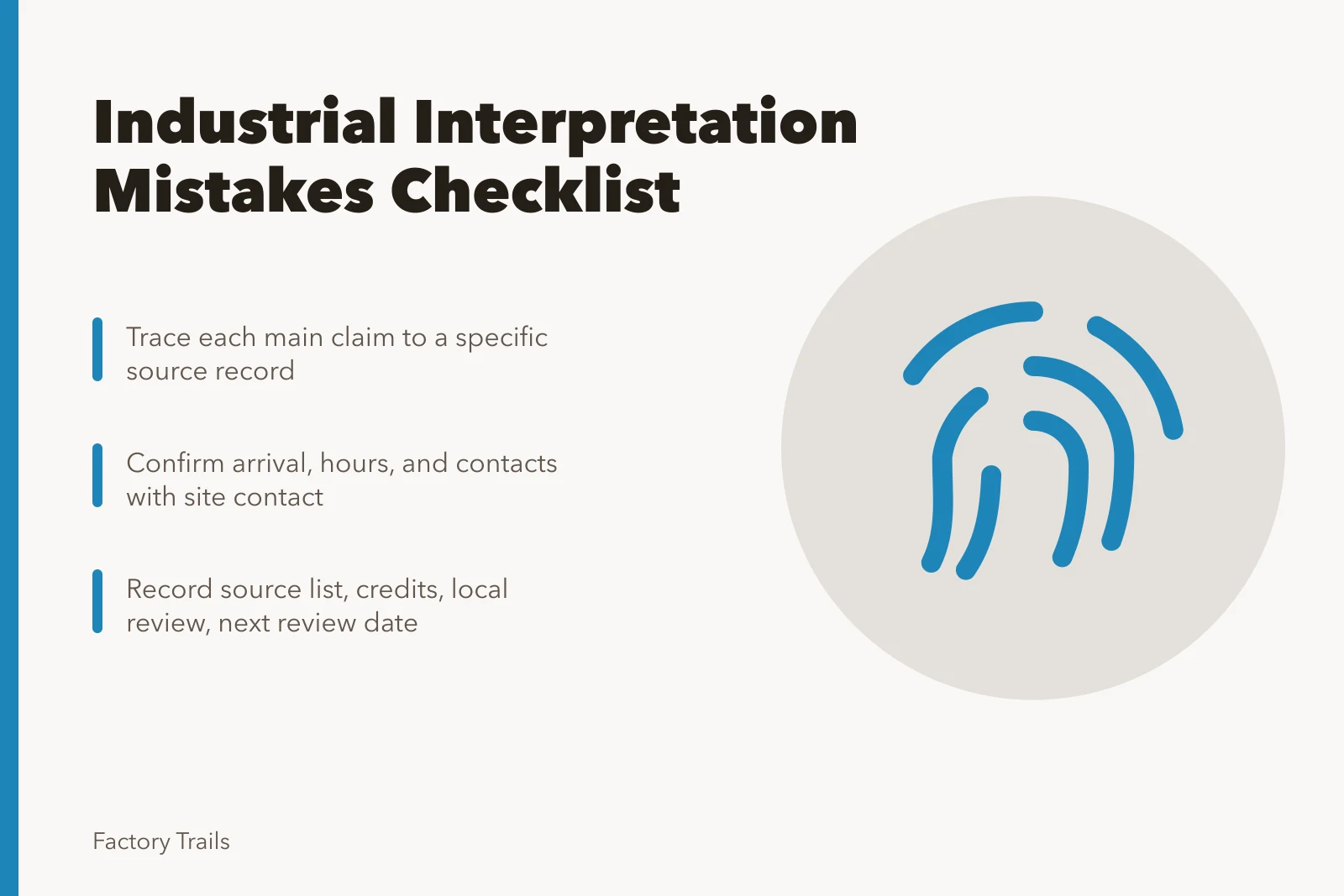
- Name the record behind each main claimphotograph, map, drawing, oral history, ledger or publication.
- Confirm hours, directions and access with the responsible site contact.
- Credit every image to its file page, not to a search result.
- Log the source list, the reviewer, the credit lines and the next review date before publishing.
Check the research before the prose
Check the research
- Identify the specific record behind each main claim.
- Note who made it, when, and for what purpose.
- Separate what the source shows from what you read into it.
- Find a second source when the claim is broad or contested.
- Mark what is still unanswered rather than writing it as settled.
- Ask a local reviewer what context or experience is missing.
The Library of Congress primary-source guides run on a sequence of observing, reflecting, questioning and investigating further. Applied to a furnace, a mill or a mine headframe, that order forces the editor to look hard before concluding. The Library of Congress analysis guides set out the sequence in full: observe, reflect, question, investigate further.
Source-check sequence before writing
- Identify the record behind each claim
- Note who made it and why
- Separate source from your reading
- Find a second source if contested
- Mark what is still unanswered
- Ask a local reviewer
Run a second pass for material claims. The National Archives document-analysis worksheets split observation, interpretation and use of an item as evidence.
Suppose a draft claims the furnace was built in 1889. The record might be a Sanborn map sheet, a company ledger, a dated photograph or a newspaper item. Note which record you saw and what it says about the year. If only a later summary repeats the date, the claim stays open.
If the public wording outruns the source, find corroboration or narrow the claim. The same discipline applies to industrial interpretation on any site.
Check the visitor-facing material
Item / Review needed
- Arrival direction
- Current confirmation from the responsible contact
- Hours or program date
- Date checked and by whom
- Historic map
- Clear label that it is not a current route
- Image
- Accurate caption and file-page credit
- Restricted or private area
- Approved public wording only
- Contact detail
- Current official channel for updates
Do not lift directions from an old brochure, map or search result. A historic site page can explain the past and still point visitors to present-day information. Say which is which.
Suppose the draft says the gates open at 9 a.m. on weekdays. The record is the site contact and the date that person confirmed the hours. Write both into the source list, as you would for a furnace date at a preserved works such as Sloss Furnaces in Birmingham, Alabama.
Check the scope
Read the page as a first-time visitor. Can they tell what happened here, what evidence supports it, and what to do next?
Keep the claim honest. A short article can document one building, one work process, one family memory or one collection item well. It does not have to explain a whole industry or town. The narrower claim usually holds up better.
Test the page on a reader who did not draft it. The Visitor Use Management Framework covers park operations, not editorial review. Ask your test reader to name the main historical claim, find its source, and sort historic material from current facts. Log every point of confusion and correct it.
Keep the handoff record
Before publication, record the source list, the content owner, the local review and the media credits. Also record the visitor-information check and the next review date. A new editor can then correct the page without redoing the research.
Keep current directions out of the historical source note. The National Archives visit-planning instructions cover researcher access to records, not visitor wording.
The completed checklist is the last handoff item:
- Every main claim, with the record behind it.
- Every image, with its file-page credit.
- Every visitor fact, with the source and the date confirmed.
- Every open question, with the next review date.
When a source, image or detail changes, that record is what makes a responsible correction possible.
Common questions
Does every claim need two sources?
Match the evidence to the claim. A direct local fact may rest on one strong record. A broad or disputed conclusion needs corroboration or narrower wording.
Can a historic map go on a visitor page?
Yes, with an accurate label and credit. Never present it as a current route or access instruction.
What if current visitor information cannot be confirmed?
Remove the detail and send visitors to the responsible public contact or the official update channel.