Guides
How to prevent industrial site interpretation mistakes before you publish
Industrial site interpretation mistakes to avoid in 2027, with practical checks for evidence, context, visitor facts, credits, review, and clear limits.
The easiest way to weaken industrial interpretation is to make it sound finished before the evidence and local review are finished. A page can have clean design, polished prose, and a useful map while still repeating an unsupported claim, missing an important experience, or directing visitors with outdated information.
Good interpretation does not need to promise a complete story. It needs to be clear about what the sources show, what the site can confirm, what visitors can do, and where the limits are. This guide identifies common editorial mistakes that appear in industrial-history pages, tours, signs, guides, and public programs.
What to take away
- Build claims from specific, traceable evidence rather than familiar industry language.
- Keep a local place and its people visible in every broad historical frame.
- Treat visitor directions as current information that needs separate review.
- Credit media and record who confirmed public-facing facts.
Mistake 1: starting with a grand statement
"Industry transformed the region" may be true, but it tells a visitor almost nothing by itself. Which industry? Which period? Which places? Whose work or daily life changed? What document, object, building, map, or recorded account supports the statement?
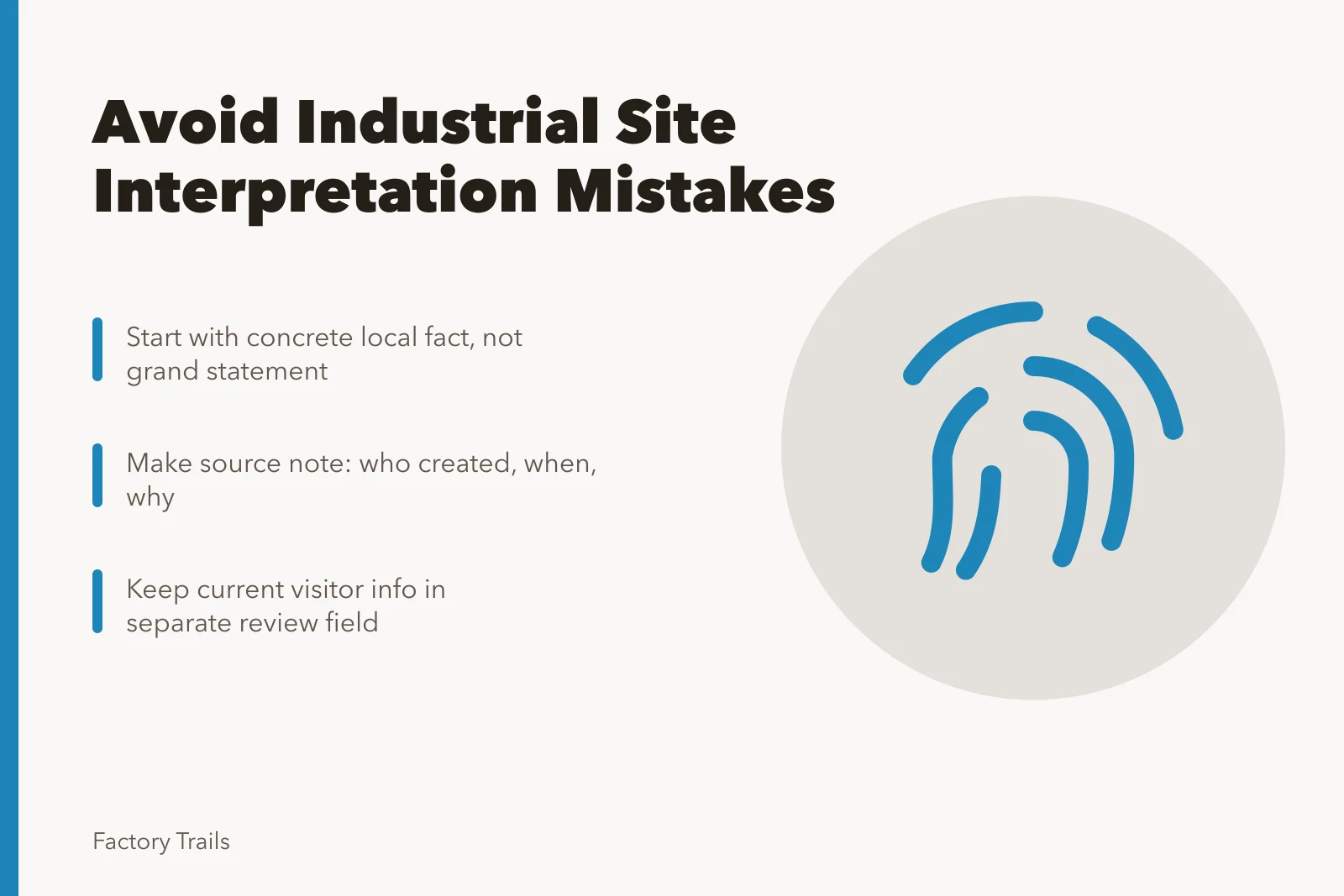
Start instead with a concrete local fact. A former machine shop, rail spur, mill village, blast furnace, loading dock, laboratory, or worker record gives a visitor something to locate in time and place. The larger connection can follow once the article has established the evidence.
Here is the same move as a rewrite.
Before: "Industry transformed the region." After: "Lowell, Massachusetts, grew along the Merrimack River in the 1820s, when textile mills and power canals replaced farmland. Mill and boarding-house records show who came to work in them."
This does not mean every page needs a long chronology. It means the first paragraph should earn the broad claim. If the source only supports a local description, keep the text local. If more research later supports a regional connection, add it with the source.
Mistake 2: treating one record as the whole story
Company reports, promotional brochures, property records, engineering drawings, oral histories, photographs, newspapers, union records, and family collections can all be useful. Each was created for a reason, by someone, at a particular time. One source may document a fact well while leaving other experiences out.
Hopewell Furnace National Historic Site in Pennsylvania keeps account ledgers for iron production and wages. Those ledgers document output and pay, but they say little about the working lives of the people in the furnace yard.
Make a small source note before drafting:
- Record
- who made it, when, and why.
- What it supports
- the one claim the record can carry.
- What it leaves out
- the people, places, or periods it does not cover.
- Where it is held
- collection, item reference, and holder.
- Who checked it
- name and date.
Source note before drafting
- Who created this item?
- When was it created?
- What does it directly show?
- What does it not show?
- Who can help interpret it?
The Library of Congress evidence guide describes historical research as a dialogue among photographs, documents, and personal narratives, and recommends comparing sources for agreement and disagreement.
Check each record the same way before treating it as proof. The National Archives document-analysis worksheets set out four steps: meet the document, observe its parts, make sense of it, and use it as historical evidence.
Mistake 3: separating the site from its community
Industrial sites are often described as buildings, machines, and production milestones. That frame can leave out workers, families, surrounding neighborhoods, displaced residents, visitors, suppliers, and people who experienced the effects of production or closure. A site does not have to cover every history at once, but it should not imply that a single institutional record speaks for everyone.
Ask whose work, knowledge, and experience appear in the draft. Then ask who is absent. Look for records that can add context, and ask local reviewers whether the language turns a living community into scenery for an industrial story. If the evidence remains limited, state the subject narrowly rather than offering a false summary.
Mistake 4: confusing historic material with current information
An old map may be excellent evidence for how a plant, rail yard, canal, or town once worked. It is not automatically a present-day route. A historic photograph may show an entrance that no longer exists. A guide written five years ago may list hours, contacts, or public access that have changed.
Historic vs current information
Historic material
- Evidence for
- Past layout and work
- Example
- Old map or photo
- Risk
- Mistaken for today
- Action
- Interpret with context
Current visitor information
- Evidence for
- Present-day visit
- Example
- Official hours and routes
- Risk
- Outdated or unconfirmed
- Action
- Confirm and date
Keep current visitor information in a separate review field. The responsible site contact should confirm public directions, hours, arrival instructions, accessibility notes, photography rules, and closures. Date that confirmation. If the project cannot confirm a detail, direct readers to the current official contact or leave the detail out.
Never turn interpretive copy into an implied permission to enter property, cross a boundary, or inspect equipment.
Mistake 5: balancing a readable claim with visible sources
Readers need evidence, but a page packed with names and dates can become difficult to follow. The answer is not to remove the sources. It is to put the main claim in a plain sentence, cite the source where it supports that claim, and offer a fuller source list for people who want more depth.
Use a simple pattern:
- Claimone sentence a visitor could check.
- Source linethe record that supports it and where the record is held.
- Short listfuller sources at the end of the page for readers who want depth.
- Credit linecreator, rights, and collection for each image.
Readable source pattern
- State what the visitor is looking at
- Explain the supported industrial connection
- Identify the confirming source or collection
- Add context or a question to look again
This keeps the page readable while showing that interpretation came from research rather than from a generic template.
Worked example. Readable claim: "The mill drew workers from surrounding farms." Source line: "Source: mill payroll ledger, site archive. Checked by the source reviewer on the review date." Swap in your own claim, record, holder, and confirmation.
Mistake 6: treating image credit as a final detail
An image can make a page feel specific, but it also needs a clear source, creator credit when provided, rights or license information, and a truthful caption. Do not use a photograph of one site to imply that it depicts another. If the image is contextual, say so.
Keep the media record with the page record. Credit template:
- Creator, title, or description.
- File page and the collection that holds it.
- Rights or license note.
- Download date if the organization needs it.
- Alt text and published caption.
When a photo is removed at a creator's request or because the license does not fit the project, update both the page and the media record.
Mistake 7: skipping the test with a first-time visitor
The people who researched a site often know too much to notice what is missing. Before publication, give a reader who has never visited the place a short task list and watch what happens.
- In one sentence, what happened here? The reader should name the industry, the period, and the place.
- Which source supports the main claim? The reader should find the source line on the page.
- Which image is historic, and which shows the site today? The reader should read the captions rather than guess.
- How would you plan a visit? The reader should reach an approved contact or a current page.
Write down the answers.
First-time visitor test
- Identify what happened there
- Tell which source supports the main point
- Distinguish historic image from current route
- Find an approved public way to learn more
Observe where the reader hesitates. A vague heading, unmarked map, unexplained acronym, or missing contact may be obvious only to a newcomer. Fix the public material, then ask a different reviewer to repeat the task.
The Visitor Use Management Framework describes assessing conditions through monitoring and using that information to guide management actions. An editorial project can adopt a small version: give readers a task, note where the page causes confusion, and make a documented revision. This is a usability check, not an access or safety assessment.
Mistake 8: publishing without a revision path
Interpretation should change when better evidence appears, a partner supplies a correction, or a community asks for context. A revision is not a failure. It is the normal result of keeping public history connected to current research.
Assign an owner to each article or exhibit. Keep a record of its sources, review date, partner comments, image credits, and current visitor details. When something changes, note what changed, why, which page or sign was updated, and whether any related material needs a review.
Mistake 9: letting one format carry the entire project
A long article, a wayside sign, a tour, a map, and a short collection record have different jobs. A sign can orient a visitor, but it cannot carry a source list or a correction path. A web page can. A guide can help someone plan a visit. A collection page can provide depth.
Choose the format based on what the visitor needs at that point. Keep the message consistent, but do not force identical paragraphs into every channel. The same claim may need a short sentence on a sign and a fuller explanation online.
Mistake 10: claiming more authority than the project has
An interpretation project can explain history. It cannot certify a structure, set operational rules, establish public access, resolve ownership, decide preservation treatment, or determine legal compliance. State the boundary when necessary and provide the responsible contact or process for questions outside the article's scope.
This does not make the writing less useful. It makes it more trustworthy. Visitors get accurate historical material and a clear route to current information without being given advice the project is not qualified to provide.
The National Archives visit-planning guidance advises researchers to identify where records are held and contact the location before travel.
A final pre-publication check
Before approving a page, sign, route, or guide, confirm these points:
- Each broad claim names a source, and no claim outruns that source.
- The place, the workers, and the surrounding community appear by name.
- A named person has confirmed public directions, hours, arrival details, accessibility notes, photography rules, and closures, with the date.
- Every image has a creator credit, a rights note, and a caption that matches the picture.
- The format fits the joba sign orients, a page carries sources and a correction path.
- Review roles are filledcontent editor, source or subject reviewer, media or rights reviewer, and the responsible site contact.
- A first-time reader completed the tasks in Mistake 7.
- An owner is named and the review date is recorded.
If a check fails, do not hide it with smoother prose. Narrow the claim, add the needed evidence, update the current fact, or postpone publication until the responsible reviewer can confirm it.
Common questions
Can an industrial-history article be useful with a small source base?
Yes. Keep the scope narrow, identify the source clearly, and avoid conclusions the record cannot support.
Who should review an industrial interpretation page?
Use a content editor, a source or subject reviewer, a media or rights reviewer, and the responsible site contact for visitor-facing facts. Add local reviewers when the page concerns community history.
What should happen when a visitor reports an error?
Record the report, check the source and current fact, make the correction if warranted, and review related pages or materials for the same issue.
In this guide
- Industrial site interpretation mistakes checklist: what to review before the proseAn industrial site interpretation mistakes checklist for heritage teams: trace every claim to a source, confirm visitor facts, and log the review.
- Industrial site interpretation mistakes: questions to ask before you draw a conclusionIndustrial interpretation mistake questions for 2027 help teams test source purpose, point of view, historical context, visitor facts, and unsupported assumptions.
- How to keep industrial site interpretation mistake records that survive reviewA mistake record survives review when it names the claim, the source, the reviewer, the affected channels, the approval thread, and the date the fix went live.