Reviews
Part of How to prevent industrial site interpretation mistakes before you publish
Industrial site interpretation mistakes: questions to ask before you draw a conclusion
Industrial interpretation mistake questions for 2027 help teams test source purpose, point of view, historical context, visitor facts, and unsupported assumptions.
The right research question slows down a weak draft before it becomes public. It asks what the evidence shows, who made it, and whether the visitor information is still current. A weak question asks only how to make the story sound bigger.
What to take away
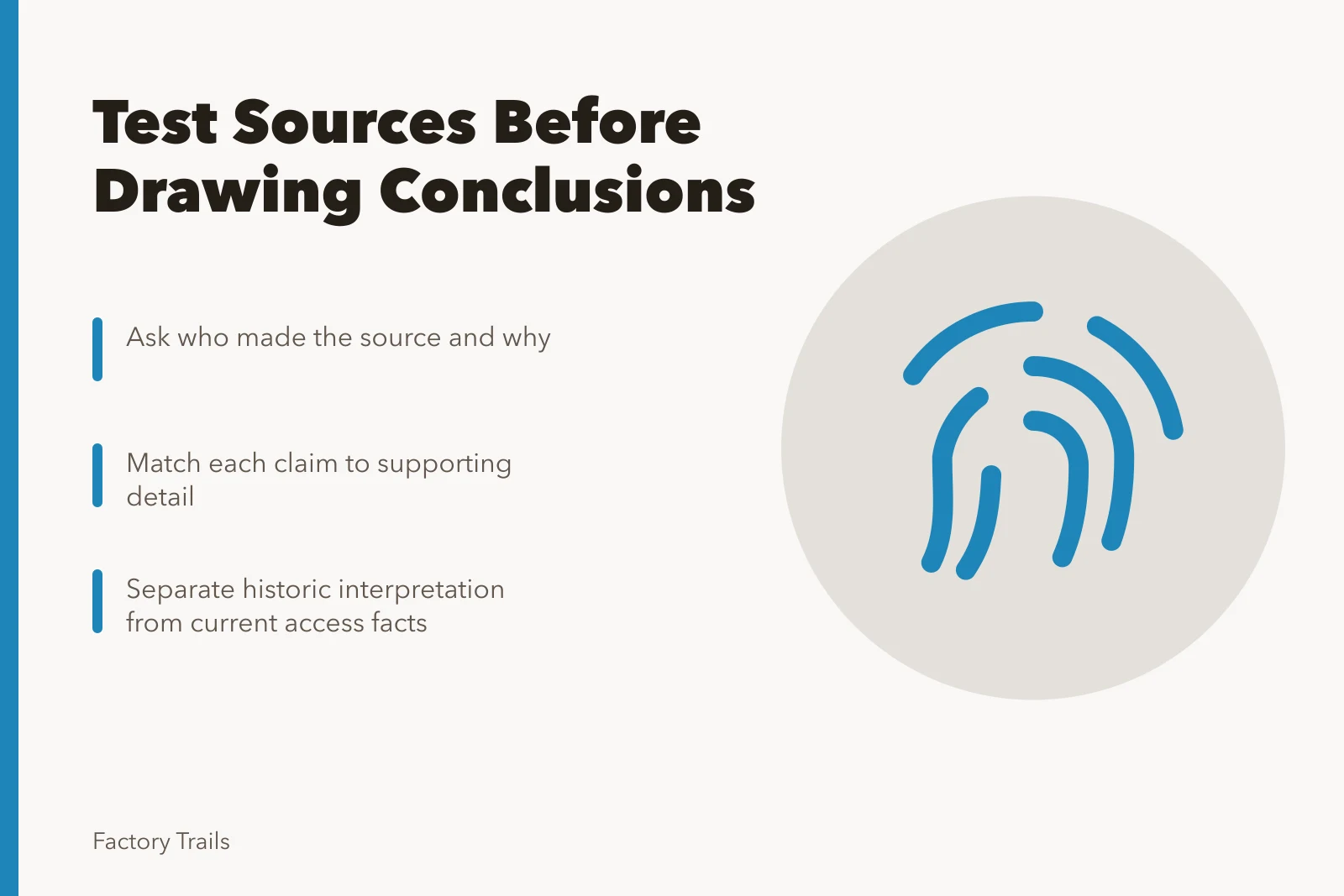
- Ask what a source proves before using it as evidence.
- Consider the creator's purpose and point of view.
- Separate historical interpretation from current access information.
- Use unanswered questions to guide research, not to fill space with assumptions.
Compare questions that help with questions that mislead
Useful questions vs misleading questions
| Useful question | Question to avoid |
|---|---|
| Who made this source, and for what purpose? | How can this source prove the story I already want? |
| What detail supports this exact claim? | Can I use the image because it looks industrial? |
| Whose experience is missing from this record? | Does one official record settle every perspective? |
| Is this map historic or current? | Can I copy the old route into a visitor guide? |
| Who confirms the visitor fact today? | Does last year's page still seem plausible? |
The comparison is not about making research slow for its own sake. It prevents a photo, brochure, map, or company record from being used beyond what it can reasonably support.
Useful vs Misleading Questions
Useful question
- Source purpose
- Who made this, why?
- Claim support
- What detail supports this?
- Missing voices
- Whose experience is missing?
- Map currency
- Historic or current?
- Visitor facts
- Who confirms today?
Question to avoid
- Source purpose
- Prove my story?
- Claim support
- Looks industrial?
- Missing voices
- One record settles all?
- Map currency
- Copy old route?
- Visitor facts
- Last year plausible?
Ask about purpose before drawing a conclusion
A promotional image may be useful evidence of how a company wanted to present itself. It may not be a neutral record of working conditions. A newspaper report may show public discussion at a particular moment. It may not represent everyone involved. An oral history may preserve a personal experience that no company record contains. It may not establish every date or operational detail.
The Library of Congress warns that primary sources can mislead a casual observer and asks readers to consider why an item was created, along with the creator's point of view and purpose. That is a practical question for industrial interpretation, especially when a vivid image or familiar story feels persuasive. See the Library of Congress source-evaluation guide for the cited guidance.
The National Archives document-analysis worksheets offer another useful prompt sequence: identify the item, observe its parts, make sense of it, then use it as historical evidence. Put a proposed sentence beside each source at the last step. This makes it easier to spot an unsupported motive, date, or broad conclusion before publication.
Ask whether the claim fits the evidence
Put the proposed sentence beside the source. Does the source directly support it? Does it require a second source? Does the draft add a motive, outcome, or region-wide effect that the item does not show? If so, revise the sentence or continue researching.
This check is useful for captions. A caption should say what the image depicts, identify its place and date when known, and explain any relevant connection to the article. It should not claim that the photograph shows a different site or proves a broader conclusion than the image can support.
Ask the visitor question separately
After checking the history, ask what a visitor needs to do. Where can they find current hours, arrival instructions, access limits, or a public contact? The answer should come from the responsible site authority, not from a historical source or a vague memory of an earlier visit.
If the current detail cannot be confirmed, use a short approved update path rather than a likely-sounding direction. This keeps an interpretation page useful without making it responsible for site operations or access decisions.
For an onsite research source, treat access planning as its own question. The National Archives visit-planning guidance tells researchers to identify the relevant facility and contact it before visiting. Use an equivalent process for visitor facts: check the current official material with the responsible site contact and state its review date.
Ask one final reader question before release. The Visitor Use Management Framework describes assessing conditions through monitoring and using the results to adjust actions. A basic editorial test asks whether a reader can locate the evidence, understand the scope, and avoid mistaking past conditions for current instructions.
Common questions
Can one primary source support an article?
It can support a narrow claim. Use more sources when a conclusion is broad, contested, or outside what the item directly shows.
Why ask about a source creator's purpose?
Purpose helps readers understand what the item may document well and what perspective or context it may leave out.
Should historical maps be removed from visitor guides?
No. Label and credit them clearly, then provide current visitor information from an approved source in a separate location.