Features
Factory tour safety records: what U.S. operators must keep after an incident
Post-incident record keeping for U.S. factory tours and manufacturing museums: OSHA logs, visitor registers, PPE assessments, retention periods, and safety holds.
What to take away
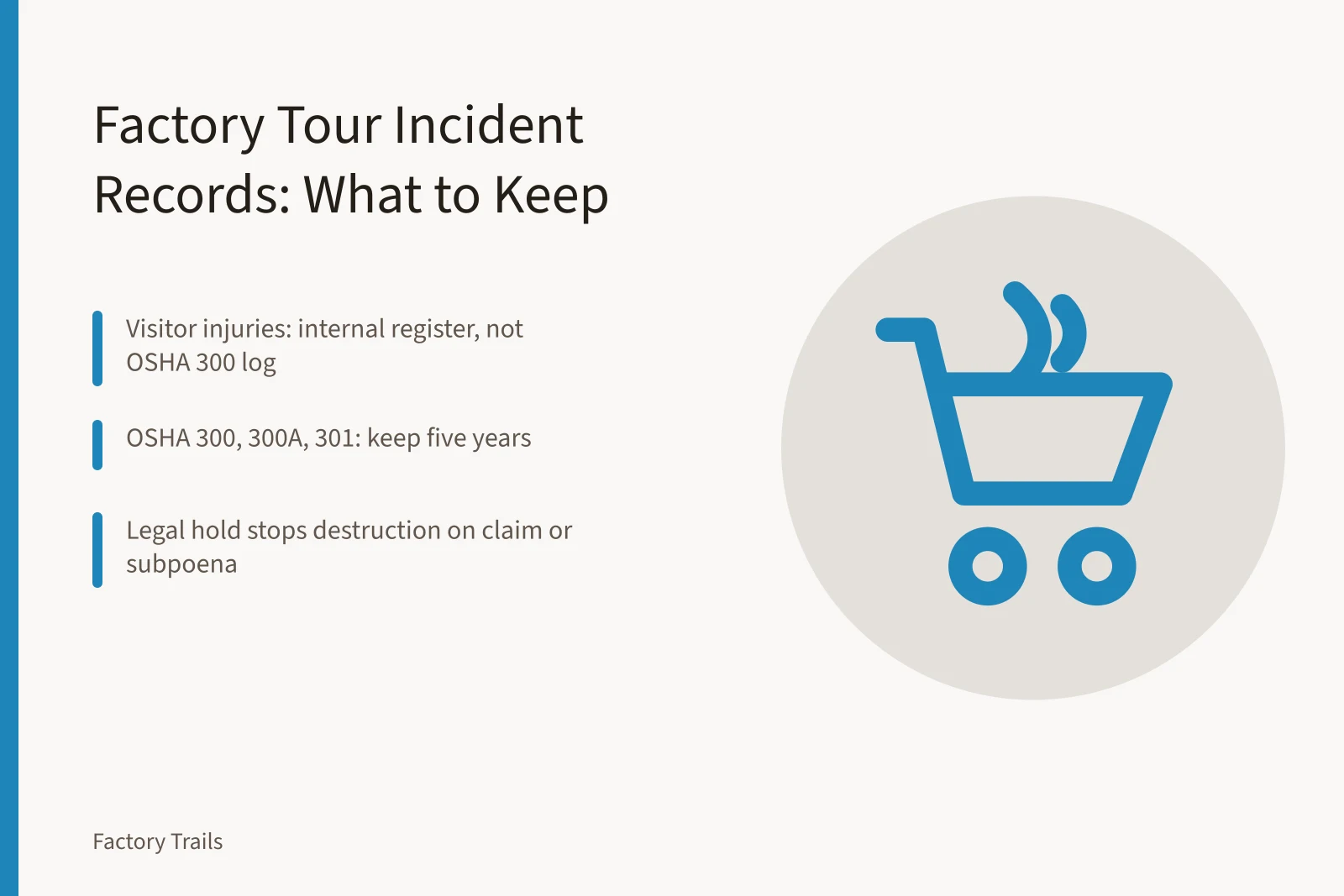
- Visitor injuries stay out of the OSHA 300 log, but they still belong in an internal incident register.
- OSHA 300, 300A, and 301 forms stay for five years after the calendar year they cover.
- A legal hold stops destruction as soon as a claim, subpoena, or insurer request arrives.
- PPE hazard assessments, route inspections, and maintenance logs are the first documents a claim tests.
- The scope you published for the tour decides which records prove you kept your promises.
Visitor incidents and the OSHA 300 log
OSHA recordkeeping under 29 CFR 1904 covers employees, not guests. A visitor who trips on a mill floor does not enter the 300 log. Your duty to document the event does not end there.
Open a visitor incident register. Record the tour name, group size, guide, route segment, and the time of day. Add the treatment given, whether emergency services responded, and who was notified.
Employee injuries during a tour do fall under 1904. A guide hurt on the job enters the 300 log within seven calendar days if the case goes beyond first aid. Under 29 CFR 1904.39, report a fatality within eight hours. Report an in-patient hospitalization, amputation, or loss of an eye within 24 hours.
PPE rules shape what you must show afterward. Under OSHA 1910.132, when hazards require protective equipment the employer provides it at no cost and certifies the hazard assessment in writing.
Where tour routes pass under overhead loads, conveyors, or stacked stock, OSHA 1910.136 requires protective footwear for falling and rolling object hazards.
Boundaries matter in the paperwork. A visitor center such as Hershey's Chocolate World sits apart from the working plant, so your records must show what visitors actually entered.
The post-incident record packet
Build one packet per incident and keep the sections in order.
- Secure the scene and photograph it before anything moves. Timestamp each image.
- Collect written statements from the guide, the injured visitor, and two witnesses who stayed in place.
- Log the PPE the site issued, the PPE the visitor wore, and the condition of both.
- Pull the route inspection sheet, the maintenance log, and the training record for that area.
- Notify your insurance carrier and counsel inside the deadline the policy names.
Then seal damaged gear, broken signage, and any sample material in a labeled container. Note who handled each item and when. A short chain of custody note is easy to write now and hard to rebuild later.
Retention periods you can defend
| Record | Where it lives | How long to keep |
|---|---|---|
| OSHA 300, 300A, 301 | Safety office | Five years after the year covered |
| Visitor incident register | Guest services | Through the claim window your counsel sets |
| Workers compensation file | HR or carrier | The state minimum, often several years |
| PPE hazard assessment | Safety binder | For the life of the hazard |
| Tour roster and signed waiver | Front desk | Through the statute of limitations |
The five-year clock for the 300 series comes from 29 CFR 1904.33 and restarts with each calendar year.
Example: a fall on a catwalk
A guide slips on a wet catwalk during a school tour at a preserved furnace site. First aid is given, and the guide later needs stitches at a clinic.
The packet holds photos, two chaperone statements, the boot, the inspection log, and the clinic note. Because the guide is an employee and the case passes first aid, the safety manager adds a 300 log entry within seven days.
Six months later the guide files a workers compensation claim. The insurer asks for the hazard assessment and the inspection sheet. Both sit in the packet, dated and signed.
Records that keep your published tour scope honest
Before a season opens, manufacturing museum safety checks help U.S. sites set scope before you publish visitor boundaries, record concerns, and confirm programs.
The annual pass tells you what to review before your next season, covering visitor access, collection protection, risk records, and emergency readiness.
Public pages change. The option records you keep decide whether new text contradicts an old promise, so keep records that survive an update.
Groups still need a destination. Compare named U.S. mill sites and museums by what each shows, who it suits, and how to check current visitor terms.