Features
Factory tour insurance and liability waivers: what U.S. visitors sign before a plant walk
What U.S. visitors sign before a working plant walk, from liability waivers and indemnity clauses to insurance certificates and OSHA safety gear rules.
Factory tour insurance and liability waivers: what U.S. visitors sign before a plant walk
What to take away
- A working plant visit starts with a release form, not a ticket.
- The waiver shifts some risk to you, but it cannot erase an operator's legal duties.
- Insurance requirements usually sit with the tour provider, not the visitor.
- OSHA rules still shape what you wear and what the plant must provide.
- Read the indemnity clause and the cancellation terms before you sign.
What a factory tour waiver usually covers
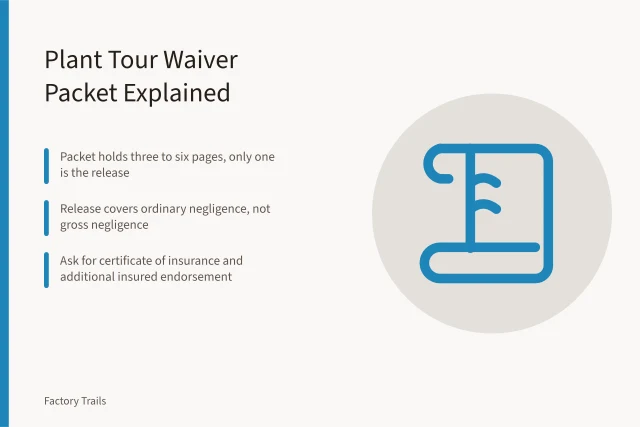
A factory tour liability waiver is a contract. It asks you to accept risks such as noise, moving equipment, slips, and dust. It may also cover your own medical costs after an injury. The form often names the plant, the tour operator, and sometimes the parent company. An industrial tour waiver form may call itself a release, a consent, or an agreement.
The waiver does not block every claim. Courts in many states reject releases for gross negligence or intentional harm. A plant tour release form also cannot waive a duty set by safety law. If the operator fails to guard a walkway or warn about a hazard, the release may not control.
| Document | Who signs | What it does |
|---|---|---|
| Liability waiver | Visitor | Accepts listed risks and limits claims |
| Indemnity clause | Visitor or group leader | Promises to cover certain losses |
| Medical consent | Visitor | Allows emergency treatment |
| Photo release | Visitor | Permits image use |
A working factory visit safety agreement often combines these forms. The liability waiver may sit on the same page as the photo release. Read each line separately. Ask for a copy before you sign.
Insurance requirements for a working factory visit
Factory tour insurance requirements fall on the operator. General liability policies cover visitor injuries on the premises. Some plants require the tour company to name them as additional insured. That certificate proves the policy exists and responds to a claim. Visitors rarely need their own policy for a standard walk.
If you book a private group tour, the plant may ask your organization for a certificate. Schools and clubs often carry liability coverage for field trips. A working factory visit safety agreement may require the group leader to collect waivers. Check whether your health plan covers care away from home.
A release form is not a shield for broken guards or hidden hazards. It is a record of known risks.
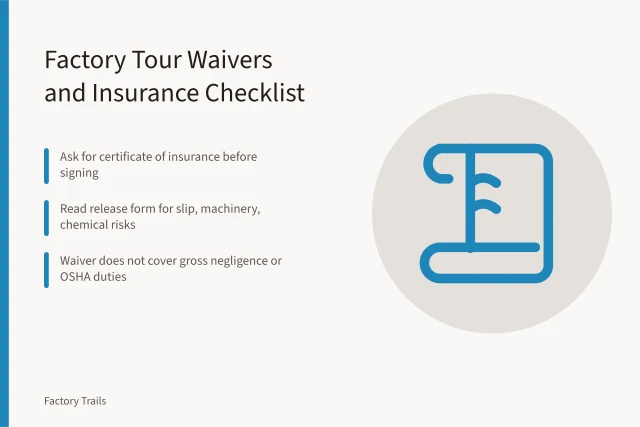
Checklist for the paperwork:
- Confirm the tour operator carries general liability insurance.
- Ask for the certificate of insurance before the visit.
- Check whether the waiver names the plant and the tour company.
- Read the medical and photo release lines separately.
- Keep a copy of every signed page.
Example: signing in at a working mill
At Lowell National Historical Park, visitors walk through textile mill buildings that once ran on water power. The park presents working machinery and mill history. Many heritage sites use a simple sign-in sheet and a short safety talk. In Canada, the Britannia Mine Museum runs an underground tour with a hard hat and train ride.
Use the working factory visit comparison checklist to compare tour terms before you pay. That step helps you spot missing insurance details and vague release language.
Some famous factory tours are not plant walks. Hershey's Chocolate World is a visitor center, and the actual factory is not open for public tours.
The United States Mint offers tours at some facilities, but rules vary by location. Sloss Furnaces in Birmingham, Alabama, is an industrial heritage site with guided options.
Royal Canadian Mint tours in Winnipeg show a working production facility. The Ottawa site is a boutique mint, not a factory floor.
Liability when a visitor gets hurt
Factory tour liability for visitors usually turns on control. The plant controls the floor, machines, and warnings. The tour operator controls the group, pace, and instructions. If a guide sends you past a barrier, the operator may share fault. If a machine lacks a guard, the plant may share fault.
OSHA rules apply to workers, not tourists. Still, they set the safety baseline for the site. The general PPE rule at 1910.132 explains when employers must provide protective equipment. See OSHA 1910.132 for the general duty.
The eye and face rule at 1910.133 covers safety glasses and face shields. See OSHA 1910.133 for eye and face gear.
The foot protection rule at 1910.136 covers protective footwear where falling objects are a hazard. See OSHA 1910.136 for foot protection.
What to ask before you sign
- Ask for the liability waiver before you pay.
- Check the insurance certificate and the named insured.
- Confirm whether the waiver covers the plant and the guide.
- Ask what happens if the tour is cancelled.
- Keep a copy of the signed form and any medical consent.