Guides
Part of How to plan industrial site interpretation: a workflow for visitor teams
How to run an industrial site interpretation planning checklist before you assign approval
An industrial site interpretation planning checklist for 2027: set scope, log sources, map the route, name an approver, and book the review.
A working plant and its preserved twin need different interpretation. The working plant has a shutdown calendar, an escort ratio and a safety officer who controls access. The preserved twin has opening hours and a collections policy.
Decide which one you are planning for before anything else. This checklist takes a site from idea to an approvable plan, and it stops where site rules take over.
What to take away
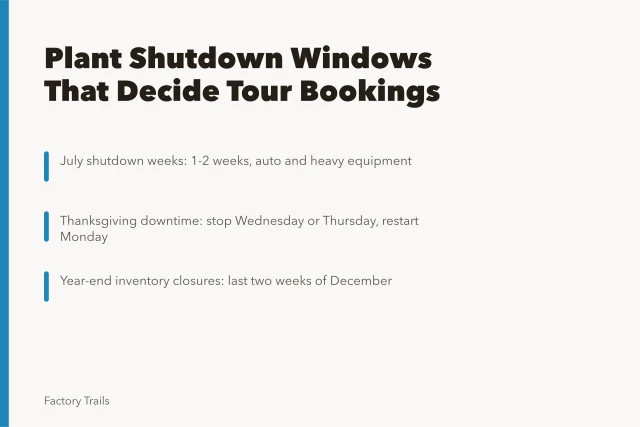
- Confirm whether the line is running or shut for July or December maintenance before you write a single stop.
- Log every factual claim and image to a source you can show a reviewer.
- Test the route at the arrival point, not at a desk.
- Name one content owner and one review date before production starts.
- Defer any item waiting on access, rights or site approval rather than guessing.
Ten steps from idea to approvable plan
- Write the visitor question the program answers, in one sentence.
- Name the visitor group, the physical area and the time they have.
- List what the program will not cover.
- Open a source log for every claim and every image.
- Draft two to four themes the evidence actually supports.
- Map arrival, stops and departure as one path.
- Choose formats only after the message and the location are fixed.
- Assign reviewers for history, site boundary, rights and visitor language.
- Walk the route in ordinary visitor conditions.
- Record the sign-off on the approval form.
Steps 1 to 3 are the ones teams skip. A program that cannot say what it excludes will grow until it covers nothing well.
Ten steps to an approvable plan
- Write the visitor question in one sentence
- Name visitor group, area and time
- List what the program will not cover
- Open a source log for claims and images
- Draft two to four evidence-backed themes
- Map arrival, stops and departure as one path
- Choose formats after message and location
- Assign reviewers, then walk the route and set review date
Copy or print this block and tick each row as it clears. Effort figures are typical ranges.
| Tick | Steps | Typical effort | Ready when | Not ready when |
|---|---|---|---|---|
| [ ] | 1 to 3 | 2 to 3 hours | You can say what is out | The list still grows |
| [ ] | 4 | Runs with every step | Every claim has a record | A claim has no page |
| [ ] | 5 to 6 | Half a day | Each stop points at something visible | A host must explain it |
| [ ] | 7 to 8 | 1 to 2 weeks | Rights, access and upkeep are known | Upkeep has no owner |
| [ ] | 9 to 10 | 1 to 2 weeks | A first-time visitor finds the first cue | A reviewer has not signed |
Readiness table
| Planning item | Ready when |
|---|---|
| Scope | The team can state what is in and what is out |
| Sources | Every published claim traces to a record |
| Route | A first-time visitor finds the first step unaided |
| Media | Format, rights, access and upkeep are all known |
| Review | A named person has signed each responsibility |
Treat a blank cell as a reason to pause, not a note for later.
Readiness table
- Scopeteam states what is in and out
- Sourcesevery published claim traces to a record
- Routefirst-time visitor finds first step unaided
- Mediaformat, rights, access and upkeep known
- Reviewnamed person signed each responsibility
Where the evidence standard comes from
The National Park Service National Historic Landmarks thematic framework treats interpretation as a research task, starting broad and narrowing to the stories a resource can carry.
That order matters at a site like Sloss Furnaces or Pullman National Monument, where the surviving fabric supports some stories and not others. A furnace aisle can carry a charge-floor narrative. It cannot carry a corporate history the buildings never recorded.
Use the same test at a mine museum such as Britannia Mine Museum: match the story to what a visitor can see and stand next to.
A filled source-log line looks like this.
| Claim | Source | Checked by | Date | Status |
|---|---|---|---|---|
| The charging floor fed the furnaces | Site maintenance plan, section 3 | Content owner | 4 March | Confirmed |
Route, access and timing
Walk the arrival point first. Check that a first-time visitor meets the first cue before they need it, and that each stop points at something visible.
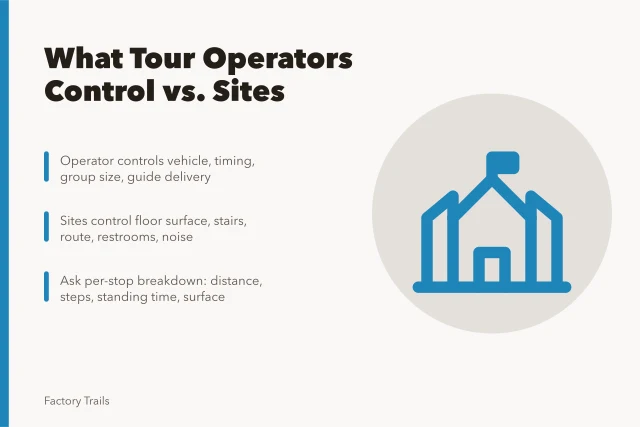
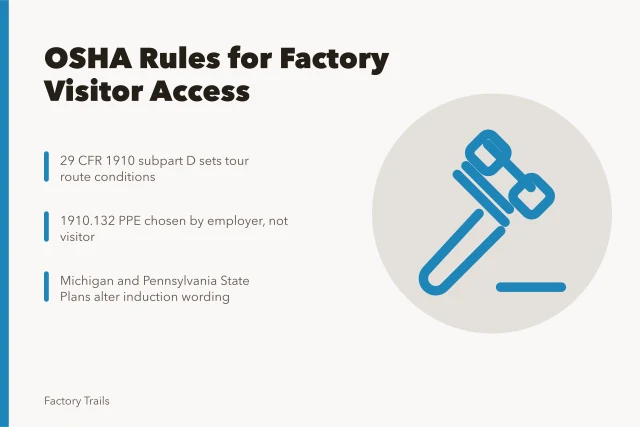
Then check the operational facts. Is the line running, or shut for July or December maintenance? What is the escort ratio? What PPE does the site require, and who issues it?
None of those answers come from a planning document. They come from the plant's safety officer and its published visitor rules. Ask before you promise access.
Coach and vehicle timing windows decide how many stops fit. Photography permissions decide what the program can show. Tripod bans and noise levels decide whether a stop works at all.
Stair access decides who can reach it. Route accessibility belongs in the plan, not in a note added after a complaint.
For the wider planning sequence this checklist sits inside, see industrial site interpretation planning. Cost lines for guides, transport and insurance belong in the factory tour budget checklist, which is where a plan meets a number.
Close the file before production
Put the approved source log, final route, drafts, rights notes and review record in one shared location. Record the assumptions still waiting on a check.
The NPS planning policy moves from purpose toward detailed action, and a visitor program can follow that order without running a federal planning process.
Planning a sign, guide or page includes its upkeep. The NPS lifecycle-cost overview is the reminder that publication is the start of the cost, not the end.
Keep a short change record: old wording, new wording, the source or approval behind the change, the date, and what triggers the next review. The National Archives web-records guidance sets the standard for that record.
A filled change-record line looks like this.
Field / Entry
- Old wording
- The line closed in 1971
- New wording
- The line ran until 1971
- Source or approval
- Site maintenance plan, section 3
- Date
- 4 March
- Next review trigger
- The 1972 maintenance file arrives
Who signs what: the content owner signs the source log and the final text, the safety officer signs access, escort ratios and PPE, and the rights reviewer signs images, quotes and permissions.
| Approver | Name | Date |
|---|---|---|
| Content owner | ||
| Safety officer | ||
| Rights reviewer |
The industrial site interpretation checklist covers the field test in detail. Take the plan to the actual stops and note what a visitor understands without a host.
Common questions
Does a checklist replace a full plan?
No. It confirms the plan holds the information a reviewer needs to approve or reject a decision.
What if the route changes before launch?
Update the route map, the arrival instructions and anything that names the old location. Publish nothing until those three agree.
Can a program start with one stop?
Yes, if that stop has clear orientation and a named owner for upkeep. One supported stop beats five that nobody maintains.
Who confirms safety and access requirements?
The plant's own safety officer and its published visitor rules. Requirements vary by site and by state, so confirm them directly rather than relying on a general guide.