Guides
How to plan industrial site interpretation: a workflow for visitor teams
Planning industrial site interpretation means matching source types to claims, testing themes against evidence, and assigning each medium a review owner.
An industrial interpretation plan turns a working plant or a preserved one into a visit people can follow. It decides which stories can be told responsibly, which visitor needs come first, and who keeps the program current. The plan can be short. It still needs evidence, boundaries, and named owners.
What to take away
- Match each source type to the claim it can actually carrya dated map proves layout, not motive.
- Write three to five theme-testing questions and discard any theme that fails one.
- Choose the medium after the message, never before; a process nobody can see needs a diagram, not a panel.
- Give every item an owner, a review date, and a removal trigger.
- Keep orientation, interpretation, and restricted operational detail in separate layers with separate schedules.
What each source type can carry
Build a source log before drafting a word. For each item record where it came from, who checked it, the exact statement it supports, whether it can be published, and where its evidence stops. The log is what stops a team writing a smooth story and finding the proof later.
Source types and limits
Source
- Dated map or plan
- Documented layout at a stated time
- Archive photograph
- A visible condition or object
- Annual report
- A published figure or company statement
- Approved interview
- One person's attributed recollection
- Site observation
- What is visible and permitted today
- Maintenance log
- Equipment condition on a date
Supports
- Dated map or plan
- How people actually used the space
- Archive photograph
- An unstated motive or outcome
- Annual report
- Independent proof of broad impact
- Approved interview
- A claim about all workers or eras
- Site observation
- Historical facts not shown on site
- Maintenance log
- What the public may be told about it
Does not support
- Dated map or plan
- Archive photograph
- Annual report
- Approved interview
- Site observation
- Maintenance log
Sloss Furnaces in Birmingham and Pullman National Monument in Chicago both hold collections that mix company records with oral history. The two carry different weight. A payroll ledger and a retired worker's memory of the same shift answer different questions, and a plan that treats them as interchangeable will overclaim.
Keep stable copies or references, and record rights and permission terms for images, recordings, and quotations. Where the evidence does not answer a question, write that down. Precision about limits reads as authority.
Theme-testing questions
A theme is a claim linking a site feature to a larger idea. "Labor" is a topic. "Work here depended on linked roles across loading, processing, and shipping" is a theme, if the record supports it.
Put every candidate through the same questions:
Theme-testing questions
Can a visitor meet evidence on site?
Keep as candidate theme
Move to research file as lead
A theme that fails any question goes into the research file as a lead. It does not become a headline because it would draw a crowd.
The NPS National Historic Landmarks thematic framework is a useful scope check: start from the broad national context, then keep only the themes the specific place, record, and visitor route can support. Britannia Mine Museum near Vancouver runs the same discipline in miniature, telling a single ore-to-concentrate story rather than the whole history of British Columbia mining.
Choosing the medium after the message
List messages first, formats second. A short arrival instruction can be a sign, a web page, or a host sentence. A changed streetscape needs an archival image. A process nobody can watch needs an approved diagram or a short video. A complicated question belongs in a scheduled conversation, not a dense panel.
Message types and media
Message type
- Orientation
- Sign or web page at the gate
- Change over time
- Paired archival and current image
- Invisible process
- Diagram or short video
- Contested or complex point
- Hosted conversation
- Live operations
- Nothing published
Medium that fits
- Orientation
- Buried under history
- Change over time
- No date on either frame
- Invisible process
- No caption plan
- Contested or complex point
- Panel text too dense to finish
- Live operations
- Detail the plant has not cleared
Common failure
- Orientation
- Change over time
- Invisible process
- Contested or complex point
- Live operations
For every medium, note these details:
- location
- content owner
- installation requirement
- access need
- review date
- removal trigger A video with no caption plan, a sign with no maintenance owner, or a page nobody can edit is not ready to launch.
National Park Service information centers commonly use a hierarchy: broad orientation first, specific themes at later stations, on-resource interpretation closest to the thing itself. That order works at industrial sites because it keeps practical information from competing with the story.
Assign reviews by subject
No single reviewer can approve everything. Historical claims go to whoever can evaluate the research. Site boundaries go to a facility authority. Rights go to the person who handles licenses. Visitor-facing language goes to an editor or program lead. One final owner resolves conflicts and records the decision.
Assign reviews by subject
- Historical claimsresearch reviewer
- Site boundariesfacility authority
- Rightslicense handler
- Visitor-facing languageeditor or program lead
- Final conflict resolutionone owner
Reviewers need the actual proposed wording and placement, not a description of it. A correct sentence can still fail at a noisy doorway.
A clear sign can still carry a detail the plant will not release. The NPS planning policy sets out the same progression from broad purpose to detailed action, with analysis and accountability attached at each step.
A visitor program can follow that sequence without becoming a government plan.
Implementation tasks that finish
Break the plan into tasks small enough to close. Each needs one owner, a date, and evidence of completion. A task called "create interpretation" hides several things. These include research, writing, access checks, and design. It also hides review, installation, staff briefing, and upkeep.
Implementation tasks and owners
Task
- Confirm sources
- Research lead
- Draft visitor text
- Content editor
- Clear site boundaries
- Facility contact
- Prepare media
- Designer or editor
- Walk the route
- Program lead
- Publish and monitor
- Content owner
Owner
- Confirm sources
- Source log with reviewer note
- Draft visitor text
- Versioned draft
- Clear site boundaries
- Written approval
- Prepare media
- Final file with rights record
- Walk the route
- Dated notes on noise, light, sightlines
- Publish and monitor
- Live item and review date
Completion evidence
- Confirm sources
- Draft visitor text
- Clear site boundaries
- Prepare media
- Walk the route
- Publish and monitor
Leave time for corrections. A review that finds a missing source or an unclear route is working. Changing the plan costs less than replacing installed material.
Keeping it current after launch
Set review dates, and review early when a route changes, a source is corrected, a boundary shifts, or a public page goes stale.
Keep a change log stating what changed, why, who approved it, and which items were affected.
The National Archives web-records guidance applies narrowly here. Retain these items so a later correction is traceable:
Retention for traceable corrections
- Source baseline
- Approved copy
- Media credits
- Date
- Owner
- Visitor items affected
Themes age slowly. Visitor instructions, digital tools, and physical access age quickly. Treat them as separate layers with separate schedules. The NPS planning and lifecycle-cost overview makes the same point about design, construction, and maintenance across a project's life: a launch plan with no upkeep owner is unfinished.
Keep a short decision record for choices someone will question later. Note the options considered, the evidence used, who decided, and what would reopen the question.
A new owner should be able to learn why a stop sits where it does, why a story was narrowed, or why a preferred format was dropped, without repeating every early meeting.
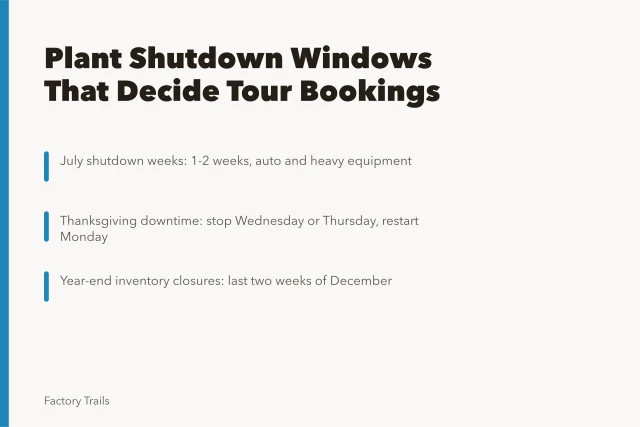
Where a tour route crosses a shutdown calendar, that record is what stops a group being booked against a maintenance window, a recurring failure covered in our notes on regional scheduling questions.
Reading the plan as a visitor
Walk the route at the hour a visitor will use it. Check noise, lighting, line of sight, weather exposure, and the gap between stops. Ask someone seeing it first to explain the opening message back to you. That is not a vote on whether they enjoyed the visit. It is a check that the program makes sense in place.
Use feedback as evidence for a defined change. If several visitors miss the first stop, revise the arrival cue. If a sourced point confuses people, simplify the wording. A handful of comments is not a finding about all visitors.
Then read the whole plan from the visitor's side. Basic access and schedule information should arrive before it is needed. Interpretation should sit where it can be used.
Every item should point to a real feature, a piece of evidence, or an approved activity. If the plan cannot answer those questions in plain words, simplify it before production.
The industrial site interpretation checklist covers the field-testing and change-record side of the same work.
Common questions
How long should an interpretation plan be?
Long enough to make the decisions and no longer. A small site may need a charter, a source log, a route map, a task list, and a review schedule.
Can a plan cover current manufacturing operations?
Only where the facility authorizes the information. Keep operational detail out when it is restricted, proprietary, or not cleared for publication, and confirm with the plant's own safety officer and published visitor rules.
What gets reviewed first?
Factual claims, site boundaries, and basic arrival instructions. Design and production come after those hold.
Does every visitor need the same route?
No. Hosted groups and self-guided visitors can take different paths, provided each has clear orientation and accurate content.
In this guide
- How to run an industrial site interpretation planning checklist before you assign approvalAn industrial site interpretation planning checklist for 2027: set scope, log sources, map the route, name an approver, and book the review.
- Industrial site interpretation planning questions to answer before you publishIndustrial interpretation planning questions for 2027 help U.S. teams compare visitor goals, source limits, routes, media choices, review roles, and upkeep.
- Warning signs in industrial site interpretation planning before you commitWeak evidence, shifting scope and missing upkeep owners show up early in industrial interpretation planning, and pausing them costs less than a public correction.
- How to keep industrial site interpretation planning records ready for a new ownerPlanning records for industrial visitor programs hold the charter, source log, route version, media rights and review dates in one findable place.