Guides
Part of Industrial site interpretation cost planning: how to estimate research and upkeep
Industrial site interpretation cost planning: a scope checklist before you approve
Industrial interpretation cost checklist for 2027 helps U.S. teams confirm scope, estimate stage, research, production, upkeep, risks, and approval before spending.
What to take away
- Price every scope line separatelyresearch, rights, writing, design, fabrication, installation, contingency and annual upkeep.
- Match the number to an estimate stage. Early ranges run -30 to +50 percent; detailed ones tighten to -10 to +15 percent.
- Set contingency at 10 to 20 percent of base cost on a detailed estimate. Keep escalation outside it.
- Give every scope line four fieldsassumption, exclusion, risk and owner.
- Approve nothing without a version date, a named approver and a maintenance owner.
The eight checks that gate approval
Eight checks stand between a scope draft and a spending decision. Each needs a written answer.
[figure 1]
Estimate Checks and Evidence
- Scopevisitor objective and excluded work
- Estimateversion, date, range, assumptions
- Upkeepowner and review trigger
- Riskspecific uncertainty and response
- Approvalnamed decision maker and date
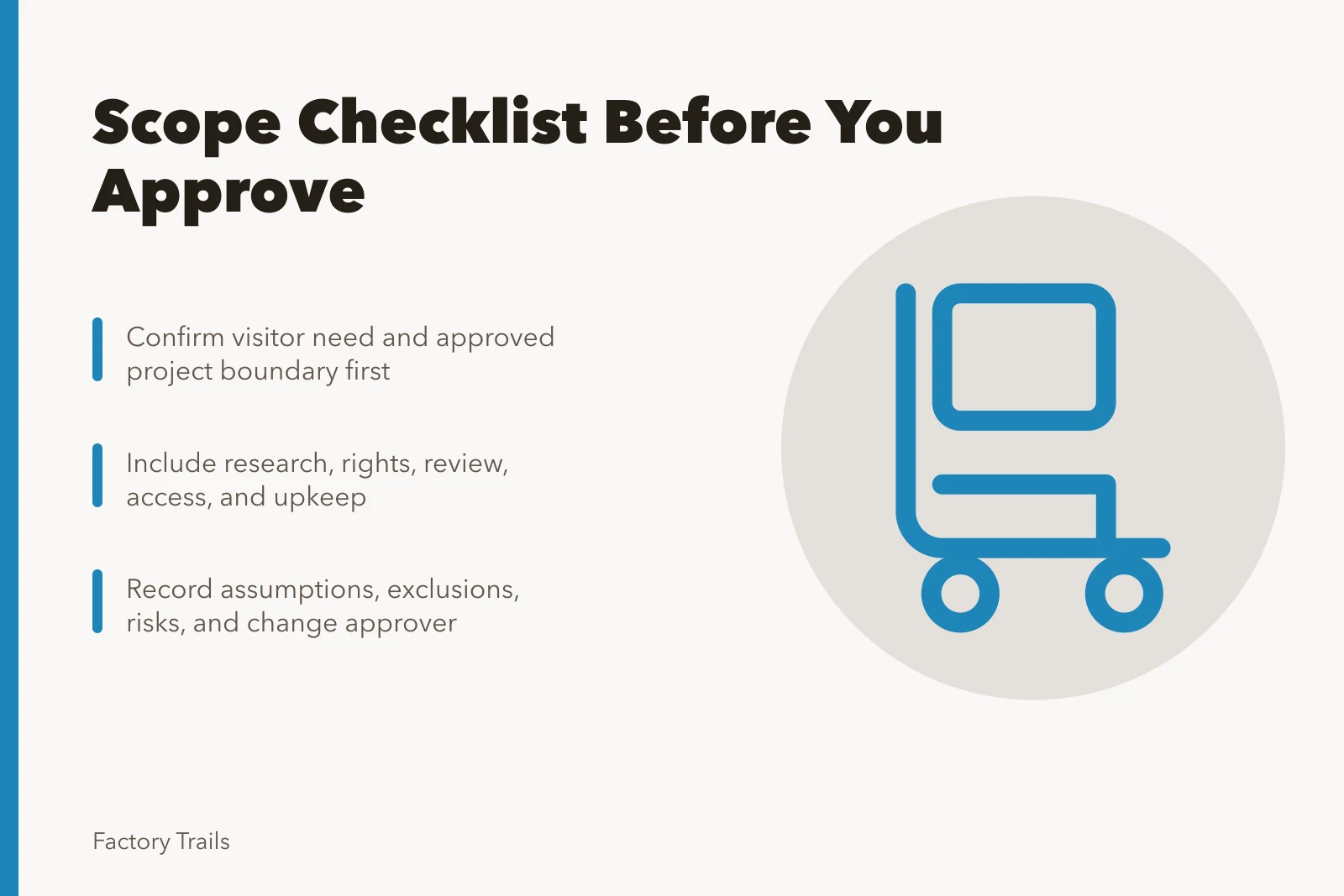
- State the visitor problem and the approved project boundary.
- Name the estimate stageorder of magnitude, budgetary or detailed.
- List research, source checking, rights and reviewer time.
- List writing, design, fabrication, installation and testing.
- Name recurring review, repair, hosting and replacement work.
- Record quantities, unit rates, exclusions and risks.
- Separate contingency from the base scope.
- Name the person who approves a change.
If your line list is still short, the 2027 scope checklist for factory tour budgets names the items U.S. operators forget most often.
Budget lines and typical U.S. ranges
Interpretation budgets fail when a line carries no unit rate. Price the work before you total it.
Budget line / Typical U.S. range
- Research and source checking
- $70 to $140 per hour
- Interpretive writing
- $1.50 to $4.00 per word
- Graphic design and layout
- $95 to $175 per hour
- Exhibit fabrication
- $300 to $900 per square foot
- Wayside panel, fabricated and installed
- $2,500 to $8,000 each
- Installation labor
- $55 to $95 per hour
- Annual upkeep
- 2 to 4 percent of installed cost
These figures are typical planning ranges, not quotes. Get two local prices for each major line, and check prevailing wage rules when public money pays for the work.
GSA's cost-management guidance expects an early figure to be updated as design, site conditions and requirements become clearer, so date every revision. The reimbursable services cost guidance is written for federal projects, but the update habit fits any visitor-story job.
Estimate stages and their accuracy bands
| Stage | Typical accuracy | Main use |
|---|---|---|
| Order of magnitude | -30 to +50 percent | Screening options |
| Budgetary | -15 to +30 percent | Funding requests |
| Detailed | -10 to +15 percent | Board approval, bid package |
| Definitive | -5 to +10 percent | Contract award |
These bands follow AACE International Recommended Practice 18R-97, the common reference for estimate classification. Pick the class first. Then accept only the range that belongs to it.
GAO's guide ties a credible number to defined work, stated assumptions and supporting evidence, rather than to a tidy spreadsheet. It is a cost estimating and assessment guide built for large programs, and the documentation standard transfers to a single gallery case.
If you are weighing formats before the estimate, the factory tour budgeting options for 2027 compares what each one demands of staff time and money.
Contingency, escalation and 2027 cost factors
Contingency covers risk you can name. Use 10 to 20 percent of base cost on a detailed estimate, and 20 to 30 percent earlier. A management reserve is separate and needs its own approval.
Add escalation of 3 to 5 percent a year when work starts more than 12 months out. Fabricated metal, specialty lighting and media hardware carry the longest lead times, often 12 to 20 weeks.
Three pressures shape 2027 figures. Shop labor rates, tariffs on imported steel and aluminum, and longer accessibility review for sites inside historic districts. Federal money or a federal permit also brings Section 106 review.
Late change requests and safety reviews are the usual culprits; our list of mistakes that inflate working factory visit budgets shows how each one lands in the estimate.
Example: one scope line with all four fields
A scope line becomes usable when it carries four fields. Here is one filled in for a mill-yard wayside.
Scope: six wayside panels, mill yard, fabricated and installed. Assumption: $5,200 each, 24 by 36 inches, single-sided aluminum, existing concrete pads reused. Exclusion: pads, footings, electrical service, French translation. Risk: if the yard sits inside the historic district boundary, review adds 6 to 10 weeks and $8,000 to $20,000 in documentation. Owner: the site superintendent approves scope changes; the maintenance lead owns annual cleaning.
NPS wayside exhibit planning guidance treats panel placement and site relationship as planning questions. Field-test the location before fabrication counts as the whole physical cost, as its wayside exhibit planning page explains.
Documents to keep with an approved estimate
Store the version date, estimate class, contingency, exclusions and approver in one file. A change request gets checked against that file first.
If the item sits inside the approved scope, the named approver decides. If it does not, it needs a new line and the same approval path.
Keep the source list and current site photographs beside the estimate. A rerouted path or an unavailable image changes the work that looked settled.
Our cost map and capacity notes for 2027 shows how weekly throughput limits move the installation line.