Guides
Part of Industrial site interpretation cost planning: how to estimate research and upkeep
How owners should keep industrial site interpretation cost records
Industrial interpretation cost records for 2027 help U.S. teams retain estimate versions, assumptions, approvals, changes, spending checks, and lifecycle decisions.
Cost records let a visitor-program team explain what it approved, what changed, and what it still needs to maintain. Keep them with the project scope rather than in a separate folder nobody checks.
What to take away
- Retain estimate versions, assumptions, changes, approvals, and spending checks.
- Connect each cost line to a work item and owner.
- Update records when a scope, route, source, or lifecycle commitment changes.
| Record | Minimum content |
|---|---|
| Estimate | Date, version, range, scope, and assumptions |
| Work breakdown | Task, owner, quantity, and completion evidence |
| Approval | Decision maker, date, authorized scope, and limit |
| Change log | Request, reason, cost effect, schedule effect, decision |
| Spending check | Planned amount, current amount, variance, and explanation |
| Lifecycle note | Review date, upkeep owner, replacement or removal trigger |
Worked example. v1: six panels, no audio, example range $22,000 to $34,000 from a typical $150 to $400 per square foot fabrication band plus content and installation. v2: add two audio stops and one outdoor panel because the route changed. New example range $29,000 to $45,000. Reason: scope added after a route test. Keep both versions.
Use a stable name with an ISO date and a two-digit version: 2027-05-14_interpretation-cost-estimate_v02.xlsx. Set the version date to the date the estimate changes, not the file save date.
Do not overwrite an approved estimate. Save the next version and explain what changed. A later reader should be able to see why the current plan costs more, less, or has a different scope.
Minimum cost record contents
- Estimatedate, version, range, scope, assumptions
- Work breakdowntask, owner, quantity, evidence
- Approvaldecision maker, date, scope, limit
- Change logrequest, reason, cost, schedule, decision
- Spending checkplanned, current, variance, explanation
- Lifecycle notereview date, upkeep, replacement trigger
Keep a usable cost file
Use NARA's records scheduling guidance to write a one-page file plan: what each record covers, where it lives, and who acts on the review date.
Use the GAO Cost Estimating and Assessment Guide to connect every estimate line to its work definition and evidence.
Use the GSA cost-management guidance to label estimate maturity and store the approving person with the version.
Use the National Archives records-management profile to add documentation requirements and the next review trigger to the project plan.
Review the record at decision points
Check records when research is complete, before a production commitment, after a route test, at launch, and before a scheduled update. Compare planned and current work plainly. If the variance cannot be explained from the record, update the information before authorizing more spending.
Give each working file a location that the next owner can access. Keep private invoices, contacts, and negotiation notes under the organization's own access rules. The published visitor article needs only current, approved content and the required image credit.
Set up the record for a handoff
Give every estimate a stable identifier and version date. Keep the approved scope, source baseline, work breakdown, decision log, and current spending check under that identifier. Then state where a new owner can find the current file and who can approve a change. This supports a careful handoff when staff, contractor, or program responsibility changes.
When work is retired or deferred, preserve the decision reason and the relevant estimate version. State whether the visitor need is met by a smaller option, a current page, a hosted program, or no replacement. The record should explain why the cost was not spent and what condition would make the project worth revisiting in the future.
Common questions
How often should estimates be versioned?
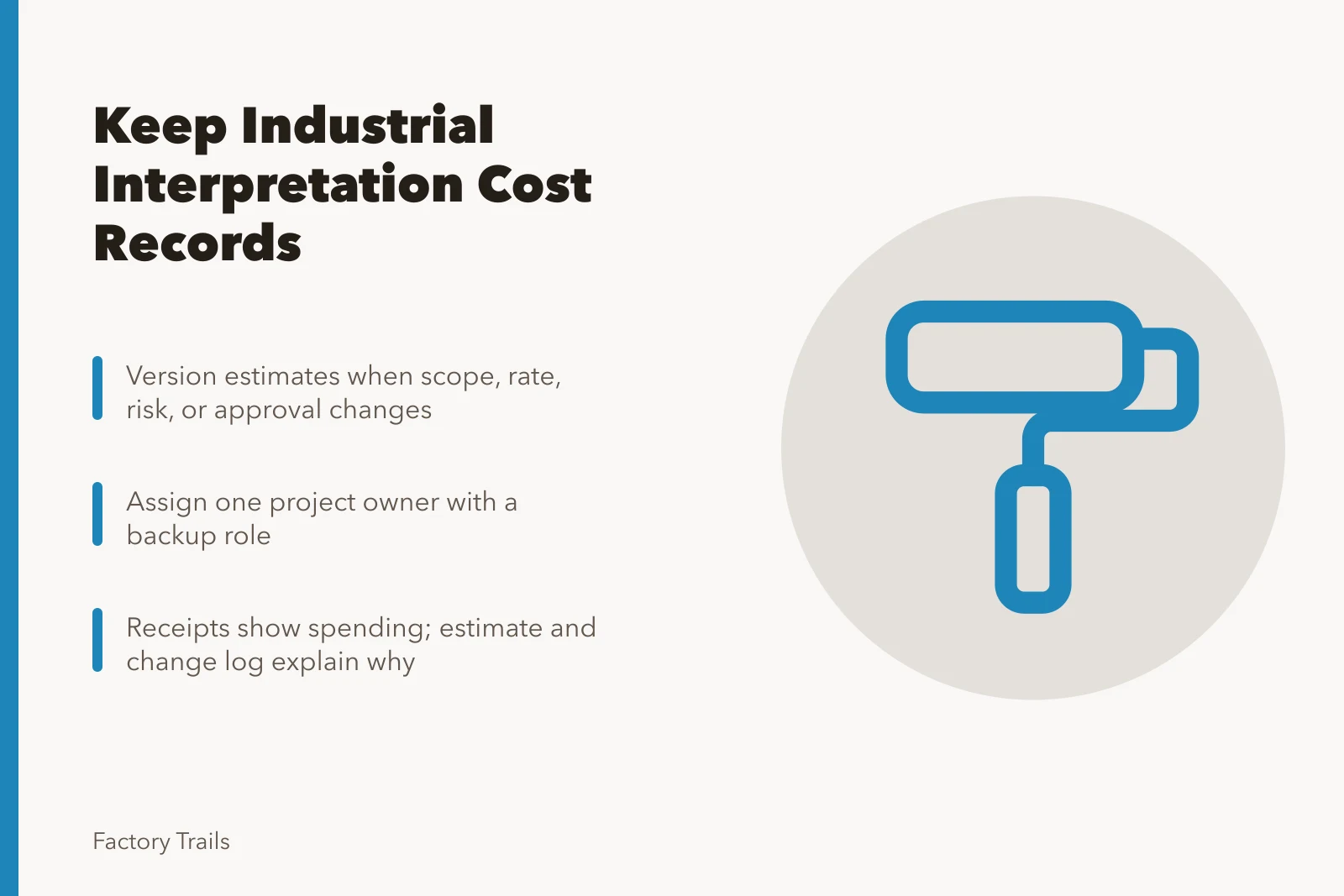
Create a new version whenever a material scope, assumption, rate, risk, or approval changes.
Who owns cost records?
Assign one project owner with a backup role. Contributors can update their work areas, but one person should maintain the current decision file.
Are receipts enough?
No. Receipts show spending. The estimate, scope, approvals, and change log explain why the spending was authorized.