Guides
How an industrial heritage maintenance plan for 2027 keeps records and reviews on track
Industrial heritage maintenance plan for 2027 helps U.S. owners and stewards organize observations, source records, priorities, and qualified preservation review.
Industrial heritage places need more than admiration. A former mill, rail building, canal structure, mine feature, shop, warehouse, or company-town resource may hold historic materials, working systems, public responsibilities, and changing environmental conditions. A useful maintenance plan does not begin with an online repair trick.
It begins with clear records, careful observation, defined authority, and qualified review when work could affect historic fabric, public safety, or regulations.
This guide is for owners, stewards, nonprofits, public agencies, and project teams who need a practical planning framework. It is not a substitute for a preservation architect, engineer, conservator, building official, or other qualified professional. Do not enter unsafe structures, disturb materials, or begin treatment based on a general article.
What to take away
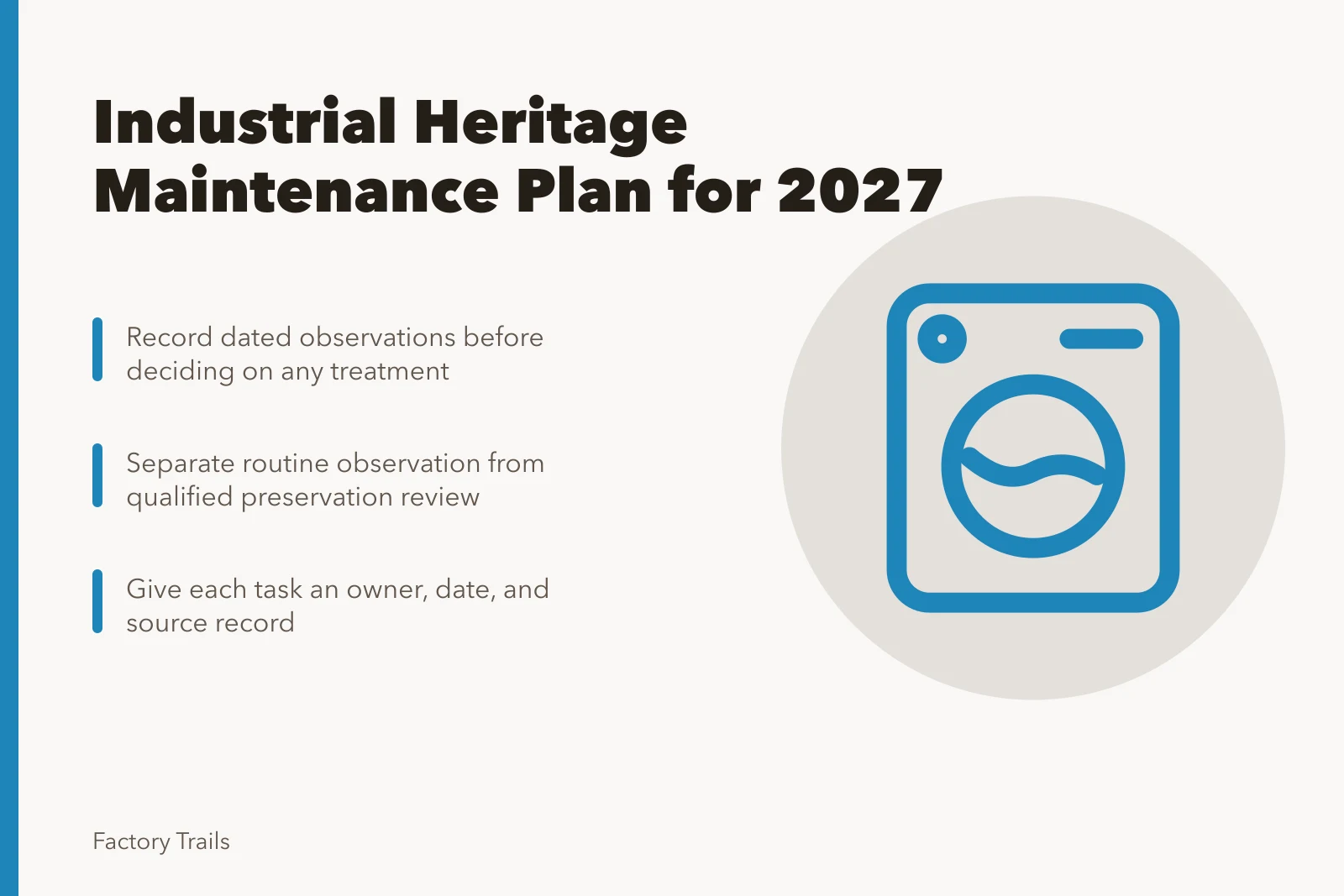
- Record observed conditions before deciding on treatment.
- Separate routine observation from work that needs qualified review.
- Protect historic evidence, public safety, and current access at the same time.
- Give each task an owner, a date, a source record, and a clear limit.
- Use a written plan to prevent duplicate work and unsupported assumptions.
A simple plan structure
- Scope, authority, and current use.
- Baseline records and source limits.
- Observation schedule and reporting path.
- Priority categories and escalation rules.
- Budget, approvals, and qualified-review needs.
- Work records, updates, and annual plan review.
The strength of this structure is not its complexity. It creates a reliable trail from observation to decision and from decision to record. That trail makes it easier to explain priorities to a board, funder, contractor, public agency, or future caretaker.
Start with purpose and responsibility
State what the plan protects. It may cover a single building, a collection of structures, a site feature, an interpretive area, or a broader industrial district. Then name who has authority to observe, approve, fund, contract, communicate, and respond to a change in condition.
A plan fails when everyone assumes someone else will decide whether an issue is routine or urgent.
Begin with a simple scope statement. It should identify what is included, what is excluded, the current use if any, known access limits, and the decision-makers. Do not expand the scope casually. An old factory can include equipment, utilities, contamination concerns, adjacent land, worker housing, and archives, each with different responsibilities.
Build a baseline record
Before recommending work, create a baseline that records what exists now and where the information came from. Take dated photographs from safe, legal public or authorized locations. Preserve previous reports, drawings, maintenance logs, permits, and historic records. Label each file clearly enough that a later steward can understand whether it describes historic context, current condition, or proposed work.
Record Types and Limits
Record
- Historic photograph or drawing
- Earlier appearance
- Condition observation
- What was seen
- Current maintenance log
- Completed work
- Qualified assessment
- Professional evaluation
Can establish
- Historic photograph or drawing
- Current condition
- Condition observation
- Cause or risk
- Current maintenance log
- Historic significance
- Qualified assessment
- Owner decisions
Cannot establish alone
- Historic photograph or drawing
- Condition observation
- Current maintenance log
- Qualified assessment
| Record | What it can establish | What it cannot establish alone |
|---|---|---|
| Historic photograph or drawing | Earlier appearance and context | Current condition or safe access |
| Condition observation | What was seen on a given date | Cause, risk level, or treatment method |
| Current maintenance log | Completed work and monitoring dates | Historic significance by itself |
| Qualified assessment | Professional evaluation within its scope | A substitute for owner decisions or approvals |
The National Park Service's Preservation Brief 47 describes why a written maintenance plan can coordinate work, establish inspection schedules, preserve baseline photographs, and retain records. Its technical recommendations must be applied to the actual property by people with appropriate knowledge and authority.
A filled-in baseline entry, for illustration:
- Site and featureBuilding 2, north wall, brick with stone lintels.
- Date and observer2027-03-12, site steward.
- Positionnorth elevation, third bay, viewed from the public sidewalk.
- Record typecondition observation with 14 dated photographs. No close access.
- Sources1918 Sanborn map, plus one 1962 company photograph held by the county historical society.
- Observedmortar joint loss and two spalled brick faces near the third window.
- Limit of knowledgecause unknown. No structural assessment.
- Next steprequest a condition assessment before any repointing.
Sort observations by decision type
Do not give every observation the same response. A missing label, a blocked gutter, a changed paint surface, a cracked component, and a possible structural concern have different implications. Use categories that guide the next decision rather than pretending to diagnose the cause from a casual view.
Sort Observations by Response
Observation category?
Routine record update -> date and add to next review
Access or visitor issue -> follow safety procedures
| Observation category | Planning response |
|---|---|
| Routine record update | Date it and add it to the next review |
| Access or visitor issue | Follow current safety and operations procedures |
| Change in historic material | Preserve evidence and seek qualified review before treatment |
| Possible urgent condition | Follow emergency and safety protocols, then document actions |
| Unknown condition | Record the limit of knowledge and define the next investigation |
The first useful action is often documentation and escalation, not intervention.
Set a regular review rhythm
A plan needs dates, not vague intentions. Create a calendar for routine observation, seasonal checks, record updates, and annual review. Match the rhythm to the site's use, climate, operations, and known vulnerabilities. The plan should also describe how someone reports a new issue between scheduled reviews.
Review Record Checklist
- Date of review
- Observer name
- Location observed
- What was observed
- Supporting photographs or files
- Decision taken
For each review, capture the date, observer, location, what was observed, supporting photographs or files, and the decision taken. Avoid labels such as "fine" or "bad." Use direct descriptions. If you do not know the cause, say so. Accurate uncertainty is better than an unsupported conclusion.
A 2027 calendar for a northern US site, with dates to change to local conditions:
| 2027 date | Task | Owner |
|---|---|---|
| February 15 | Winter check: snow load, ice at gutters, freeze damage in unheated spaces | Site steward |
| April 10 | Spring walk: roof, gutters, masonry, drainage, fences before the visitor season | Steward, reviewer on call |
| June 1 | Season opening: access, signs, barriers, current hours | Operations lead |
| September 30 | Post-season condition record with dated photographs | Steward |
| November 10 | Annual review: plan, contacts, decision log, 2028 priorities | Owner and qualified reviewer |
Shift the dates for local climate, visitor season, and staffing. Note the reason for any change in the record.
Connect maintenance to interpretation
Historic materials and systems tell a story. A maintenance plan should record why a feature matters before deciding whether it can be altered, removed, covered, or replaced. Ask: does the feature demonstrate a process, a technology, a worker's experience, a relationship to its setting, or a period of change? Is it original, later, or undocumented?
Who needs to be consulted?
This does not mean every feature remains untouched forever. It means that change is made with evidence, authority, and a record of the decision. The best plan helps future stewards understand both what survived and why choices were made.
Budget for documentation and expertise
Maintenance budgets often focus only on visible work. Include time and money for records, condition review, permits, professional assessment, staff training, access controls, and follow-up monitoring. A low initial cost can create a much larger problem if it bypasses planning or removes evidence needed for a sound decision.
Set priorities by public safety, protection from further loss, legal obligations, historic significance, and available resources. Do not promise a universal percentage or fixed schedule. Every property has different materials, use, climate, ownership, and regulatory context.
No dollar range appears here because no public schedule covers this work, and quoted rates vary too widely to present as typical. What determines the bill is the scope, not a standard rate.
Cost drivers: the number and size of structures, access methods, how much of the record already exists, whether a licensed architect or engineer must seal drawings, and local permit fees.
Ask each consultant for a written scope, an hourly or fixed rate, and the assumptions behind the total. Set a threshold above which a second estimate is required.
Define the escalation path before it is needed
Write down who receives a report, who decides whether an issue needs professional assessment, and who is authorized to communicate publicly. For a nonprofit, that may include a site manager, board representative, preservation consultant, and emergency contact. For a public owner, the path may include facilities staff, a preservation office, risk management, and a building official.
The exact roles vary, but uncertainty about the next call wastes time when a condition changes.
Escalation Path Steps
- Report concern from safe location
- Preserve basic evidence
- Decide if professional assessment needed
- Defer to local emergency instructions
- Authorized person communicates publicly
The escalation path should not encourage unqualified people to inspect a dangerous area. Keep names and contacts current, and review them whenever staffing or ownership changes.
Name the outside offices before an issue appears. For a property listed in or eligible for the National Register of Historic Places, the first call is usually the State Historic Preservation Office (SHPO) or the Tribal Historic Preservation Office (THPO).
If a federal agency funds, permits, or licenses the work, Section 106 of the National Historic Preservation Act requires review. The SHPO or THPO is the state contact. Local building permits, occupancy, and fire requirements go through the local building official or code enforcement office.
Preserve a decision log
A decision log is different from a maintenance task list. It records why a course of action was chosen, the sources consulted, the person with authority, any qualified advice received, the date, and the work or monitoring that followed. Over time, this makes patterns visible.
It also prevents a future team from mistaking an earlier temporary measure for an approved long-term treatment.
Decision Log Contents
- Why the course of action was chosen
- Sources consulted
- Person with authority
- Qualified advice received
- Date of decision
- Work or monitoring that followed
One filled-in decision log entry, for illustration:
| Field | Entry |
|---|---|
| Date | 2027-09-14 |
| Issue | Spalled brick and mortar joint loss, Building 2 north wall |
| Sources consulted | Baseline record of 2027-03-12, Preservation Brief 47, structural engineer's letter of 2027-08-30 |
| Authority | Board facilities committee |
| Decision | Defer repointing to 2028; monitor at 60-day intervals |
| Reason | Funding cycle; no immediate safety risk reported |
| Follow-up | Photographs due 2027-11-15; item on the annual review agenda |
Include decisions not to act. If an observation was documented and deferred pending funding, research, seasonal conditions, or professional review, record that reason. A transparent deferral is easier to revisit than an unexplained silence.
Review the plan with the people who use the site
Staff, volunteers, tenants, visitors, nearby residents, and program partners may notice different changes. Invite observations through a defined channel, but keep the evaluation process disciplined.
At the annual review, ask whether the plan still reflects current use, access, stewardship capacity, and known risks. Remove outdated contacts, update the baseline where authorized work changed a feature, and identify questions that require further research. This keeps the plan a living tool rather than a file that only appears when an emergency occurs.
Keep visitor messaging honest
If a site is open to visitors, maintenance work may affect access. Publish only current information supplied by the responsible operator. Do not present a historical source as a current hours notice, and do not encourage visitors to go around fences, closed trails, equipment, or work areas. A closure can be part of responsible care.
Simple Plan Structure
- Scope, authority, and current use
- Baseline records and source limits
- Observation schedule and reporting path
- Priority categories and escalation rules
- Budget, approvals, and qualified-review needs
- Work records, updates, and annual plan review
Confirm the public and historical record
The National Park Service visitor conditions guidance shows why visitor-facing details require a current source. Maintenance planning can change access, but a historic maintenance record does not establish today's public terms.
The National Archives describes basic records-management concepts. Record the source, date, decision, authority, and later correction for each live planning detail so a future team can retrace the decision.
The National Park Service Museum Handbook supports careful documentation of historic material. A collection item or historic image should remain clearly labeled as context, not as an instruction about treatment, access, or current safety.
Common questions
Can a volunteer create a maintenance plan?
A volunteer can help organize records and observations, but decisions involving treatment, safety, regulations, or historic fabric should follow the authority and qualified-review process appropriate to the property.
What should happen when a new problem appears?
Document it safely, follow emergency procedures if needed, and escalate it to the person or professional responsible for the next decision.
Is an old photograph enough to plan work?
No. It can establish historical context but must be considered alongside current condition, authority, and qualified assessment.