Guides
How to build an industrial heritage travel case study method that holds up
Industrial heritage case study method for 2027 helps U.S. writers document public places, source limits, living communities, and current visitor facts.
What to take away
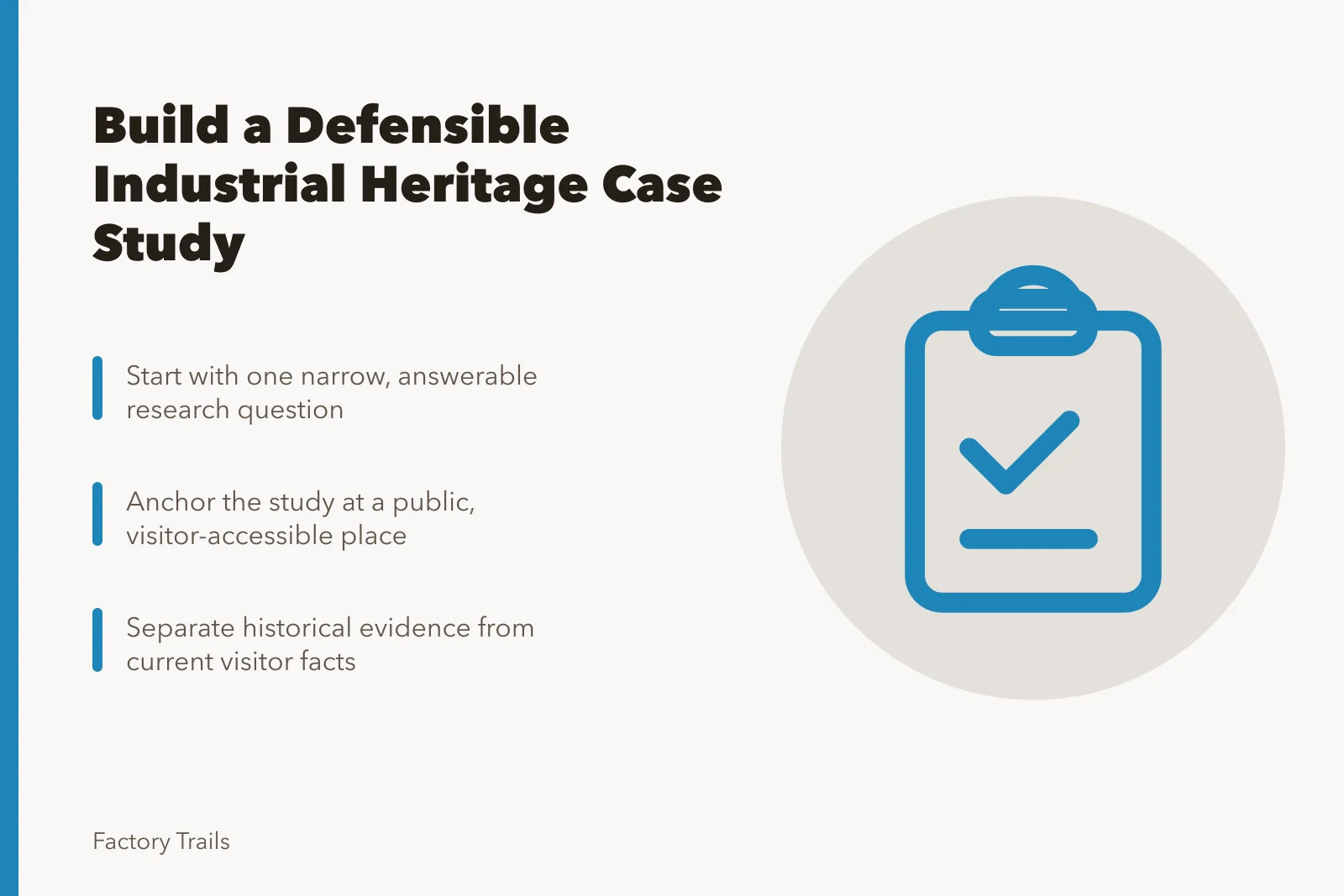
- Narrow the case study to one question a public source can answer, such as how a canal shaped a mill district's layout.
- Write a short method note listing sources, dates checked, and what you could not verify.
- Keep historical questions, live visitor facts, and image credits in three separate lists.
- Match each source to the job it can do, and write down what it cannot establish.
- Re-check every live claim every 6 to 12 months, with one named owner for the record.
Start with one answerable question
A case study gets weak when it tries to cover a whole industry, town, or company. Pick one question instead.
Good questions sound like this: how did a rail yard shape the layout of a public district? What evidence explains a mill's relationship to water and labor? How does a museum interpret a local manufacturing process?
The question sets the scale. One building, one guided tour, one exhibit, one canal feature, or one documented process usually gives you enough material for a focused piece.
That also blocks a common error. A structure you can see from a public road is not automatically a public attraction.
Open three lists before you start research. List one holds historical questions. List two holds live visitor questions. List three holds images and their credits. Do not merge them.
Three Lists Before Writing
- Historical questions
- Live visitor questions
- Visual material
- Do not merge them
If the field is new to you, how to pick an industrial heritage travel provider for 2027 sets out how sites, trails, and tours differ before you settle on a subject.
Write a transparent method note
Readers trust a case study more when they can see how it was built. Put a short method note near the start or the end.
- Name each source, its type, and the date you read it.
- State the claims that source supports.
- Give the date you last checked each live detail.
- List what you could not verify.
- Name the next review date and the person who owns it.
Five-Part Method Note
- State research question and scope
- Identify the public anchor experience
- Name historical and current sources
- Explain limits and unconfirmed conditions
- Give the date live info was reviewed
Here is a filled example, using Lowell National Historical Park in Massachusetts.
Method note. Sources used: National Park Service pages for Lowell National Historical Park and its museum; the park's current tour and canal pages; exhibit labels at the Boott Cotton Mills Museum read on 12 March 2027; a published history of the mill workforce.
Live details checked 12 March 2027. Not verified: interior access to privately held mill buildings, current tenants in them, and machinery described only in historical accounts. Next review March 2028, owned by the site editor.
This example is short on purpose. Keep the note in the same file as the source record, so a later editor can match each sentence to its evidence. The system described in factory tour records shows how owners log sources and corrections over time.
Build an evidence map
Map each source to the question it can answer. The National Park Service HABS/HAER/HALS collection works this way, holding measured drawings, large-format photographs, written histories, and field notes.
| Evidence type | Answers | Cannot answer |
|---|---|---|
| Historical report or archive | Process, dates, people, physical change | Today's hours or access |
| Current responsible visitor page | Hours, entry, tickets, closures, safety terms | Historical interpretation |
| Map or route record | Orientation and spatial relationships | Whether you may cross a boundary |
| Archival photograph | Visual context and comparison | Present condition or ownership |
| Interview or provider statement | Perspective and leads | A published fact on its own |
The rule behind the table is simple. Use a live source, maintained by whoever controls the site, for anything a reader might act on today.
Example: reading Lowell's mill district
Lowell National Historical Park gives you a compact test case. The park holds 19th-century textile mills, a canal system, and the Boott Cotton Mills Museum inside a walkable district.
Apply the three lists to it. Historical: how did canal water power the mills, and who worked them? Live: which tours run, on what days, and at what price? Visual: which photographs may be published, and who holds the rights?
Then write only what each source supports, and say where the evidence stops.
Sloss Furnaces in Birmingham, Alabama allows the same treatment for a preserved blast furnace site with public grounds. For more places where the method applies, a guide to Alabama's industrial heritage sites goes past Sloss and covers the rest of the state.
Field notes and the review record
Fieldwork adds observation. It does not replace research.
- Confirm the public route, timing, and any booking or photography terms before you travel.
- Bring questions drawn from your three lists.
- Mark what you saw yourself, separately from what an organization published.
- Never turn one visit into a permanent claim.
A display seen once becomes: "A display read on 12 March 2027 described..." A staff comment becomes a lead to verify, not a source.
One named editor owns the review, not a team. The source record lives in a single file with a row for each claim: URL, date read, claim, last check, next check. Re-check live claims every 6 to 12 months, or sooner when a route, price, or schedule changes.
Many published errors are process slips rather than research failures, and 8 mistake prevention fixes for 2027 covers the ones that recur at working sites.
Common questions
What separates a case study from a travel list?
A case study answers one question with explained evidence and stated limits. A list can still be useful, but it needs its own article to justify its inclusion rules.
How often should live claims be re-checked?
Every 6 to 12 months, and sooner when access, hours, prices, or safety terms change. The method note carries the date so readers can judge how old a claim is.
Should a case study mention private or active plants?
Yes, as context, when the history is sourced. Never suggest that readers may enter without a current statement from the owner or operator.
Where should the source record live?
In one file, owned by one named editor, with a row per claim. The next revision then becomes a row edit instead of a rewrite.