Guides
Factory visit cost planning checklist: scope, assumptions and actuals
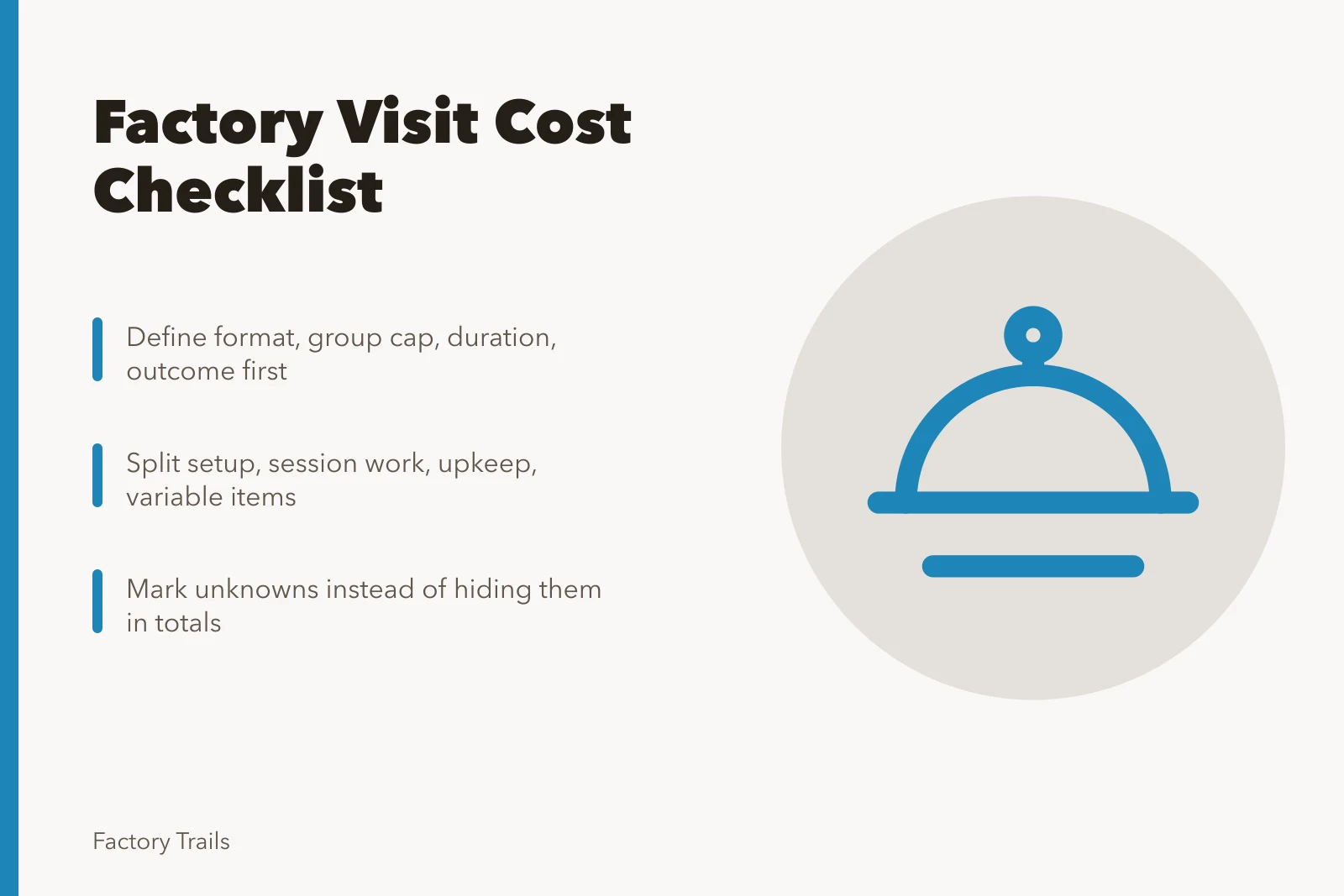
Factory visit cost checklist for 2027 helps U.S. teams capture setup work, session labor, materials, assumptions, exclusions, contingency, and actual results.
What to take away
- Write the scope line firstformat, session count, and the 2027 planning window.
- Five drivers carry most of the estimategroup cap, session length, route complexity, host time, and materials.
- Give every material line a labeled range, a source note, or the word pending.
- Store the approved checklist with its decision, then add an actuals note after the first sessions.
- Reopen the estimate when the session count, group cap, staffing, or route changes.
Confirm five readiness checks first
| Check | Ready when |
|---|---|
| Purpose | The estimate supports a named decision, such as approving four fall 2027 sessions. |
| Format | Audience, group cap, duration, and intended outcome are set. |
| Route | The visitor path is marked pending or approved by the facility. |
| Roles | Program, host, and facility contacts are named. |
| Window | The 2027 session count and timing are stated. |
Confirm these five checks before building the estimate. A checklist built on an undefined format produces numbers nobody can defend.
[figure 1]
Pre-Estimate Readiness Checks
- Purposesupports a named decision
- Formataudience, group cap, duration defined
- Routevisitor arrangement pending or approved
- Rolesprogram, host, facility contacts named
- Time framesessions and timing stated
Dates change cost as much as format does. Host availability collapses during July shutdown weeks and tightens through peak season. The notes on seasonal mistakes on a factory visit explain why summer dates slip first.
Cost lines, drivers and 2027 inputs
| Cost line | What sets it | 2027 input to record |
|---|---|---|
| Setup | Route complexity and approvals | Number of planning meetings, as a range |
| Host time | Session length and group cap | Sessions multiplied by host hours per session |
| Check-in and closeout | Group cap | Minutes per group, confirmed by the host |
| PPE | Facility hazard assessment | Units per visitor, from a current quote |
| Materials | Chosen format | Count per session, printed or digital |
| Upkeep | Staff turnover and scheduling load | Refresher hours per year |
| Contingency | Rules for adding a group | A stated percentage band |
Plan per session and per visitor, not as one lump sum. A cap of 12 and a cap of 24 use the same route but consume different host minutes and materials.
Group cap is the second driver. Raising it from 15 to 24 adds check-in minutes, PPE units, and guide copies without adding session hours.
Host time usually dominates. The cost map and capacity notes for 2027 show how session counts and host hours interact when capacity is tight.
No public price list exists for hosted factory visits, because every site prices host time differently. Treat any figure as local until a quote confirms it. Where a route requires safety glasses or protective footwear, the program normally pays, and OSHA's rule on general protective equipment sets out when an employer must supply it (OSHA 1910.132).
Example: a completed fall 2027 checklist
- Scopefour hosted sessions, groups up to 15, September to November 2027.
- Host time3 hours per session at the local loaded hourly rate, pending confirmation by the plant scheduler.
- Check-in15 minutes per group of 15, based on the 2026 pilot.
- PPEsafety glasses for 60 visitors, illustrative range of 3 to 12 USD each, awaiting a supplier quote.
- Materials60 printed route guides, illustrative range of 1 to 5 USD each.
- Contingency10 percent of session cost, covering one added group or a changed route.
- Exclusionsfacility utilities, insurance, and visitor-path capital work sit outside this estimate.
A range that names its source is more useful to a reviewer than a precise figure with no basis.
Documenting each cost line
Give each material line a short source note. Record whether the figure came from a prior session, a supplier quote, a host estimate, or a planning assumption. The 2027 scope checklist covers which categories belong in scope; this page handles the numbers beneath them.
A line with no basis gets a range or the word pending. That shows the reviewer what must be confirmed before the program commits. The GAO cost-estimating guide lists purpose, scope, assumptions, documentation, and updates as parts of a credible estimate.
Add the date of each quote. A PPE price from a prior year is not a current price.
Storing the checklist with the decision
Keep the approved version, its assumptions, the decision note, and the exclusions box together. Records-management fundamentals from the National Archives tie records to accountability and business needs, which is the point of keeping the checklist at all.
Name one owner for the checklist and one person who can explain each pending line. Approval should leave no figure unassigned.
Store it beside the session schedule, so a reviewer finds the estimate and the plan together.
Actuals after the first sessions
After session one, add a short actuals note: host hours used, visitors checked in, materials consumed, PPE used, and any route change. Compare it with the estimate and explain each material difference in one line.
Repeat problems appear quickly. The common factory visit mistakes to avoid in 2027 covers group size and timing errors that inflate the next estimate.
Reopen the checklist when the session count, group cap, staffing, or route changes. Note who changed it and why, and date the new version.