Guides
Factory tours in 2027: how budgeting shapes regional adaptation
2027 factory tour budgeting guide names regional adaptations, cost line items, ticketing tools, and funding tradeoffs for U.S. small operators.
What to take away
- Set the visitor promise before you price the local version.
- Use Regional planning to match route, arrivals, access, and weather. Add capacity and staffing to the review.
- Budget for the adaptations your region actually needs, not a generic national tour.
- Separate fixed costs from trigger-based costs, such as festival host coverage.
- Track cost per visitor, route changes, and funding tradeoffs each season.
Factory tours in 2027 will face tighter labor, higher insurance, and more pressure to show a return. A single national tour model will not fit every region. Budget choices decide which regional adaptation is possible: a covered wait, a shuttle, a translated booking page, or a second host. The money shapes the visitor experience.
Budgeting is the adaptation filter
Regional adaptation starts with a spending limit. A cold-climate plant may want an exterior walking route, but a $6,000 seasonal canopy budget may be the difference between operating in January or closing. A dense urban site may prefer timed entry, but $1,200 in transit signage can solve more arrivals than a new parking plan.
2027 Regional Budget Planning Ranges
- $6,000seasonal canopy budget
- $1,200transit signage
- $4,320-$5,760seasonal host wages
- $1,080-$1,440six-hour day, 10 hosts
For 2027, build a line-item budget by season and format. Use planning ranges, then replace them with local quotes. A seasonal host at $18 to $24 per hour for 40 weekend shifts costs $4,320 to $5,760. A six-hour day at 10 hosts costs $1,080 to $1,440 in wages alone.
The GAO cost-estimating guide says credible estimates need scope, assumptions, documentation, and updates. Apply that to each regional version. List the season, group cap, route status, and session count next to every cost. That record shows why one region spends more on accessibility and another spends more on coach check-in.
The Regional adaptation budget should show what the local version requires. The U.S. Small Business Administration offers free budget templates and district office counseling for small operators. Use those templates to separate fixed costs from trigger-based costs.
Named regional adaptations and their budget drivers
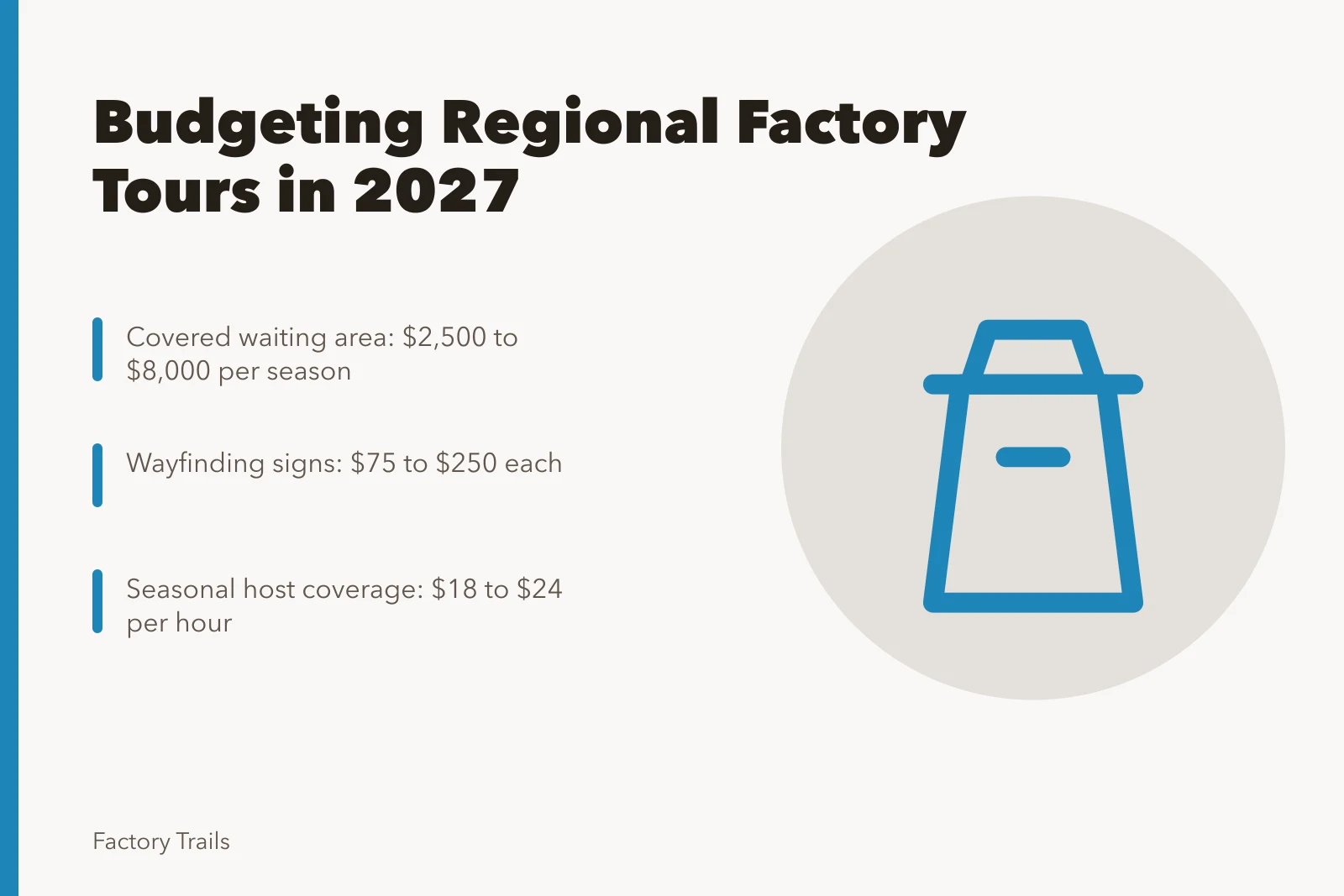
Northeast and Midwest winter adaptation. The budget driver is weather delay and safety. Plan $2,500 to $8,000 for a seasonal covered waiting area. Add $75 to $250 per durable wayfinding sign. Allocate $400 for two hours of host training across 10 hosts at $20 per hour.
Regional Adaptation Budget Drivers
Winter
- Budget driver
- Weather delay, safety
- Key cost
- $2,500-$8,000 covered waiting
- Other line item
- $75-$250 per sign
Sun Belt
- Budget driver
- Heat exposure, water
- Key cost
- $1,200-$3,000 shade, cooling
- Other line item
- $9,000 accessible shuttle
Urban Transit
- Budget driver
- Passenger loading, directions
- Key cost
- $1,200-$3,600 transit signage
- Other line item
- FareHarbor per-booking fee
Rural Coach
- Budget driver
- Grouped arrivals, restrooms
- Key cost
- $500-$1,500 portable restrooms
- Other line item
- $2,000-$5,000 check-in staffing
Sun Belt summer heat adaptation. The budget driver is heat exposure and water. Plan $1,200 to $3,000 for shade, cooling stations, and water. Shift exterior stops to early morning. A 30-day season with a $75 per hour accessible shuttle and a four-hour minimum costs $9,000.
Dense urban transit adaptation. The budget driver is passenger loading and directions. Allocate $1,200 to $3,600 for transit signage, curb instructions, and digital map updates. Use FareHarbor for tours with online reservations because it uses a per-booking fee model with no monthly subscription. Eventbrite charges per paid ticket and is free for free events.
Rural coach arrival adaptation. The budget driver is grouped arrivals and limited restrooms. Budget $500 to $1,500 for portable restroom service and $2,000 to $5,000 for staggered check-in staffing. Plan $1.25 to $2.50 per minute for phone interpreting. LanguageLine Solutions uses per-minute billing with account minimums.
Historic plant accessibility adaptation. The budget driver is route limits and compliance. Use free guidance from the ADA National Network regional centers. Budget $3,000 to $15,000 for a temporary ramp, route resurfacing, or accessible viewing platform. Confirm all claims with the facility access role before publishing.
Peak tourism surge adaptation. The budget driver is host capacity and reservation control. When I Work offers a free tier for small teams and paid per-user plans for seasonal scheduling. A reservation cap can protect the promised experience. A third host may cost less than a degraded tour that creates refunds.
These are named regional adaptations, not stereotypes. Each one ties a local condition to a budget line and a tool a reader can check.
Arrival, access, and weather budgets
Arrival is the first paid experience. Budget for the exact entrance, drop-off, identification check, restroom access, and late-arrival policy. Printed maps are weak if they are not updated. A $900 to $3,000 sign package may be more useful than reprinting 5,000 brochures.
Arrival, Access, Weather Budget Checklist
- Fund exact entrance and drop-off
- Fund identification check and restrooms
- Set late-arrival policy
- Price accessible routes with operators
- Get approved accessibility language
- Fund indoor fallback with host time
Access is part of the main tour. Use tour operators and facility compliance roles to price accessible routes. Do not promise fully accessible unless the responsible organization authorizes that language. Put the approved description in the booking flow.
Weather triggers need funded fallbacks. The National Weather Service provides free forecasts and alerts. Use them to set a go or no-go time. Fund the indoor route with host time, not just a PDF. A fallback that lacks a host is not a real fallback.
A 2027 budget model with line items
Use this model for a regional factory tour. Adjust all figures with local quotes.
Key 2027 Budget Line Items
- $18-$24seasonal host hourly rate
- $2,500-$8,000covered waiting per season
- $75-$250wayfinding sign each
- $75-$150accessible shuttle per hour
- $1.25-$2.50phone interpreting per minute
- 2.9% + 30¢Stripe online card fee
2027 budget model
| Line item | 2027 planning range | Trigger |
|---|---|---|
| Seasonal host coverage | $18 to $24 per hour | Peak weekends |
| Covered waiting | $2,500 to $8,000 per season | Winter or heavy rain |
| Wayfinding signs | $75 to $250 each | New route |
| Accessible shuttle | $75 to $150 per hour | Remote parking |
| Phone interpreting | $1.25 to $2.50 per minute | International groups |
| Reservation software | Per-booking or per-ticket fee | Paid tours |
| Card processing | Stripe 2.9% plus 30 cents online | Online sales |
| Card processing | Square 2.9% plus 30 cents online | On-site sales |
| Host scheduling | Free tier or per-user plans | Seasonal teams |
Stripe charges 2.9 percent plus 30 cents for a successful online card charge. Square charges 2.9 percent plus 30 cents online and 2.6 percent plus 10 cents in person. Compare those fees against your average ticket price before you promise free changes.
Funding tradeoffs are real. A $5,000 coach coordination budget may mean no new gallery display. A $3,000 translation budget may replace a printed guide. A second host may beat a larger group cap. The budget should protect the regional factory promise, not hide costs in contingency.
Use the visitor promise as a spending test
The National Park Service interpretive-planning program describes planning around outcomes and audiences. Use that order for a regional factory tour. Write one sentence: Visitors understand how this regional product is made through a host-led walk along approved viewing points.
That sentence filters budget requests. If a cost does not protect the sentence, cut it. If a weather plan moves the group indoors, the indoor option still needs interpretation. If peak demand requires smaller groups, the smaller format still needs the core story. The Visitor Use Management Framework supports that cycle: define conditions, choose strategies, monitor, and adjust.
Map conditions before you map costs
Use a site-specific map of conditions. The table below turns regional differences into planning questions.
Map Conditions to Budget Questions
Condition
- Arrival pattern
- Coach, car, transit, foot?
- Weather exposure
- Which stops are outdoors?
- Visitor demand
- When are visits clustered?
- Building layout
- Long distances or levels?
- Local calendar
- Do events change access?
Budget Question
- Arrival pattern
- Fund check-in staffing and signs
- Weather exposure
- Fund covered waiting or indoor fallback
- Visitor demand
- Fund surge hosts and reservation limits
- Building layout
- Fund route variants and access support
- Local calendar
- Fund seasonal notices and alternate dates
2027 Response
- Arrival pattern
- Weather exposure
- Visitor demand
- Building layout
- Local calendar
Map conditions before costs
| Condition | Budget question | 2027 response |
|---|---|---|
| Arrival pattern | Do visitors arrive by coach, car, transit, or foot? | Fund check-in staffing and signs. |
| Weather exposure | Which stops are outdoors? | Fund covered waiting or indoor fallback. |
| Visitor demand | When are visits clustered? | Fund surge hosts and reservation limits. |
| Building layout | Are there long distances or levels? | Fund route variants and access support. |
| Local calendar | Do events change access? | Fund seasonal notices and alternate dates. |
Refresh this map from observations. A plan written once becomes a story about the past. A quarterly review keeps the budget tied to real arrivals.
Choose capacity with cost per visitor
Capacity is not only tickets. It is the number of people who can receive the promised experience in a given time and route. A group that fits a gallery may not fit a narrow observation point. A capacity that works with two hosts may not work with one.
Track cost per visitor by season. If a summer festival requires three hosts, the cost per visitor may rise. That is acceptable if the promise holds. If the fallback route runs often, make it the default for that season. Then budget for it as a standard line, not an emergency.
Record regional decisions
The National Archives records-management profile describes responsibility for records. Keep a compact record: regional message version, route or format, visitor-facing change, owner, and cost. Add the next review date. This preserves learning without duplicating sensitive facility systems.
Track on-time arrival rate, route changes, group-size variance, access requests, and weather changes. Add repeat questions and cancellation reasons. For each indicator, set a discussion question. If late arrivals rise, is the meeting point unclear? If translation costs rise, should booking prompts add language options?
A practical regional budget review
Hold a brief review after a high-demand season, major weather period, or operational change. Bring the program owner, a facility contact, a host, and the access role. Review facts: what visitors encountered, what changed, what the host did, which alternative worked, and what needs a decision.
End with three fields: change, owner, and review date. Add cost and funding source. This makes the guide a living operating tool. It also prevents the same local issue from being rediscovered by each new host.
Common questions
Does each state need a separate factory-tour plan?
Not necessarily. Create a distinct operating version when site conditions, public access, seasonal patterns, or local requirements materially change the visitor experience. The unit of planning is the real condition, not a state line.
How should a tour handle unpredictable weather?
Use a preapproved fallback, a clear cancellation authority, and honest guest communication. Fund the fallback host time in the 2027 budget. Do not create a weather promise that the site cannot consistently deliver.
Can a regional guide make accessibility claims?
Use only language approved by the responsible organization. Use the free ADA National Network for general guidance. Describe route characteristics and available options clearly, then direct technical questions to the appropriate site contact.
What is the first thing to track?
Track route changes and their reasons. That record usually reveals the conditions that the standard itinerary is not addressing.