Guides
Factory tour warning signs: how to spot weak visitor planning before 2027
Factory tour experience warning signs for 2027 help U.S. hosts identify unclear routes, weak visitor communication, poor access planning, and unsafe assumptions.
What to take away
- Vague visitor information is a practical warning sign.
- A route needs an approved alternate when access may change.
- Hosts should pause when a safety, access, or authority question has no clear answer.
Most weak tour experiences show their problems before visitors arrive. The warning signs are usually ordinary: an outdated confirmation email, an unclear meeting point, a route nobody has recently checked, or a guide asked to explain boundaries without knowing who has decision authority. Spotting them early protects both the visitor and the site.
Treat a warning sign as a prompt to stop and verify, not as proof that someone has failed. The fix may be small.
A date on a route sheet, a named backup contact, or a clearer arrival message can prevent a difficult start. What matters is whether the responsible team can identify the issue, make a decision, and record the current answer before the next group arrives.
The year 2027 is the planning horizon for this guide, because tour schedules and safety reviews for that season are being set now. A food plant that lists production floor without stairs or noise details, or an assembly line that names no backup contact for a line change, shows these signs early.
Signs that need attention
| Warning sign | What it can cause | Better response |
|---|---|---|
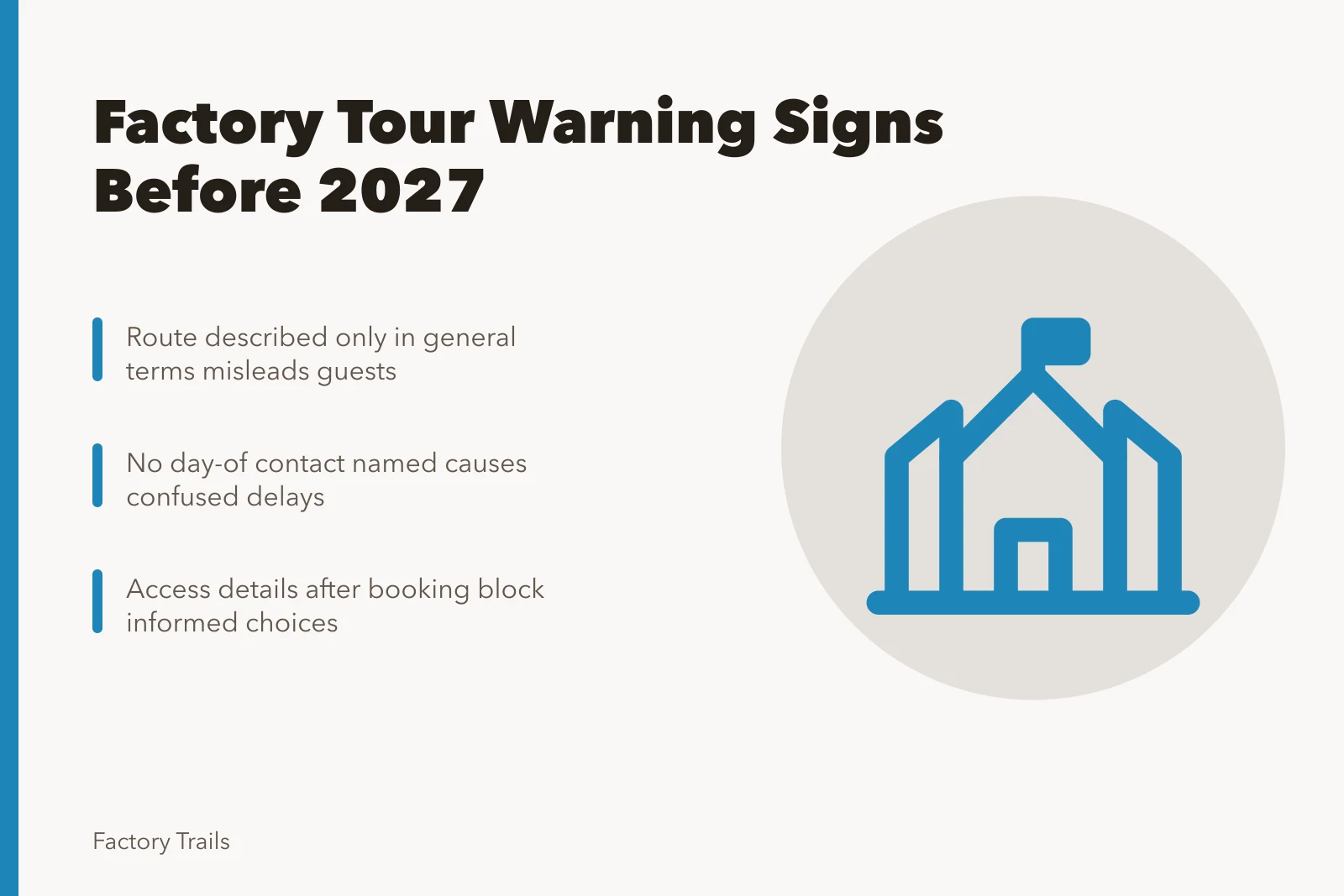
| Route is described only in general terms | Guests arrive with wrong expectations | Share the current route and likely limits |
| No day-of contact is named | Small changes become confused delays | Assign a lead and backup contact |
| Access details appear after booking | Visitors cannot make an informed choice | Put walking, stairs, noise, and alternatives in advance information |
| Photography rules are unclear | Privacy or operating boundaries are crossed | State the policy before entering the site |
| One closed stop ends the tour | The group loses the purpose of the visit | Prepare an approved alternate |
| Guide must improvise safety answers | Visitors receive inconsistent instructions | Confirm procedures with the responsible site lead |
The Occupational Safety and Health Administration exit-route standard requires routes and exits to remain recognizable and free from avoidable confusion. Walk the visitor route before each group and confirm exits are clear, then state the current condition in the pre-arrival message.
Warning Signs vs Better Responses
Warning sign
- Route described generally
- Share current route and limits
- No day-of contact
- Assign lead and backup contact
- Access details after booking
- Put walking, stairs, noise in advance
- Photography rules unclear
- State policy before entering site
- One closed stop ends tour
- Prepare an approved alternate
- Guide improvises safety answers
- Confirm procedures with site lead
Better response
- Route described generally
- No day-of contact
- Access details after booking
- Photography rules unclear
- One closed stop ends tour
- Guide improvises safety answers
If a route includes stairs, narrow paths, long distances, or a change from the main circulation path, check it in person and state the condition in advance. The U.S. Access Board guide to accessible routes describes how the ADA Standards address routes between arrival points, accessible entrances, and accessible spaces.
For a specific legal question, get qualified advice, then walk the route yourself and write down what guests will meet.
Do not confuse polish with readiness
A polished brochure cannot compensate for a route that has not been tested. Be cautious when a host cannot explain the current meeting point, the change process, group-size limit, or access options. These gaps often become visible only when the group arrives, when the cost of correcting them is higher.
Another warning sign is a safety rule that exists only in one employee's memory. Write visitor-facing requirements in short language, then confirm them against the site's current direction.
The Occupational Safety and Health Administration eye-and-face-protection standard addresses protective equipment for specified workplace hazards. It does not dictate visitor policy, but it is a useful reason to clarify which equipment is required, who supplies it, and what a guest should do if a question arises.
Watch the weather plan, too. A program that depends on an exposed yard or unconditioned room should have a stated response to high heat.
The National Weather Service heat-safety resource notes that heat can strain the body and affect some people more than others. The host can set a decision point, schedule breaks, or use an indoor alternative rather than waiting for discomfort to become a day-of argument.
Repair the process
Review the confirmation, route, briefing, and alternate with the people who will deliver the experience. Record the final version and date. If a question cannot be answered safely, remove the assumption and obtain the right answer before the next visit.
Use a short correction log. Include the date, problem, immediate response, person who approved it, document that changed, and date for a recheck. Do not bury the change in an email thread. A guide should be able to find the current version quickly, and an organizer should not receive instructions that staff already know are out of date.
For example, a correction log entry might look like this:
| Date | Problem | Immediate response | Approved by | Document changed | Recheck date |
|---|---|---|---|---|---|
| 2027-03-04 | Route sheet lists old meeting point | Send updated confirmation email to next two groups | Site lead | Confirmation email template | 2027-04-01 |
Common questions
Is a changing route always a warning sign?
No. Some active or weather-sensitive sites must change routes. The warning sign is failing to plan or communicate the change. A brewery that moves a tour from the packaging line to a storage area with no notice is a warning. One that sends a new route sheet 48 hours ahead is not.
What should visitors know before a tour?
They should know where to meet, what to expect physically, what is required, what may change, and how to ask practical questions. At minimum, they need the meeting point address, the physical demands (for example, stairs or noise), and the name and phone number of the day-of contact.
When should a host cancel or postpone?
Postpone when the route, conditions, staffing, or visitor controls cannot support a responsible experience under the site's current requirements. Set a lead time, such as 24 hours before the first group, and name the decision maker, for example the site safety lead.