Guides
How to keep working factory visit planning records without losing the trail
Working factory visit records for 2027 track five things: the session brief, the guest message, the route decision, the session note, and the follow-up list.
A working plant visit generates paperwork in three places at once: the site office, the tour operator, and whoever booked the coach. The file that survives is the one holding five documents and nothing else.
What to take away
- Five records cover a visitsession brief, guest message, route decision, session note, follow-up list.
- Write every decision as one dated sentence naming who confirmed it and what guests were told.
- Save the guest message exactly as sent, because it is the only proof of what visitors were promised.
- Keep visitor files away from safety, security and employee records; refer questions to the responsible system.
- At handoff, say which copy is current and who answers the open facility question.
The five records, and what each one is for
The five records
| Record | Minimum content |
|---|---|
| Session brief | Group, arrival window, host, approved route version, escalation contact |
| Guest message | Dated copy of directions, requirements and change contact, as sent |
| Route decision | Confirming role, date, visitor-facing result, approved alternative |
| Session note | Actual count, route walked, material change, unanswered question |
| Follow-up list | Issue, owner, due date, completion note |
Anything beyond these five belongs in the system that owns it. A plant's maintenance schedule, its confined-space procedures and its personnel files are not visitor records, and a tour file that accumulates them becomes a document nobody is allowed to read.
Five visitor records
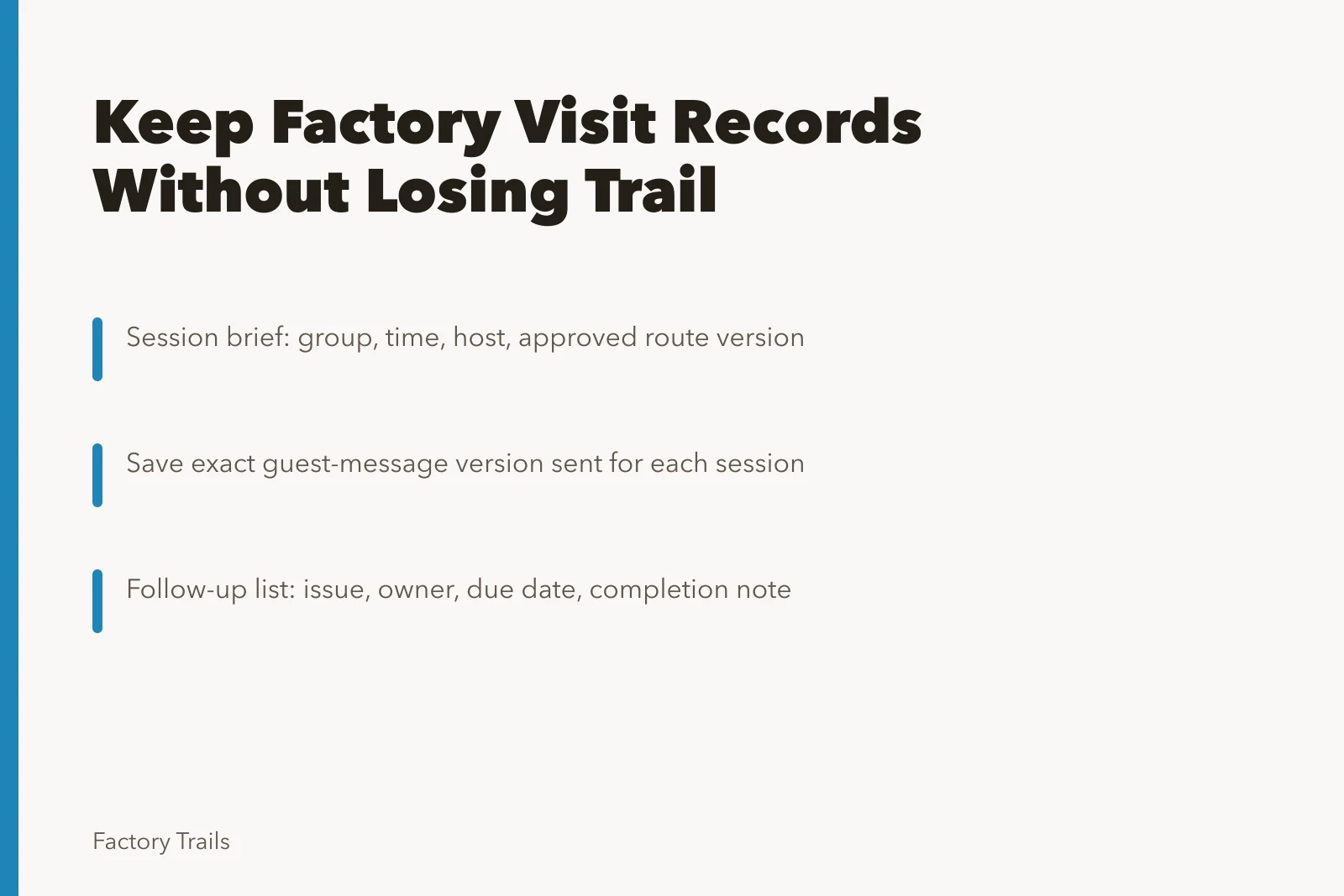
- Session briefgroup, arrival, host, route, escalation
- Guest messagedated directions, requirements, change contact
- Route decisionconfirming role, date, result, alternative
- Session noteactual count, route walked, changes, questions
- Follow-up listissue, owner, due date, completion note
The National Archives' records-management FAQ describes records management as systematic control of creation, maintenance, use and disposition. Federal guidance does not govern a factory visitor file, but the shape of the idea travels: a record has a purpose across its whole life, so somebody has to decide what stays and who may read it.
One sentence per decision
Write each decision as a single dated line naming the confirming role and the visitor-facing result. A worked example:
On 10 September the facility contact confirmed the standard route for the 14 September group, and the host will send message version 3.
That line answers four questions at once: when, who, what changed, and what guests will be told. When a decision changes, add a second line underneath. Never overwrite the first. The replaced line is the reason a later reader can tell why the route moved.
The records-management profile treats responsibility assignment as part of records work. Name the visitor-program owner for the file, then name the roles that confirm route, staffing and facility conditions. The owner keeps the visitor-facing record current. That is not authority over site operations, security or access, and the file should not imply otherwise.
Handoff, retention and the published message
When the coordinator changes, write a handoff note: where the file lives, which version is active, which questions are still open. A calendar entry does not carry that, and the incoming coordinator will otherwise rebuild the plan from memory.
The scheduling guidance explains that records schedules carry disposition instructions. Visitor files follow the operator's applicable retention requirements, not a period chosen for convenience. Keep the current plan and the versions behind live decisions available to the authorized team until that process applies.
Save the guest message exactly as sent. The web-records guidance makes the point that published content can itself be a record. When a direction or a route description has to be corrected, the sent version shows what visitors actually read, which is the only fair basis for a correction.
Naming sessions so the file stays findable
Label a session with the date, the group type and the approved format, and leave out personal detail the program does not need. Use the same label on the brief, the message and the follow-up note.
That convention lets an authorized reviewer pull the three records together and notice when a current message disagrees with the session result. It also makes the file legible to a plant contact who was not on the original call.
Common questions
How long should a visitor-program file be kept?
Follow the operator's applicable retention policy and the requirements that apply to it. Keep only what the program needs, then dispose of it through the approved process rather than leaving old versions in a shared drive.
What matters most after a route change?
Who confirmed the change, what guests were told, which alternative was walked, and who owns the follow-up. The route decision line and the session note together carry all four.
Should a visitor's personal request go in the session file?
Record only what is necessary and authorized for the program. Send personal or sensitive matters through the operator's own process, and refer any question about site access, safety or accessibility to the plant's safety officer and published visitor rules.