Reviews
Manufacturing museum options: questions to ask before you choose
Manufacturing museum option questions for 2027 help U.S. visitors choose collections, tours, preserved sites, demonstrations, and industrial routes by fit.
What to take away
- Five questions decide the choicewhat the public can do, whether the factory floor is included, how entry works, what the season closes, and which process or place you want explained.
- A manufacturing museum, a working plant tour, and a designated industrial route are three different products with different rules.
- Hershey's Chocolate World is a visitor center. The working factory is not open for public tours, and other brand attractions follow the same pattern.
- Pick this ifCarrie Blast Furnaces for structures, Corning for a live process, Lowell for process and place, Britannia for underground work.
Five questions to ask first
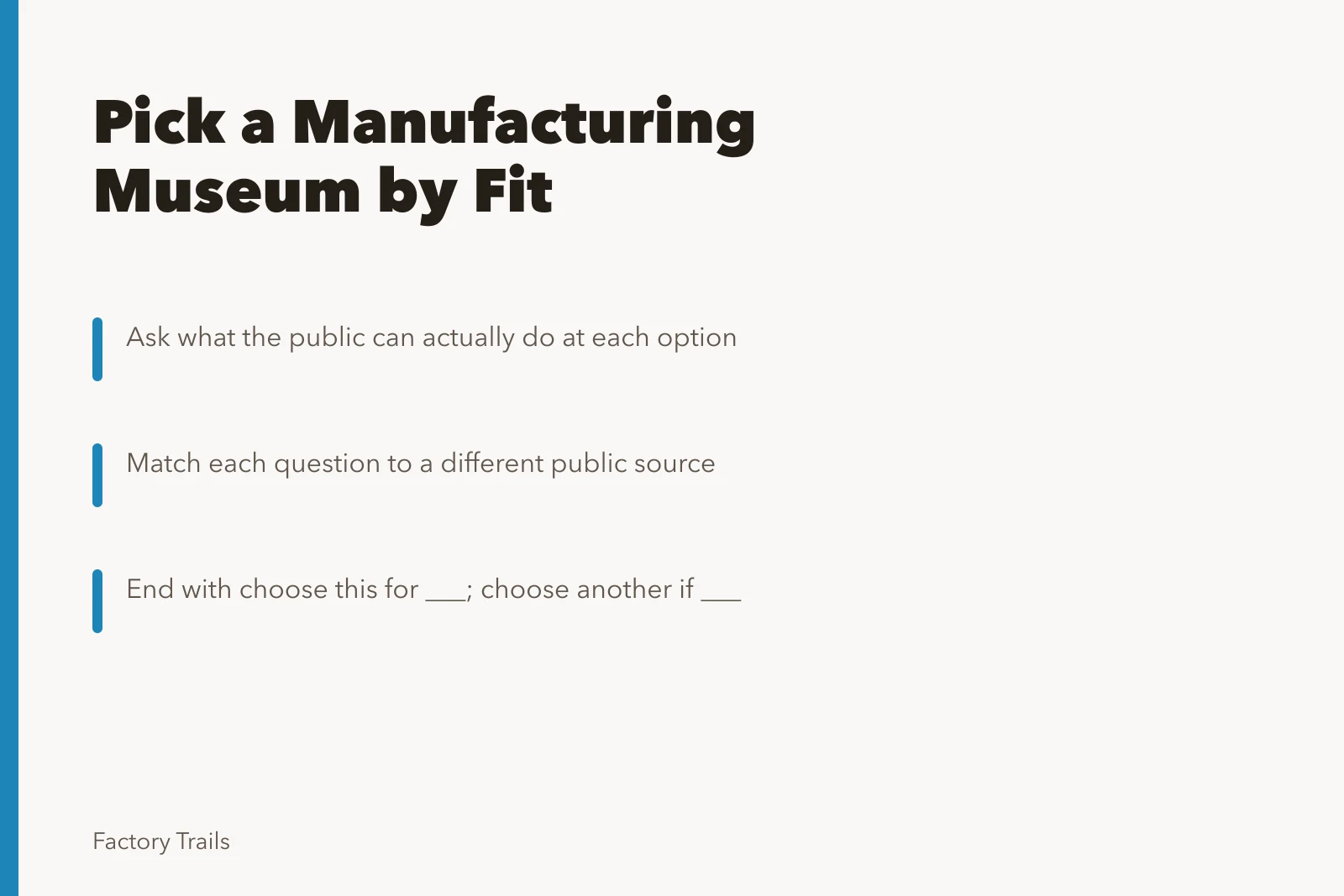
- What can the public actually do here? Objects, a running process, a walkable site, and a live demonstration are four different visits.
- Is the production floor part of the tour, or only the story of it? Brand visitor centers often sit beside a plant that stays closed.
- How does entry work? Free walk-in, timed ticket, guided slot, or booked group. That answer sets your planning window.
- What does the season change? Tours usually close before grounds do, and shuttle routes often stop first.
- Which process or place do you want explained? Steel, textiles, coins, glass, and beer point to different sites and guides.
[figure 1]
Questions to ask before choosing
- What public activity is offered?
- What industrial question can it answer?
- What is the current public boundary?
- What format is used?
- What must be checked for the date?
Question five is the one people skip. Britannia Mine Museum answers a clear process question with a guided underground mine train tour, and the booking steps for that tour show how timed entry changes the plan.
Named sites and the question each one answers
| Site | What a visitor can do | Question it settles |
|---|---|---|
| Lowell National Historical Park, Massachusetts | Exhibits, operating looms, a boarding house exhibit, canal and turbine exhibits | Can I watch a process run and see the town around it? |
| Sloss Furnaces, Birmingham, Alabama | Self-guided walk through a preserved blast furnace site | Can I stand inside the real structure? |
| Carrie Blast Furnaces, Rankin, Pennsylvania | Guided weekend tours of the Carrie furnaces | Can I get inside a furnace with a guide? |
| The Henry Ford and Rouge Factory Tour, Dearborn, Michigan | Museum and village collections plus a separate plant tour | Can I combine objects with a live plant? |
| Corning Museum of Glass, Corning, New York | Hot glass demonstrations, galleries, studio sessions | Can I watch a process and try it? |
| Hershey's Chocolate World, Hershey, Pennsylvania | Visitor center with a ride and exhibits, no public access to the working factory | Is this the factory, or the story of the factory? |
| Royal Canadian Mint, Winnipeg, Manitoba | Production tours in Winnipeg, boutique mint in Ottawa | Can I see coins being made? |
| Britannia Mine Museum, Britannia Beach, British Columbia | Guided underground mine train tour, timed entry, surface exhibits | Does the tour go underground? |
Lowell is a useful test case, because the park's own places to go guide separates exhibits, operating looms, a boarding house exhibit, and a turbine exhibit with different public terms. Hold other sites to that standard.
Pick the Rouge Factory Tour for a live assembly plant. Corning wins when one craft process matters more than scale. Lowell covers both, and Sloss or Carrie are for the structure itself.
Sloss is the headline industrial name in Alabama, but the state holds more, and the Alabama industrial heritage sites guide shows which ones fit a Birmingham trip.
Museum, mill tour, or industrial route
- A museum gives you objects, labels, climate control, and no schedule risk. It rarely shows a live line.
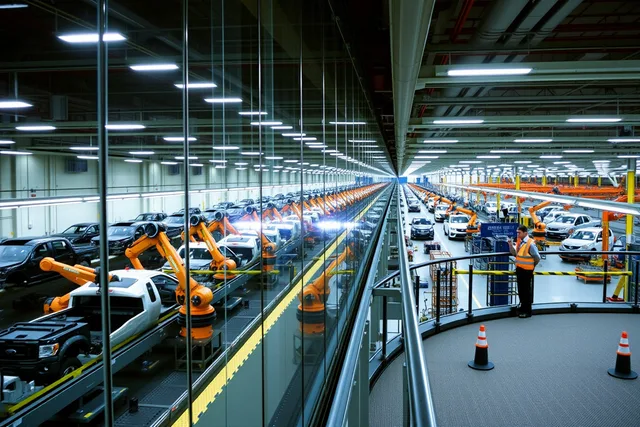
- A plant tour gives you a guide, running equipment, safety rules, fixed times, and usually no photography.
- A designated industrial route gives you buildings, river, rail, and housing on a mapped walk you set yourself. Interiors often stay closed.
Match the format to the question you wrote down. A route answers a place question. A museum answers an object question. Only a live tour answers a process question, and only on the days it runs.
Practical checks before you book
Hour, ticket, season, safety, and access are the five items to confirm before you fix a date.
- Hours and last entry, then the ticket type
- free, timed, guided, or group.
- Reservation window
- when slots release and whether same-day tickets exist.
- Seasonal closure
- tours, grounds, and shuttles close on different dates.
- Safety rules for live plants
- closed shoes, eye protection, no loose clothing, no photography.
- Access
- walking distance, stairs, elevators, and seating along the route.
For group bookings, choosing industrial tour providers before booking adds the screening steps that follow once the format is settled.
The Royal Canadian Mint runs production tours in Winnipeg and a boutique mint in Ottawa, and its visit page compares the two before you commit. Winnipeg production tours are seasonal, so treat four to six weeks ahead as a typical summer booking window and confirm release dates on that page.
The United States Mint has run public tours at Philadelphia and Denver, but those programs have opened and closed at different times. Check before you build a trip around one.
Hershey's Chocolate World has free admission, and its Wikipedia entry records that the working factory is not open for public tours. That gap between a brand attraction and a production floor is the check most visitors miss.