Guides
How manufacturing museums should keep owner hiring records usable
Manufacturing museum hiring records for 2027 help U.S. sites track scope versions, qualifications, approvals, deliverables, changes, and project closeout.
Keep a short hiring record for each provider project. It lets a manufacturing museum explain how a need was defined, which scope was reviewed, what was approved, and what documentation must stay with the collection or project file.
What to take away
- Preserve the scope version used for each proposal and decision.
- Record the provider's relevant role and documented deliverables.
- Separate internal technical records from approved public wording.
Hiring record fields
| Field | What it captures |
|---|---|
| Project need | The resource, decision, and known problem or visitor effect. |
| Scope version | The brief, date, assumptions, and exclusions reviewed by candidates. |
| Selection evidence | Relevant experience, references, proposal response, and rationale. |
| Approval | Who authorized work, changes, acceptance, and public communication. |
| Deliverables | Reports, condition notes, source files, images, records, or recommendations. |
| Change log | New evidence, revised scope, decision, and effect on schedule or cost. |
| Closeout | Final acceptance, unresolved work, and next review date. |
The Smithsonian overview of collections-management work describes roles that include policies, recordkeeping, care, storage, accessibility, and automated collection-management systems. That range shows why a hiring record matters: technical work needs a traceable connection to the collection and to the people responsible for its continued care.
Hiring record fields
- Project needresource, decision, problem
- Scope versionbrief, date, assumptions
- Selection evidenceexperience, references, rationale
- Approvalwho authorized work, changes
- Deliverablesreports, notes, files, images
- Change logevidence, scope, schedule, cost
- Closeoutacceptance, unresolved work, review date
Filled example entries for one project, illustrative only.
| Field | Example entry |
|---|---|
| Project need | Pump seal leaks; water reaches the visitor walkway. Reported 2027-02-10. |
| Scope version | Scope_v2, dated 2027-03-04. Covers seal replacement. Excludes repainting. |
| Selection evidence | Two proposals. The chosen firm cites two similar pump restorations and two references. |
| Approval | Director of collections approved Scope_v2 on 2027-03-11. |
| Deliverables | Condition report, parts list, seal replacement note, 12 photographs. |
| Change log | 2027-04-02: corrosion found. Scope extended. Director of collections approved. |
| Closeout | Accepted 2027-05-20. Repainting deferred. Next review 2028-05-20. |
Ownership and approval belong in the record. The registrar or collections manager owns the hiring record file and keeps the index. The project lead writes the entries. The director of collections or the executive director approves the scope, any change that affects the object, and the public wording. Record the approver's name and date in the approval row.
Keep records usable
Use factual labels. Write "condition assessment requested" instead of claiming treatment occurred. Write "public copy approved" only after the director of collections has approved it. Store confidential proposals, security details, and sensitive collection information according to the museum's own rules, not in public articles.
Give the file a retention period from the museum's records schedule. A typical schedule keeps hiring and project files for seven to ten years after the engagement closes. Records tied to an accessioned object usually stay for as long as the object is in the collection. Where no schedule exists, set the period in writing before work starts.
The National Park Service Museum Handbook treats documentation and accountability as connected collections-management duties. It does not prescribe a private provider file. It supports retaining the scope, decision rationale, deliverables, and change record in a form that a museum can locate and review after staff change.
The National Archives' records-management fundamentals, the Records Management 101 training module, explain why organizations preserve information that documents their actions. A museum engagement should similarly identify the current file, decision owner, approval date, and source of a change rather than relying on informal email chains.
The Smithsonian Institution Archives describes conservation services as distinct activities such as examination, treatment, and preservation-management consulting. That supports using precise record labels. A request, recommendation, and completed treatment are different events and should not be recorded as though they mean the same thing.
Make the record findable during ordinary work. Use a stable project identifier in the scope, provider correspondence, deliverables, approval note, and change log. Store a short index beside the files that identifies the current version and next review date.
Name each file with the identifier, the record type, and the date, for example PRJ-2027-014_scope_v2_2027-03-04.pdf. Common choices for long-term storage are PDF/A for text records, CSV for tables, and TIFF for master images.
When a visitor-facing statement is approved, record the exact wording and where it appears. It gives the museum a controlled way to check whether a public claim matches the project record before staff repeat it in a newsletter, event page, or conversation.
Closeout and handoff
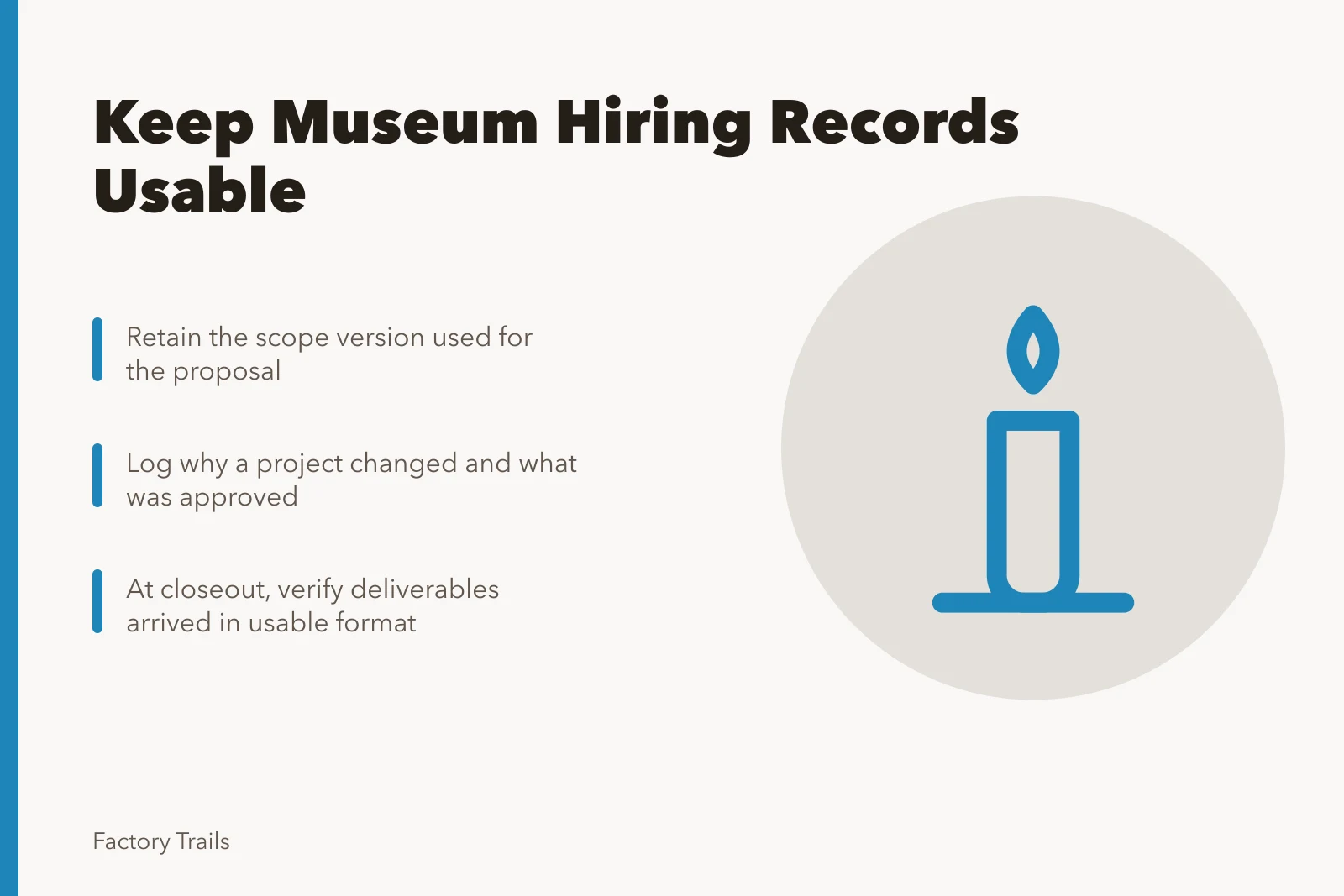
At closeout, verify that all contracted deliverables were received in a format the museum can use. Record any future maintenance, research, or communications task separately. This prevents a completed assessment from being mistaken for a completed repair or a published article from being mistaken for a technical report.
Write a short handoff note: what was completed, what was not, where the final records are stored, and who owns the next review.
Verify that the museum received the agreed report or record, the file format is usable, the scope and approval versions are filed, and any limitation is visible. Identify confidential information that should stay inside the project file.
Assign one review date for unresolved items so they do not disappear when the provider engagement closes. Name the staff member responsible for the next research, maintenance, review, or visitor update.
A clear handoff does not guarantee a project has solved every problem. It ensures the museum knows what it received, what it still needs, and where an informed next decision can begin.
Common questions
What document should be retained first?
Retain the scope version that the provider used to prepare the response.
Why keep a change log?
It shows why a project changed and prevents a later reader from confusing the original plan with approved work.
What belongs in public content?
Only the approved visitor-relevant effect, not internal proposals, security details, or technical records.