Guides
Manufacturing museum provider selection: a scope checklist before you hire
Manufacturing museum hiring checklist for 2027 helps U.S. sites define scope, check relevant expertise, compare deliverables, document safeguards, and approve work.
Use this checklist before requesting help with a manufacturing museum project. It keeps the search focused on the work that needs to be done, the expertise required, and the record the museum needs at the end.
What to take away
- Define the resource and desired decision before looking for a provider.
- Check experience against the relevant material or work type.
- Put scope, deliverables, approvals, and public effects in writing.
Hiring checklist
| Check | Record |
|---|---|
| Resource | Object, machine, archive, building area, exhibit, route, or article. |
| Problem | Observed condition, visitor need, research question, or communications task. |
| Required expertise | The relevant conservation, collections, facilities, exhibit, research, or content role. |
| Evidence | Records, current sources, images, reports, and access information available. |
| Deliverable | Assessment, recommendation, treatment proposal, report, design, copy, or other output. |
| Authority | Who can approve scope, changes, public messages, and final acceptance. |
| Review point | When the museum will assess progress and possible changes. |
| Filled-in example | Resource: a stationary steam engine in the pump house. Problem: active corrosion on the frame. Expertise: a metals conservator. Deliverable: a condition report and a treatment proposal. Authority: the collections manager. Review point: when the condition report arrives. |
Before contacting a provider, complete the checklist with the person responsible for the collection or project. Flag questions that require qualified advice instead of trying to solve them with a generic request for proposal. This makes the first conversation more useful and reduces avoidable scope changes later.
The NPS curation guidance says that agencies should consult people with appropriate collections-management and preservation expertise before preparing a scope of work or request for proposals for curatorial services. The rule binds federal agencies, but the principle holds anywhere: get technical input before you define work that depends on it.
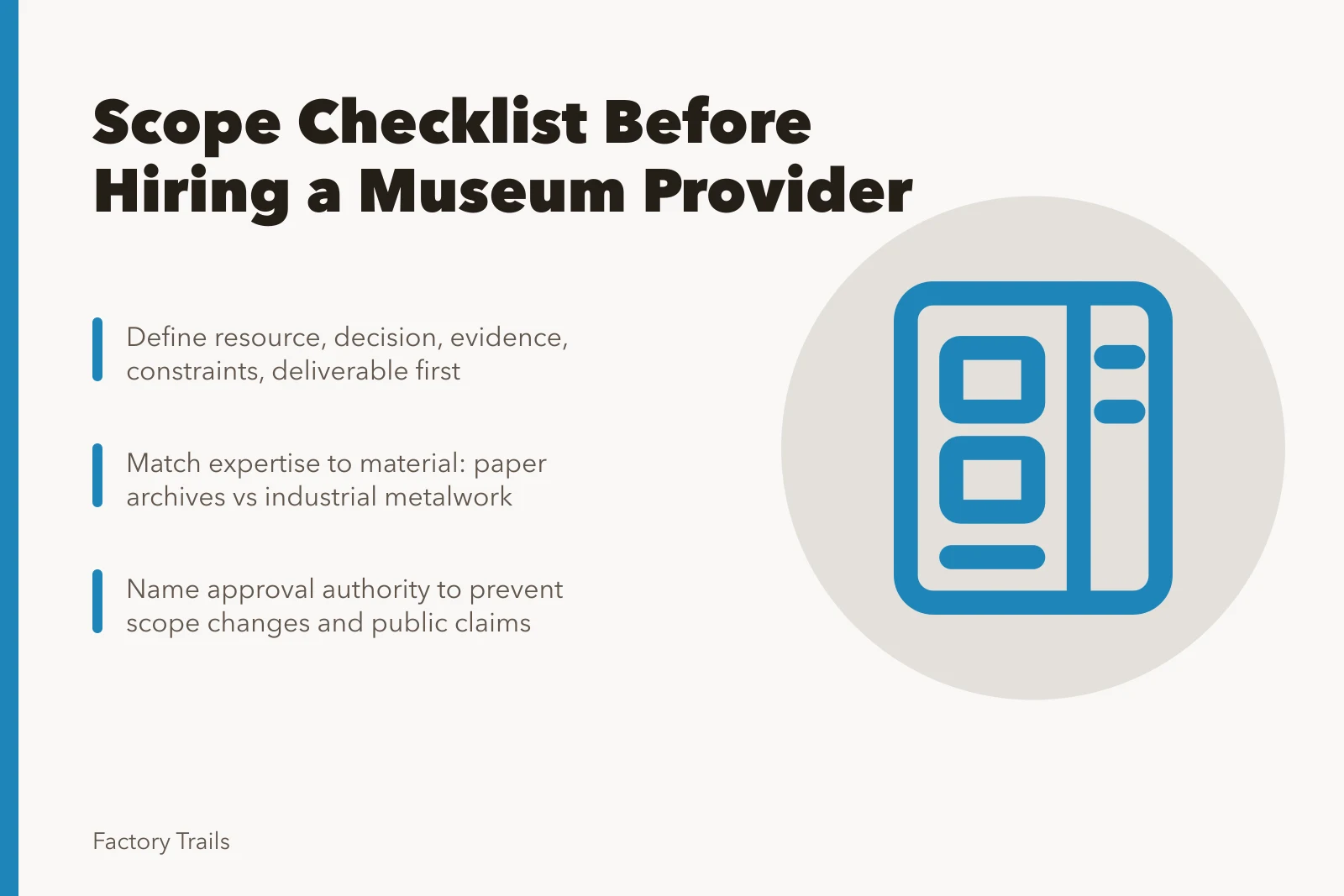
Scope Checklist Before Hiring
- Resourceobject, machine, archive, building area, exhibit
- Problemcondition, visitor need, research question
- Required expertiseconservation, collections, facilities, exhibit
- Evidencerecords, sources, images, reports, access
- Deliverableassessment, recommendation, treatment proposal, report
- Authoritywho approves scope, changes, messages
- Review pointwhen progress and changes assessed
Check the fit, not only the title
Ask candidates about their direct experience with the materials, setting, and task in the scope. A person who is excellent with paper archives may not be the right fit for industrial metalwork. A facilities specialist may understand building access but not object treatment. A content provider may explain a completed project but should not diagnose a collection.
Provider types to weigh include metals and paper conservators, industrial archaeologists, collections-management consultants, historic-structures engineers, exhibit designers, mount makers, and riggers.
Compare each response against the same checklist. This makes it easier to identify a genuine gap, request clarification, or bring in another appropriate professional.
Beyond the checklist, compare candidates on:
- Direct experience with the same material, machine class, or archive type.
- References from two comparable projects, with contact details.
- The named staff who will do the work, not only the person who bids.
- Lab, workshop, or equipment access, and any work to be subcontracted.
- Insurance, safety training, and site-access requirements.
- Deliverable format, including records the museum can reuse.
- A price broken out by phase, with travel and lab fees listed.
The Smithsonian Institution Archives describes conservation work as condition examination, treatment, and preservation-management consulting. Those are different services, so a proposal should name which one it covers. The archives do not rank providers.
The National Park Service Museum Handbook treats documentation and accountability as core elements of collections management. Keep the scope, qualifications review, proposal, decision rationale, and change log together in one file.
The National Archives' records-management fundamentals describe the need for recorded information that documents decisions. Date each version and name one decision owner, so later staff can see the basis for the scope and approval.
Create a short selection record after the comparison. State the project question, scope version, candidates considered, evidence relevant to the decision, conditions attached to the selection, and next review date.
Do not use the record to declare that a provider is generally best. It should explain why a defined provider fit a defined task at a particular point in time.
If the museum receives new evidence or changes the deliverable, review the selection against the revised scope. This method keeps a legitimate change from looking like an unexplained reversal and gives future staff a reliable starting point for the next engagement.
Schedule the review before work begins. At that point, compare the active scope with the initial request, check that required records are arriving, and confirm that any proposed public message reflects an approved fact.
If conditions changed, make a documented decision to continue, revise, pause, or obtain another opinion. This small cycle keeps the checklist alive after selection and prevents the project file from becoming a static pre-contract document.
Budget and timeline
Few providers publish rates, and quoted figures vary too widely to give one reliable number. What you can control is the shape of the estimate. Ask each candidate for a price split by phase: assessment, treatment or design, documentation, and travel.
List excluded costs in writing, such as lab fees, shipping, rigging, and permits. Treat any figure given before the scope is fixed as provisional. Add a contingency line for findings that change the work, and agree who approves it.
Timing works the same way. Ask for working days per phase, the earliest start date, and when records and drafts will arrive. Tie the review point in the checklist to a calendar date, not a project stage.
Common questions
What should be defined before contacting a provider?
Define the resource, decision, known evidence, constraints, and required deliverable.
Why name an approval authority?
It prevents scope changes and public claims from being made without the museum's review.
Can one checklist fit every project?
It provides a starting structure, but the expertise and safeguards must fit the particular resource and task.