Guides
How manufacturing museums can keep care records defensible
Manufacturing museum care records for 2027 help U.S. sites track observations, approvals, sources, public effects, maintenance, and next review dates.
Good care records let a museum explain what it knows, what it decided, and what must be reviewed next. They also prevent a common publishing mistake: treating an old project note as a current statement about an object, gallery, machine, or visitor program.
The 2027 in this guide's address marks the edition. Nothing in the record format changes on that date. The review date inside each record is what sets the work.
What to take away
- Keep approval, source, public effect, and review date with each open item.
- Use records to support accuracy, not to expose sensitive security or emergency details.
- Store records where the next editor can find them.
Core care record
| Field | Purpose | Example |
|---|---|---|
| Item or area | Identifies the object, equipment, exhibit, building zone, or route. | Line shaft bay, Building 2, public walkway |
| Observation | States what was seen and when. | Flaking paint on a guardrail, seen 12 March 2026 |
| Evidence | Relevant approved photograph, report, monitor reading, or source. | Photo IMG-2026-0312-04; facilities paint note |
| Decision | Monitoring, temporary control, assessment, approved work, or closure. | Barrier in place; repaint after assessment |
| Responsible role | Names the accountable function, not necessarily a public contact. | Collections care lead |
| Visitor effect | States any confirmed change to access or programming. | Walkway open; guided route unchanged |
| Review date | Keeps deferred and active work visible. | 15 September 2026 |
The NPS Conserve O Grams index describes its leaflets as focused guidance on museum collections care, including procedures, techniques, and materials. A record should be just as focused: enough information to connect a condition to a decision, without a broad narrative that hides the next action.
Core Care Record Fields
- Item or area identified
- Observationwhat and when
- Evidencephoto, report, reading
- Decisionmonitor, control, assess, close
- Responsible role named
- Visitor effect confirmed
- Review date visible
A small museum can keep these fields in PastPerfect Museum Software, CatalogIt, or a shared spreadsheet with one row per record. The tool matters less than the fields and the review date.
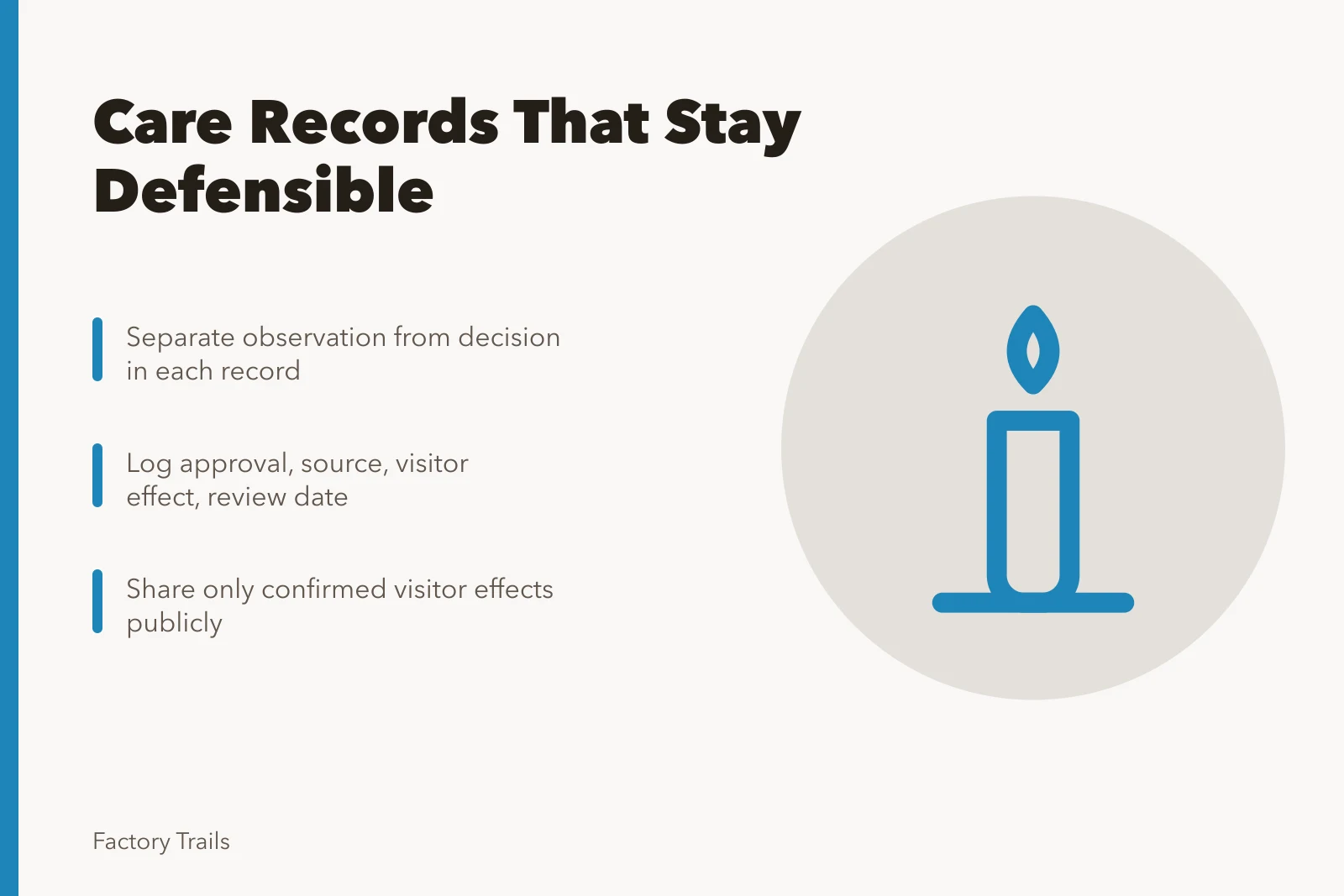
Keep the record defensible
Use neutral wording for observations. Write "corrosion visible on metal surface" only if that is what the responsible observer recorded. Do not turn that into a claim about a cause, threat level, or treatment method without supporting assessment. Put those later conclusions in their own dated field with the authority for the decision.
For public content, pull only the confirmed visitor effect. A maintenance record may include details that should remain internal, especially security, emergency, or collection-location information. A public notice can state a gallery closure or changed program without disclosing sensitive operational details.
The Smithsonian Museum Conservation Institute's collections-care guidance explains that preventive care reduces risks to collections. Takeaway: cite it for preventive care, not for an object-level record.
The National Archives' records-management fundamentals explain the value of records that document actions. For visitor content, retain the source, check date, revised sentence, and future review date when a care item changes a public claim. A typical small-museum schedule reviews stable exhibits every 12 months and active repair or construction zones every 3 months.
The National Park Service Museum Handbook page describes professional museum reference material. Takeaway: use Part II, Museum Records, for record types and retention; it does not prescribe a public record system.
The American Alliance of Museums' National Standards and Best Practices for U.S. Museums expects a written collections management policy covering documentation and records. Approval authority and retention periods come from that policy, not from the public page.
Keeping public pages in sync with the record
The next editor should be able to see what changed without inferring technical facts. Identify the item or area, the public statement affected, the source reviewed, and the date for another check. Keep names, security details, and private correspondence outside public copy.
If the article has a commercial placement, record that relationship separately. It must not change the factual standard for an access, route, program, or care statement.
Update the caption, the summary line, and the body from the same record and the same date. For the walkway record, all three carry the same check date: "Walkway open as of 15 September 2026."
A record remains valuable even when no wording changes. It shows that the claim was checked instead of silently carried forward from an older draft.
Use a single record for one public claim, then create a new dated entry if the condition changes. This keeps the history clear and prevents an updated access note from being confused with an older program or route statement.
Close the record only after all public surfaces agree. A page can still mislead if a caption, metadata summary, or scheduled promotional text repeats the prior condition.
For future work, make the review date visible in the record so planned updates start with verified facts rather than assumptions.
This small discipline makes older articles easier to maintain without recreating the original research.
It also protects readers from a stale access claim.
Common questions
Should every record be public?
No. Share only confirmed visitor information and protect sensitive collection, security, and emergency details.
When can a care record be closed?
Close it when the planned review or approved work is documented and any required follow-up is assigned.
Keep the closure date with the record so future staff can distinguish completed work from an item that was merely deferred.