Guides
How to keep a clean industrial tour record from first inquiry to closeout
Industrial tour provider records for 2027 help U.S. operators retain scope, approvals, route changes, contacts, invoices, and post-visit notes in one usable file.
What to take away
- Keep one current provider file that explains the assignment, authority, route assumptions, and results.
- Store approvals and changes where the operator can retrieve them before the next tour.
- Use closeout notes to improve the next assignment rather than merely closing an invoice.
Open the record before selection
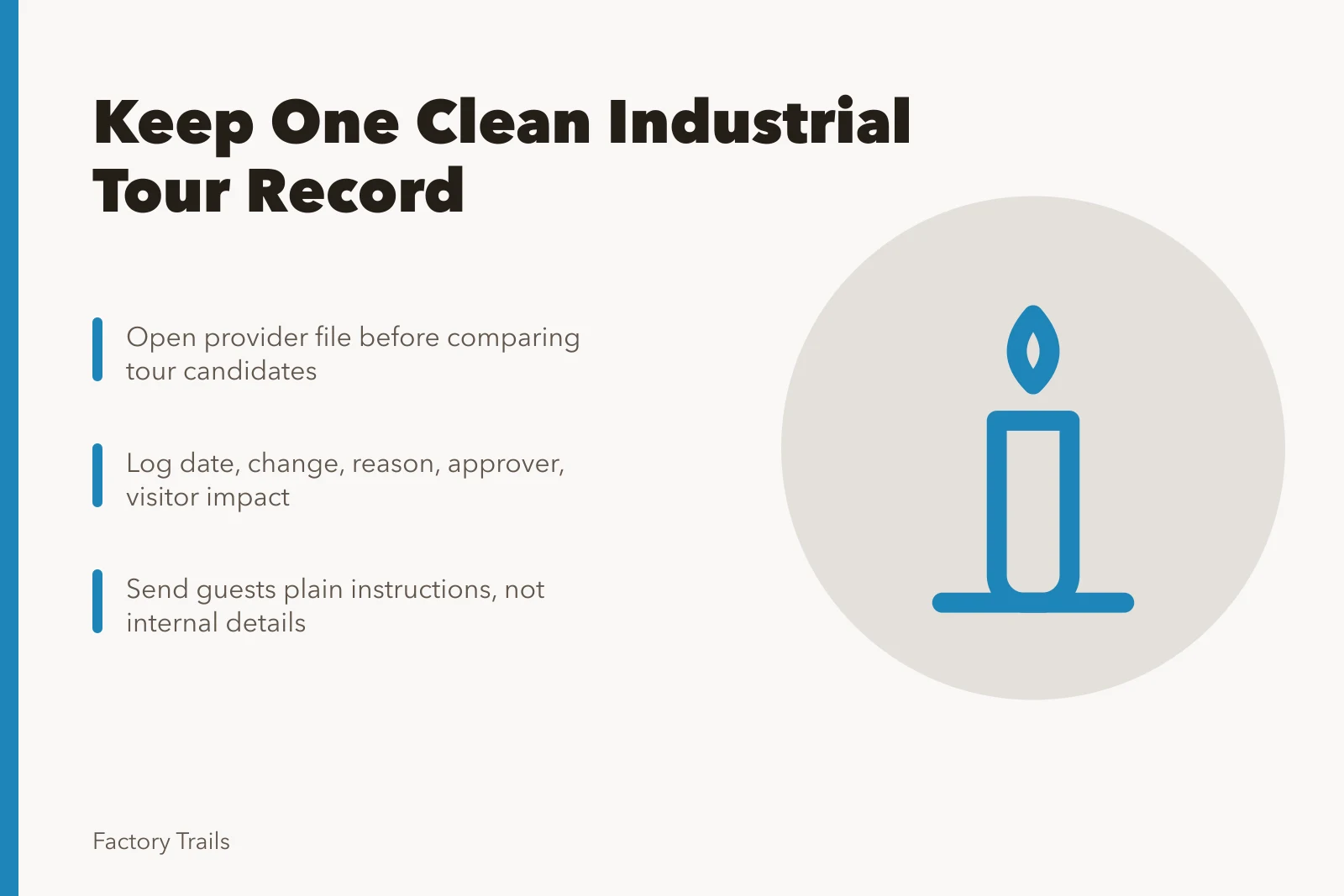
Provider records are operational tools. They explain what was agreed, who could change it, and whether the delivered visit matched the plan. Open the file when the operator starts comparing candidates, not after a missed handoff or disputed invoice. Keep the inquiry, route information, proposal, selection note, scope, current contacts, and post-visit report together or clearly cross-referenced.
The file should answer a basic question for a new staff member: what is this provider meant to do on this route, and what remains under site control? If the record cannot answer that question quickly, it is not ready for a live program.
| Record | Include | Why it matters |
|---|
Provider record contents
- Assignment sheetsite, route, group, dates
- Selection noteoptions and reason
- Scope and contactsauthority, approval path
- Route updatedate, change, owner
- Financial recordquote, changes, invoice
- Closeout notedelivery, issues, improvements
Keep the current version easy to find. An archive is useful only if it does not hide the route instructions and contact list staff need today.
Write factual route assumptions
Provider files should record facts rather than impressions. State the public entrance, meeting point, anticipated route, restricted areas, group limit, physical demands, available alternate, and who confirms same-day conditions. Do not write that a route is "easy" or "fully accessible" unless the site has supplied a specific basis for that language.
Factual route assumptions
- Public entrance and meeting point
- Anticipated route and restricted areas
- Group limit and physical demands
- Available alternate route
- Who confirms same-day conditions
- Stable names for doors and areas
The National Archives records-management FAQ describes records management as controlling the creation, maintenance, use, and disposition of records. The point for a tour operator is practical: create the record for a purpose, keep it current while it is used, and follow the organization's retention rules when the assignment ends.
Use stable names for route segments, doors, loading areas, and contacts. "North visitor entrance" is clearer than "side door." A date on each change gives staff a way to distinguish the current instruction from an old one.
Preserve approvals and scope changes
Tour conditions can change after selection. A production boundary can move, an entry can be closed, a group can grow, or a weather plan can move an outdoor stop. Record the change before it is implemented when time permits. If an immediate response is required, record the facts as soon as the group is settled.
Use a short change entry:
Change entry steps
- Date and time of change
- What route, group, cost changed
- Why it changed
- Who approved the response
- What visitors and staff were told
- What follow-up remains
This is enough to protect continuity. It also prevents a temporary workaround from becoming an undocumented normal practice.
The Internal Revenue Service recordkeeping guidance says good records can help monitor a business, prepare financial statements, identify sources of receipts, and track expenses. Keep the provider's operational change record next to the financial approval so the invoice can be understood in context.
Separate public messages from the internal file
Visitors need plain, practical instructions. If an entrance changes, tell them where to go. If the route shortens, explain the physical effect and the alternate experience. If arrival timing changes, name the new time and contact. Do not send guests internal discussion about staffing, contracts, or site operations.
The provider record can include more detail, such as the site contact who approved a closure, a route photo reference, and the invoice effect. Put personal information and private contact details in the approved internal system, not in a public document or shared visitor list.
For weather-related changes, retain the condition observed, the site decision, the visitor message, and whether the alternate succeeded. The National Weather Service heat-safety resource provides practical material on heat risk. It supports clear preparedness documentation for an outdoor program, but it does not replace the host's weather and safety procedures.
Establish ownership and review dates
Every file needs a current owner. That person does not have to perform every task, but they must know who updates route information, approves provider scope, sends visitor notices, reviews invoices, and archives completed records. Add a "next review" date to the active document.
The Small Business Administration information-quality page addresses the quality of information the agency disseminates. Its broader lesson applies to operational records: information needs an owner, a standard for correction, and a way to distinguish current material from superseded material. Use version dates and do not rely on an undated attachment.
Close out with an operating note
After a tour or a defined run of tours, write a short closeout note. Compare the planned and actual route, staffing, guest count, timing, changes, visitor questions, approved additional cost, and follow-up needs. Do not turn the note into a performance essay. Record what a future operator needs to know.
| Closeout question | Useful response |
|---|---|
| Did the provider deliver the scope? | Note the complete work and any exception |
| Did the route work as expected? | Identify a physical or scheduling change |
| Did visitors receive current instructions? | State message used and any confusion reported |
| What must happen before next use? | Name owner and deadline |
Review unresolved items before contracting the provider again. A history of well-documented changes can support a repeat engagement. A history of unresolved ambiguity is a reason to revise the assignment first.
Common questions
How long should provider records be kept?
Follow the operator's retention policy and applicable obligations. Keep active route, approval, and financial records available for as long as they are needed to operate and review the assignment.
Who should update the current contact list?
Assign one program or operations role to maintain it, with site contacts confirming changes that affect access, authority, or visitor instructions.
Should a cancelled tour get a closeout note?
Yes, when the cancellation involved a provider, route decision, visitor message, or cost. The note helps the operator handle a similar situation later.