Guides
How to build an industrial tour cost checklist before you set a price
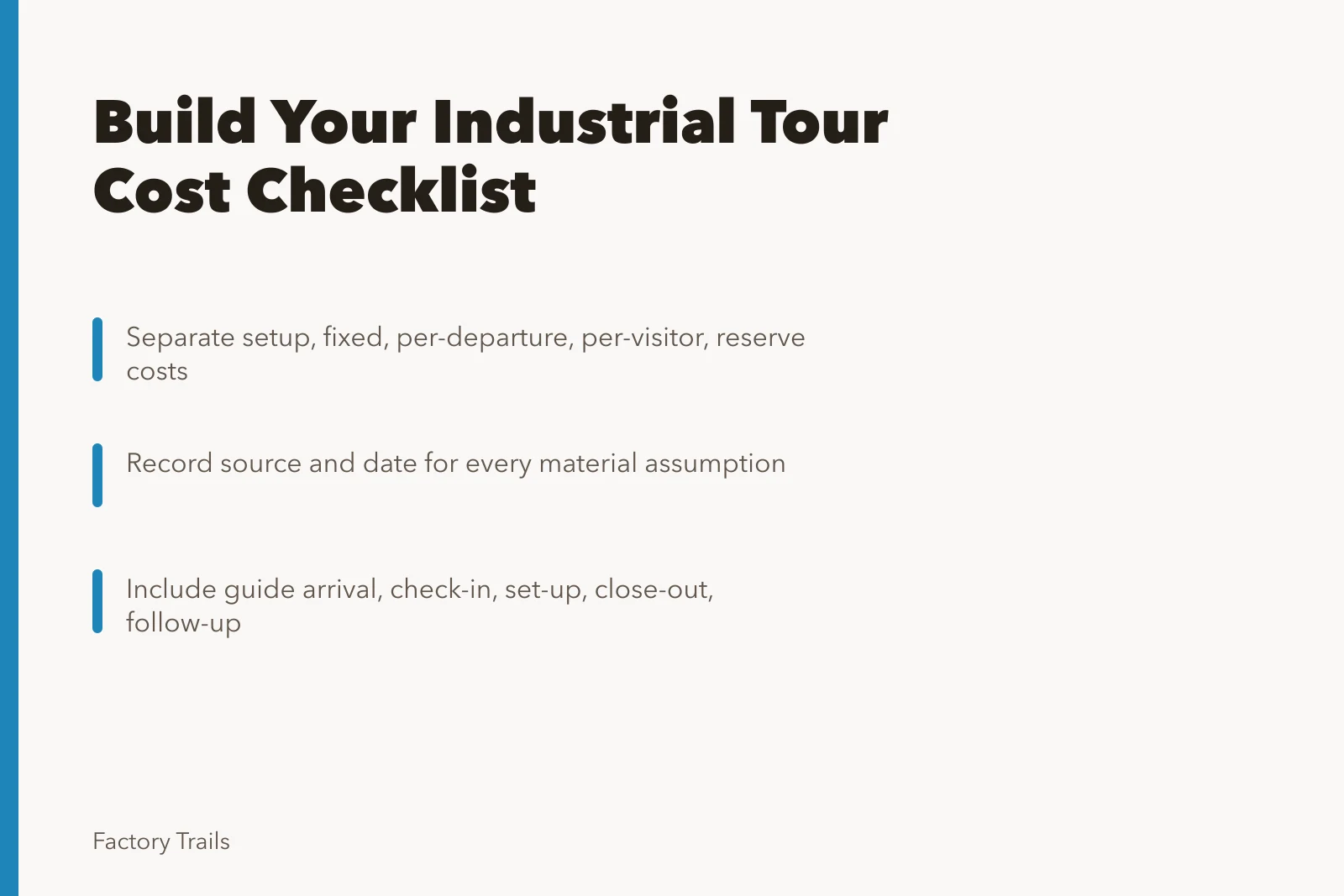
An industrial tour cost checklist separates setup, fixed, departure, visitor and reserve costs, and records the source document behind each number.
What to take away
- Every cost line needs a proof typeinvoice, signed quote, contract, time log, published fee, or a labelled estimate.
- A final status column (confirmed, estimated, pending, no longer applicable) tells the pricing lead which numbers can still move.
- Staff hours run from arrival to close-out, not from the first guest to the last.
- Route changes carry their own cost: extra escort, different coach timing, a paused departure.
- A pending insurance certificate or site fee can decide whether the departure happens at all.
A plant tour is priced before anyone walks the route. The checklist below records what each number is, who can confirm it, and what document backs it.
Cost lines and their proof types
| Cost line | Proof type | Renewed when |
|---|---|---|
| Route research and testing | Time log | Route changes |
| Guide training | Time log, wage record | Guide roster changes |
| Site access fee | Signed agreement | Contract term ends |
| Insurance certificate | Policy document | Annual renewal |
| Coach and transport | Dated quote | Fuel or schedule change |
| Entry fees, headsets, print | Invoice or published fee | Vendor price change |
| Contributed partner labour | Written note of hours | Partner staffing changes |
| Weather and cancellation plan | Priced alternate | Season start |
An estimate is fine during planning if the cell says "estimate" and carries a date. An unlabelled number is the one that misleads a quote.
Cost Lines and Proof Types
- Route research and testingtime log
- Guide trainingtime log, wage record
- Site access feesigned agreement
- Insurance certificatepolicy document
- Coach and transportdated quote
- Entry fees, headsets, printinvoice or published fee
- Contributed partner labourwritten note of hours
Five-step review sequence
- Confirm tested group capacity for the route.
- List every cost needed to run that route once.
- Mark each line fixed, variable, mixed, or contingent.
- Compare expected revenue against the documented cost model.
- After the pilot, revise only the assumption that actually changed.
The Small Business Administration glossary defines break-even as the approximate sales volume needed to cover costs, and separates fixed from variable. That distinction is the whole point of step three: launch work happens once, departure costs repeat.
Five-Step Review Sequence
- Confirm tested group capacity for the route
- List every cost to run route once
- Mark each line fixed, variable, mixed, contingent
- Compare expected revenue against documented cost model
- After pilot, revise only changed assumption
Count staff work from arrival to close-out
Tour minutes are the smallest part of a guide's day. Arrival, check-in, set-up and guest handoff all consume paid hours. Close-out and follow-up also consume paid hours. A partner who contributes that time has contributed a real cost. Record it as contributed work with hours attached, so the next operator reading the file sees the full resource requirement.
The U.S. Access Board guide to accessible routes explains how routes connect accessible spaces and elements. It sets no price, but it is a reason to write down the actual arrival and movement arrangements rather than treat access work as free.
Keep the proof beside the number
The Internal Revenue Service recordkeeping page says businesses should retain records supporting income and expenses. It prescribes no visitor-program spreadsheet, but it supports keeping the quote, invoice, agreement or time record instead of rebuilding a cost source months later.
Name the person who can confirm each cost and the document that supports it. A site fee needs a current agreement, a guide cost needs a time record, a route change needs a revised quote. When a figure moves, keep the earlier figure and its date so the difference can be explained at the next pricing review.
Worked example: a route change
A plant closes a stair for maintenance and the tour must use a longer ground-level path. Three things change at once.
The route takes twenty extra minutes, so guide hours rise. The group now crosses an active yard, so the site's escort ratio may require a second staff member.
The coach pickup window shifts, and the transport quote was written for the original window.
None of those numbers can be invented here. Each one comes from the plant's own visitor rules, the transport provider's current quote, and the site agreement. What the checklist does is force all three onto one page before the new price is announced.
Status column and close-out
Give every line a status: confirmed, estimated, pending, or no longer applicable. Then run the close-out questions.
Has the route been tested at the intended group size? Does each vendor quote show a date and the service it includes? Have guide hours been counted from arrival through close-out?
Is the alternate plan priced? Are site fees and commission terms confirmed in writing? Does the price statement say what is included?
The Occupational Safety and Health Administration's exit-route guidance requires exit routes to stay unobstructed in covered workplaces. It is not a cost formula, but it is a prompt to price the alternate path. A blocked or rerouted exit can mean extra staff, different timing, or a paused departure.
Assign a person and a date to every pending line before the checklist leaves your hands. A pending insurance certificate is not clerical noise. It decides whether the departure is possible and whether the advertised price is honest. The operator basics checklist covers the rest of the launch sequence once the cost model holds.
Common questions
Should the checklist include taxes?
Record taxes, fees and commissions wherever they change what the operator collects or pays. Tax treatment varies by jurisdiction, so confirm it with a qualified professional rather than a general rule.
How often should cost sources be renewed?
Renew before each season and whenever a vendor, route, agreement or group capacity changes. A dated quote that predates a route change is no longer a source.
What is a reserve for?
A reserve covers documented disruption risks, such as a weather alternate or a substitute guide. It is a named cost line, not a cushion folded into the ticket price.