Guides
Industrial tour case study warning signs: check the record before the narrative
Industrial tour case study warning signs for 2027 help U.S. operators catch weak evidence, undefined scope, unsupported claims, and unreviewed site details.
What to take away
- A case study becomes unreliable when its question, evidence, and conclusion do not match.
- Missing context can make an honest observation look like a general rule.
- Treat a partner's factual correction as valuable, but keep analysis independent.
Case studies are useful because they make a real operating decision visible. They lose value when the record is vague, the evidence is selected only to support a preferred story, or the conclusion is larger than the event described. The following signs are reasons to pause and repair the method before publishing.
Most warning signs can be corrected without abandoning the project. The fix starts with a plain question: what did the team observe, what does it think the observation means, and what can it fairly say in public? If those three answers are blurred together, the article needs more work before a reader sees it.
Red flags to investigate
| Warning sign | Why it weakens the study | Repair |
|---|---|---|
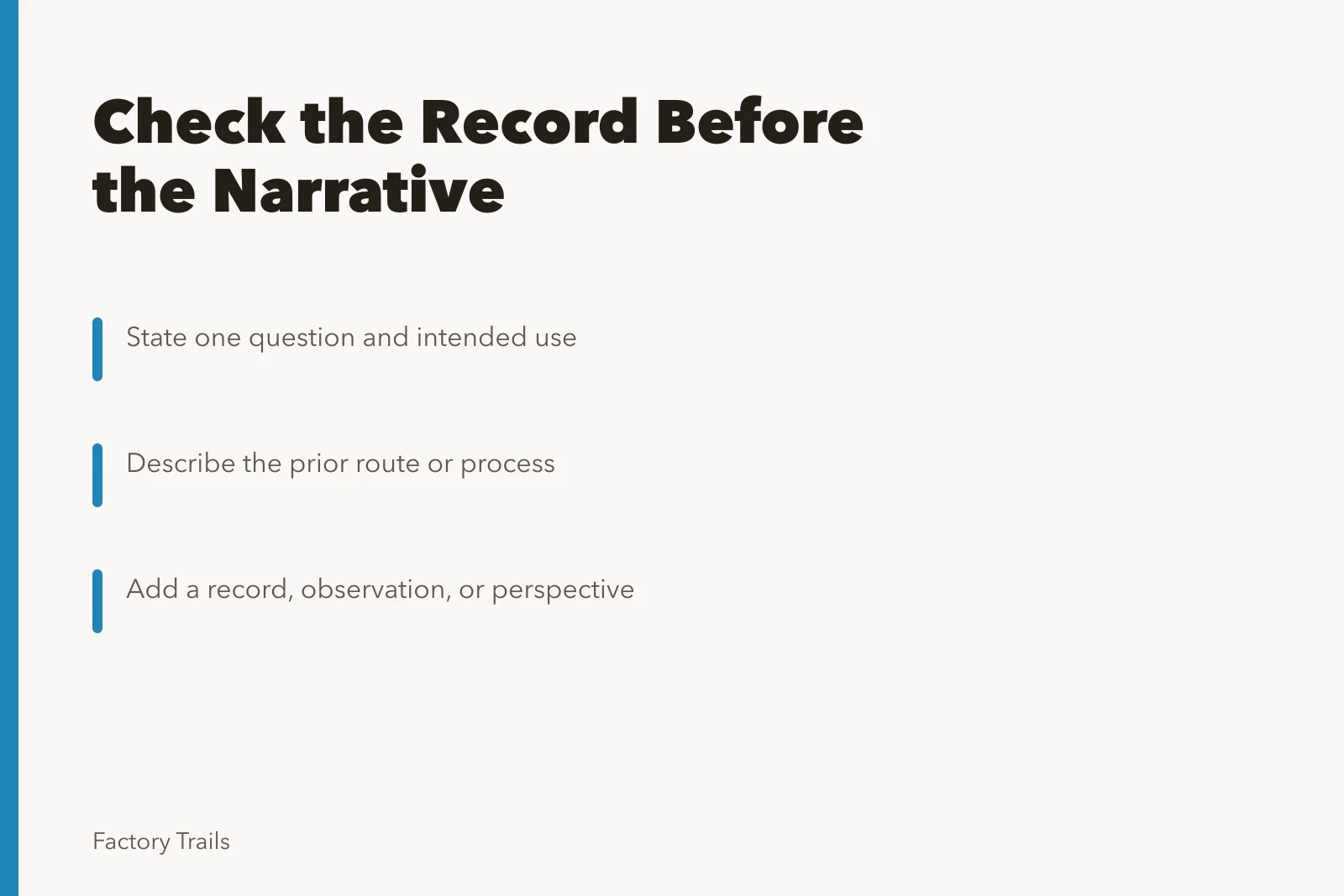
| No defined question | Notes become a recap without a decision point | State one question and intended use |
| No baseline | A reader cannot see what changed | Describe the prior route or process |
| One source of evidence | A single viewpoint may miss important context | Add a relevant record, observation, or attributed perspective |
| Result claimed too quickly | Timing or conditions may explain the outcome | State competing explanations and limits |
| Missing permissions | Quotes or images may expose private information | Confirm approval before publication |
| Unexplained revisions | Readers cannot tell which plan was used | Keep a dated change log |
The CDC's guidance on justifying conclusions advises evaluators to interpret findings using explicit standards and evidence. For an industrial-tour article, that means showing the reader what the evidence was, how it relates to the question, and where uncertainty remains.
Warning signs and repairs
- No defined questionstate one question
- No baselinedescribe prior route
- One sourceadd record or observation
- Result too quickstate competing explanations
- Missing permissionsconfirm approval first
- Unexplained revisionskeep dated change log
Check the record before the narrative
An article may look finished while the record underneath is incomplete. Ask whether the date, route version, group type, site condition, and decision owner are all known. If a partner supplied a technical fact, identify it as a partner statement until it is independently confirmed. If the fact cannot be verified or safely described, remove it rather than dressing it up with careful wording.
The National Archives records-management FAQ index provides background on maintaining records so they can be found and used later. A private operator's rules will differ, but the principle applies to a case study: retain the notes, approved route, image permission, and change record that let an editor check the story after the visit is over.
Watch for polished but weak narratives
A smooth story is not automatically a trustworthy one. Be careful when an article says a new route "improved the experience" without stating what changed, who observed it, or how the judgment was reached. Also question a case study that names a commercial partner but omits the relationship or lets the partner's marketing language stand as an independent finding.
Another warning sign is a question that was written after the result was known. The Centers for Disease Control and Prevention guidance on focusing an evaluation design describes defining the purpose, users, questions, and methods of an evaluation. For a tour case study, draft the question and evidence plan early, then report deviations honestly if conditions force a change.
Fix the method before fixing the prose
If a study has weak evidence, do not solve the problem with stronger adjectives. Return to the route record, notes, approvals, and dates. Narrow the conclusion if the evidence is limited. Add a clear limitation when the result may have been affected by weather, group composition, access conditions, or a concurrent change. These repairs protect the reader and make the next case study easier to improve.
Use a correction note instead of quietly replacing a core fact. Record what changed, the source for the correction, the date, and whether the conclusion also changed. The National Park Service interpretive planning account describes a process that connects planning and visitor experience over time. The comparable practice here is to preserve a clear path from the tour decision to the published lesson, even when the work needs revision.
Before release, ask a colleague to read only the conclusion and evidence sections. Can they tell what happened, what is inferred, and what remains unknown? If not, the problem is structure, not style. Repair the structure first.
Common questions
Is a small sample always a warning sign?
No. A small case can still be useful when it is clearly bounded and does not claim to represent every visitor or site.
Should negative findings be published?
Yes, when they are factual, fair, and appropriately reviewed. A result that did not meet expectations can prevent a repeated mistake.
What is the fastest quality check?
Ask whether every major conclusion points back to a specific observation, document, or attributed statement in the article.