Guides
Part of How to run an industrial site interpretation case study method from question to published report
How to keep industrial site interpretation case study records
Industrial interpretation case study records for 2027 explain how to track sources, permissions, selections, notes, and changes behind a public article.
Good case-study records make an article easier to review, update, and defend. They do not need to become an archive of every browser tab. They need to show what was consulted, what each item supported, what permission applied, and why a claim changed.
What to take away
- Keep a source record beside the draft, not only in the writer's memory.
- Separate evidence, interpretation, and current visitor information.
- Record selection decisions and rights questions before publication.
- Preserve an update log so later editors can see what changed and why.
Create a compact evidence record
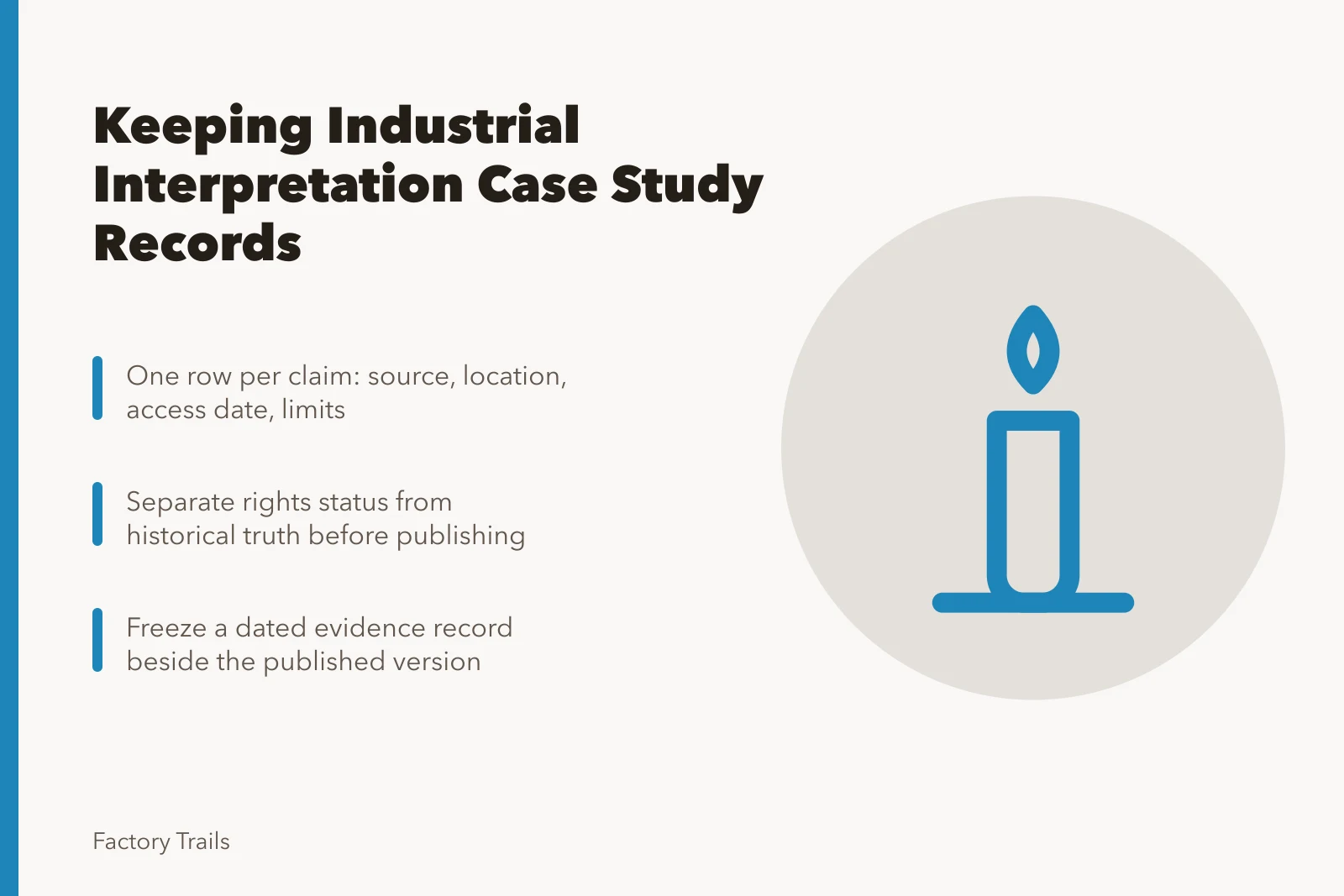
For each important claim, make one row with the source title, repository or publisher, stable location, access date, the exact point it supports, and a short note on limits. Add a separate field for rights or reuse status when images, scans, or quoted material are involved.
| Field | What it answers | Example note |
|---|
Evidence record fields
- Claimwhat the article will say
- Sourcewhere evidence came from
- Supportwhat it establishes
- Limitwhat it does not establish
- Rightscan it be reproduced
- Change logwhat changed after review
This record is a working control, not a reader-facing bibliography. It helps a later editor distinguish a verified fact from a helpful but untested lead.
Document the editorial method
The National Archives describes digital-edition work as including collecting, describing, preserving, transcribing, annotating, editing, encoding, and publishing documentary sources. It asks applicants to show the content and historical significance of particular materials and to demonstrate progress. That reinforces a simple publishing habit: make the method visible inside the project files, especially when the article selects or interprets historical records. Read the National Archives guidance on collaborative editions for the direct source.
For a site article, the method can stay brief. Note which records were selected, why they were relevant, what conflicting material was found, who reviewed the draft, and what remains uncertain. If a reader or local expert later identifies a better record, the update log gives the next editor a clear starting point.
For the source row itself, use a repeatable review sequence. The National Archives document analysis worksheets move from observation to interpretation and then use of the item as evidence. Record those distinctions so a later editor can see whether the published sentence is a direct fact, a stated interpretation, or a point that still needs another source.
Keep rights separate from historical truth
An item can be historically valuable and still be unsuitable to reproduce. Do not confuse a public web page with a reuse license. Save the rights note, attribution requirements, and permission correspondence with the evidence record. If rights are unclear, describe the fact in original language and use a different visual or omit the image.
The same separation applies to present-day details. Record the source and verification date for access, programs, or routes in a current-information section. Do not let a nineteenth-century map become evidence for a 2027 parking instruction.
The National Archives digitization FAQ asks projects to explain their selection of records and justify that choice with use, research needs, or practical constraints. Keep a shorter version of that rationale in an article's records file. It explains why a source appears in the story and why another available item was left out.
Review before release
Before publication, spot-check the strongest claims and the most specific facts. Confirm that every image has a credit path, that every external source opens to the correct page, and that any qualification in the record is reflected in the prose. Then freeze a dated copy of the evidence record alongside the published version.
For records that involved onsite research, retain location and request notes. The National Archives visit-planning guidance advises researchers to identify where records are held and to keep notes on materials consulted. Those details can save a future editor from repeating the same search.
Common questions
How detailed should a source record be?
Detailed enough for another editor to find the item and understand exactly what the draft took from it.
Should every sentence have a record row?
No. Track material claims, precise facts, quotations, images, and any point likely to need later verification.
What belongs in an update log?
The date, the changed claim or detail, the reason for the change, the supporting source, and the editor who approved it.