Guides
How to run an industrial site interpretation case study method from question to published report
Industrial interpretation case study method for 2027 shows how to frame a site question, gather evidence, document limits, test visitor use, and publish responsibly.
A case study helps an industrial-history project examine one place, question, record set, process, or visitor problem in enough detail to produce a useful public lesson. It is not a promotion piece and it is not a claim that one site represents every factory, mine, mill, rail line, port, or company town.
The method begins with a bounded question. It gathers evidence from more than one source where possible, records what the sources do and do not establish, includes local review, and tests whether the final public material helps a visitor understand the place. The result can be a web article, short guide, exhibit section, audio stop, map note, or project record.
What to take away
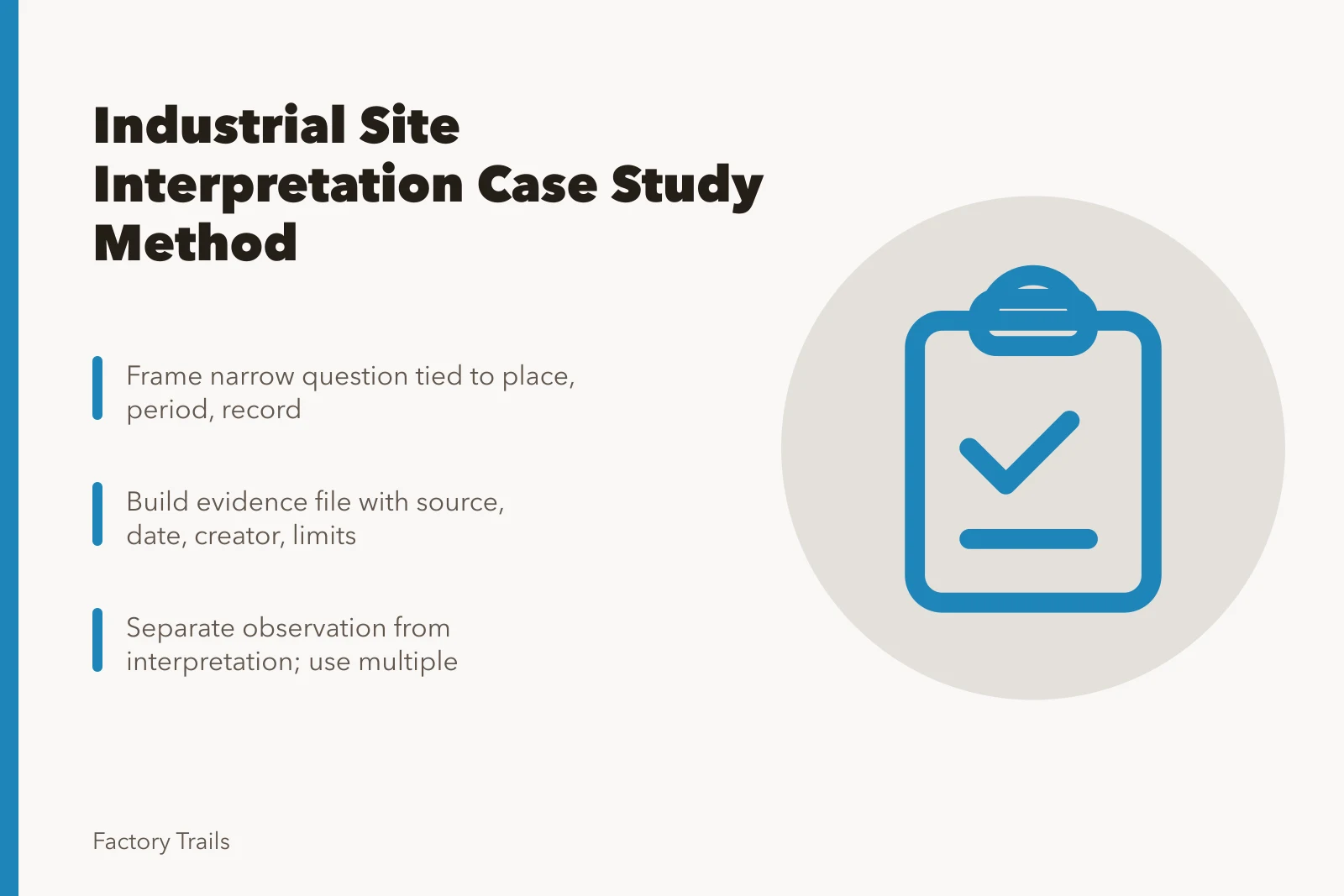
- Frame a narrow question that a site, source set, or visitor task can answer.
- Keep observations, evidence, interpretation, and unresolved questions separate.
- Use more than one perspective when the question concerns community experience.
- Confirm current visitor facts independently from historical research.
- Record the method and limits so another editor can review the work later.
Choose a case study question with a boundary
Avoid a question such as "How did this industry change America?" It is too broad for a case study and invites a generic answer. A better question is tied to an identifiable place, period, record, or visitor decision.
Examples of useful questions include:
Choose a case study question
- What do the surviving records show about one production process at this site during a defined period?
- How did a rail connection affect the location's public story, according to maps and local records?
- What can visitors learn from a worker's account when it is compared with company records?
- Which current public materials help visitors understand a closed industrial feature without entering it?
- What changed in an interpretation page after local reviewers identified missing context?
The question sets the scope. It tells a reader what the case study can answer and, just as important, what it will not attempt to prove.
Build an evidence file before writing the case
Gather the records first. The file may include objects, site observations, photographs, maps, business records, newspapers, oral histories, drawings, reports, collection descriptions, and previous scholarship. For each item, record its source, date, creator when known, purpose, what it directly supports, and limits that need further research.
Evidence File Fields
- Item descriptionidentifies exact source
- Creator and dateplaces in time
- Direct supportties claim to material
- Contextwhat reader needs to know
- Limitflags unanswered question
- Reviewerwho checked interpretation
Do not turn the evidence file into a dumping ground. Include material that can help answer the question. Keep a separate list of related sources that may matter later but do not belong in the current case.
An evidence file also needs a consistent method for reading primary sources. The National Archives DocsTeach overview describes tools for examining records, weighing evidence, and drawing historical conclusions. That supports a basic editorial rule: record what a source says before using it to support a larger interpretation.
Separate observation from interpretation
An observation says what the record or site presents. An interpretation explains what that evidence may mean in its historical context. The distinction prevents a page from quietly turning a guess into a fact.
For example, an observation might note that a map labels a rail spur beside a mill. An interpretation may explain, with appropriate supporting sources, how that connection related to material movement or distribution. A responsible case study does not jump from a single map label to a claim about the entire regional economy.
Use a two-column drafting note:
Observation vs Interpretation
Observation or source fact
- Date, person, place, feature
- What does it suggest?
- Photo visible condition
- What cannot be concluded?
- Oral history experience
- Which materials add context?
- Current site contact hours
- Which historical material
Interpretation or question
- Date, person, place, feature
- In context?
- Photo visible condition
- From one image?
- Oral history experience
- Or raise difference?
- Current site contact hours
- Is separate?
This practice produces clearer prose. It also makes source review quicker because the reviewer can find the sentence that needs support.
Include different records and perspectives
Industrial places often have several stories at once. A building may be an engineering achievement, a workplace, a neighborhood influence, a source of local pride, a site of conflict, or a changed surrounding area. The relevant story depends on the question and the evidence, not on a predetermined theme.
The NPS Oil Region National Heritage Area evaluation report describes case-study work that uses more than one data source, including documentation, interviews, key partners, and community input, to triangulate perspectives. That is a useful model for interpretation: a case becomes more reliable when it does not treat one type of record as the full account. See the NPS Oil Region evaluation report for the cited case-study approach.
Do not force balance by adding unrelated material. Add sources because they help answer the question or reveal a limit in the original evidence. When a perspective is unavailable, say what the record does contain and avoid pretending that the gap has been resolved.
Define the visitor outcome
A public case study should have a job. It may help a visitor notice a physical feature, understand why a record matters, compare two accounts, plan a short stop, or find a collection for deeper research. State the outcome before deciding on the format.
If the visitor needs a quick orientation, use a short page or map note. If the story depends on comparing evidence, use a longer article with captions and source context. If the original location is closed or sensitive, use approved public viewpoints, archives, or digital materials rather than implying access.
Keep current visitor details separate from the historical case. Ask the responsible site contact to confirm the public instruction, add a review date, and direct visitors to an official update source when details may change.
For visitor-facing material, use a documented adjustment loop. The Visitor Use Management Framework describes setting desired conditions, selecting strategies, monitoring results, and adjusting actions. A case-study editor can apply that idea by testing whether a reader finds the source path and current visitor direction, then revising when the task fails.
Test the draft with a task
Before publication, give a first-time reader a practical task. Ask them to identify the main question, find the evidence behind one claim, explain the difference between an observation and an interpretation, and locate the current approved public information. Their response will show whether the structure is doing its job.
Also ask a local or subject reviewer to check the scope. Are names correct? Does the draft overstate the source? Does a local record change the context? Are unfamiliar terms explained? Record the result and revise the affected material.
Write the case in a clear sequence
Most industrial interpretation case studies work well in this order:
Case Study Writing Sequence
- State bounded question
- Introduce anchoring place or record
- Present evidence and context
- Explain interpretation without overstating
- Note perspectives, limits, questions
- Give visitor next step or source
- Record reviewers, credits, review date
Write the case in sequence
- State the question and why it is bounded.
- Introduce the place or record that anchors the case.
- Present the evidence and its context.
- Explain the interpretation without overstating the source.
- Note other perspectives, limits, or unanswered questions.
- Give the visitor a clear next step or source path.
- Record the reviewers, credits, and next review date.
The sequence is not a formula. A photograph-led case may open with an image. An oral-history case may begin with a brief account. The important part is that the reader can still tell what is documented, what is interpreted, and what needs more research.
Record the limits and changes
Every case study needs a small project record. Include the initial question, source list, claim notes, reviews, media credits, current visitor information, published file, and revision log. When a source changes the public wording, record the old and new version, reason, date, and affected materials.
Do not store controlled, personal, security-sensitive, medical, operational, or legal information in the public editorial record unless the organization has an authorized process for it. The record is for traceability of published interpretation, not a substitute for specialized documentation.
The record should also distinguish historical research from current access instructions. National Archives visit-planning guidance tells researchers to identify the relevant facility and confirm material availability before visiting. An interpretation page can use the same practice: keep its historical sources, then separately link readers to the current organization that controls public access.
Avoid these common case-study errors
Avoid these common errors
- Starting with a conclusion rather than a research question.
- Treating one source as a complete account.
- Hiding gaps or disagreement behind smooth language.
- Confusing a historic map or photo with current visitor directions.
- Using an illustrative image as evidence of a different place.
- Publishing a current contact or route without confirmation.
- Leaving no source notes or revision path after publication.
The correction is usually direct: narrow the question, cite the source, add context, remove the unsupported statement, or return the practical fact to the responsible site contact for confirmation.
Common Case Study Errors
- Starting with conclusion, not question
- Treating one source as complete
- Hiding gaps behind smooth language
- Confusing historic map with current directions
- Using illustrative image as evidence
- Publishing unconfirmed contact or route
- Leaving no source notes or revision path
Common questions
How long should an industrial case study be?
Use the length needed to answer the defined question and show the evidence. A short case can be useful if its claim is narrow and well documented.
Must every case study include an interview?
No. Use interviews when they are appropriate and available. Other record types may answer the question more directly.
Can a case study discuss a closed site?
Yes. Use approved public information, archival material, or an authorized viewpoint. Do not imply that visitors may enter or inspect a closed area.
What makes a case study ready to publish?
The question is clear, the main claim is supported, relevant reviewers have checked it, credits are complete, current visitor facts are confirmed, and a revision record exists.
In this guide
- Industrial site interpretation case study checklist: how to frame the question and check the factsIndustrial interpretation case study checklist for 2027 helps teams frame a question, gather evidence, define limits, review context, and verify visitor facts.
- Industrial site interpretation case study questions to test before you publishTest an industrial case study against the record before it goes public, so every claim about a plant, a date, a route or a process survives review.
- How to keep industrial site interpretation case study recordsIndustrial interpretation case study records for 2027 explain how to track sources, permissions, selections, notes, and changes behind a public article.