Guides
Part of How to run an industrial site interpretation case study method from question to published report
Industrial site interpretation case study checklist: how to frame the question and check the facts
Industrial interpretation case study checklist for 2027 helps teams frame a question, gather evidence, define limits, review context, and verify visitor facts.
Use this checklist when preparing a public case study about an industrial place, record, process, or visitor question. It is an editorial research tool. It does not decide site access, operational conditions, preservation treatment, legal issues, or safety procedures.
Checklist steps in order:
- Write a bounded question.
- Build the evidence record.
- Check the public draft.
- Confirm current visitor facts.
- Finish and date the record.
Template fields:
- Question
- Evidence
- Limits
- Reviews
- Visitor facts
- Revision path
What to take away
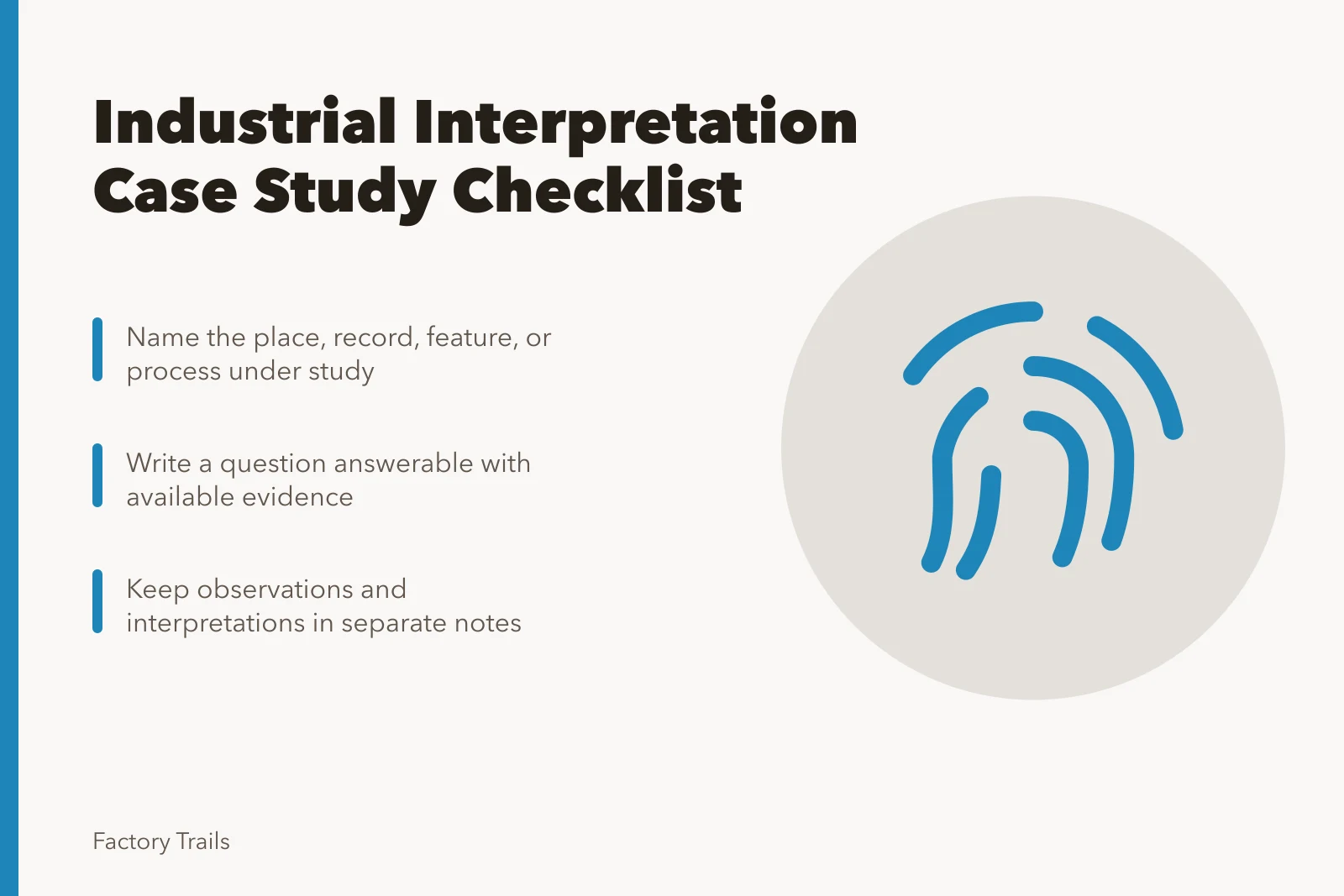
- Start with a bounded question, not a predetermined conclusion.
- Keep observations and interpretations in separate notes.
- Document what every source supports and what remains uncertain.
Set up the case
Case Setup Checklist
- Name the specific place or process
- Write an answerable question
- State time period and boundary
- List what the case will not claim
- Identify intended public outcome
Worked example. Broad question: How did an industrial plant shape its town? Narrower: What did a 1920 city directory list at the plant address?
Narrow again: What can a 1920 city directory and one oral history interview show about the plant workforce at one address in that year? The final question names a source type, a date, a place, and a limit.
Set up steps:
- Name the place, period, and source type in the question.
- List the claims the question will test.
- Set a stopping rulewhat would make you close the case.
- Log the date and editor.
Build the evidence record
| Check | Record to keep |
|---|---|
| Source identity | Creator, date, collection, file, or site observation |
| Direct support | Exact detail that supports the proposed claim |
| Context | Information needed to understand the item |
| Limit | Missing date, point of view, contradiction, or unanswered question |
| Review | Person and role who checked the relevant material |
| Example: city directory | [City] Directory, [Year], entry for [street or business]. Supports the claim that a named business operated at that address in that year. Limit: listings can lag or miss temporary occupants. Review: local librarian, [date]. |
| Example: oral history | Interview with [name or role], [date], [collection]. Supports what a worker recalled about a process. Limit: memory and one viewpoint. Review: interviewer and subject, [date]. |
For archival items, cite as: [Collection title], Box [#], Folder [#], Sheet [#]. For a site observation, cite as: [Site name], [date], [observer role].
The National Archives describes tools that help learners evaluate the credibility of historical records, weigh evidence, and draw historical conclusions. That is a practical case-study check because it keeps a writer from skipping from a first impression to a conclusion. See the National Archives DocsTeach overview for the cited approach.
Check the public draft
Read the draft against the evidence record. Does an image caption describe the image accurately? Does the page avoid turning a historic map or photograph into a current visitor direction?
Ask a subject or local reviewer to check names, context, and unsupported claims. Ask the responsible site contact to check only the current public facts they control. Record both reviews rather than treating them as the same task.
Finish the record
Before publication, keep the question, sources, published text, reviewer notes, media credits, visitor-information confirmation, and next review date together. If a fact changes later, update the public page and note the change in the record.
A case is done when the question has an answer or a stated limit, every claim has a source, both reviews are recorded, visitor facts are confirmed, and a next review date is set.
Use a source-reading step before drafting. The National Archives evidence case study shows the need to verify a document's origins and meaning before drawing a conclusion.
Test visitor-facing material. The Visitor Use Management Framework describes setting conditions, monitoring results, and adjusting management actions. An editor can apply that approach by asking a reader to identify the case question, find a cited source, and locate the current official visitor information, then fixing any step that fails.
Keep access facts current and independent from the historical source file. National Archives visit-planning guidance tells researchers to identify the relevant facility and confirm availability before travel. Record the official source, check date, and responsible contact for visitor details.
At the final review, check every media element. The caption should describe what the image actually shows. The credit should point to the image file page. The article should not use an illustrative photo to prove a claim about a different place, date, or process. If the image cannot be verified, remove it or replace it.
Keep the checklist practical. A small case may need one collection record, one local review, and one official visitor check. A larger case may need several source types. For example, a single mill site with one collection may need one archive record, one local review, and one visitor check.
A regional network of plants may need city directories, oral histories, company records, and several site checks. The decision should follow the question and the evidence, not a target number of documents. Save the dated checklist with the final draft for a later update.
Common questions
Must a case study use several source types?
Use the sources needed to answer the question responsibly. A narrow case may have one strong source, while a broad question often needs more context or perspectives.
Can a closed site be the subject of a case study?
Yes. Use approved public information, historical records, and an authorized viewpoint or collection. Do not imply that a visitor may enter a closed area.
What makes the checklist complete?
The question, evidence, limits, reviews, credits, visitor facts, and revision path are all documented.