Reviews
How manufacturing museums can sharpen case study questions before publication
Manufacturing museum case study questions for 2027 help U.S. editors compare evidence, scope, source support, limitations, outcomes, and update needs.
What to take away
- Write every question so one named source can answer it.
- Bound the case to a single facility, period, or decision.
- Build a question ledger before you collect an image or a quotation.
- Rewrite or drop any question the accessible record cannot answer.
- Publish the conclusion, the limitation, and the review date together.
A case study question is a test, not a topic. It names what the writer will examine and what evidence would settle it. The method below turns that idea into a page a museum team can actually use.
Build the question ledger before research
A ledger is one page, written before the research starts. Every later claim then traces back to a question set in advance. Build it in four steps.
- Put the main question at the top. Name the facility, the period and the decision in scope.
- List the subsidiary questions a reader must follow to understand the case.
- Against each question, name a preferred source typea dated institutional report, a collection record, a project document, or an identified interview.
- Mark a question unresolved when the source is absent. Do not fill the gap with an inference.
Work the list against our industrial interpretation case study questions before you write a word. Interpretation claims need the same treatment as production claims.
A ledger also stops a writer from gathering material that answers nothing. A detail that adds color without proof can stay as background. It should not carry the main claim.
Five questions to test against the record
- What exactly is the case examining?
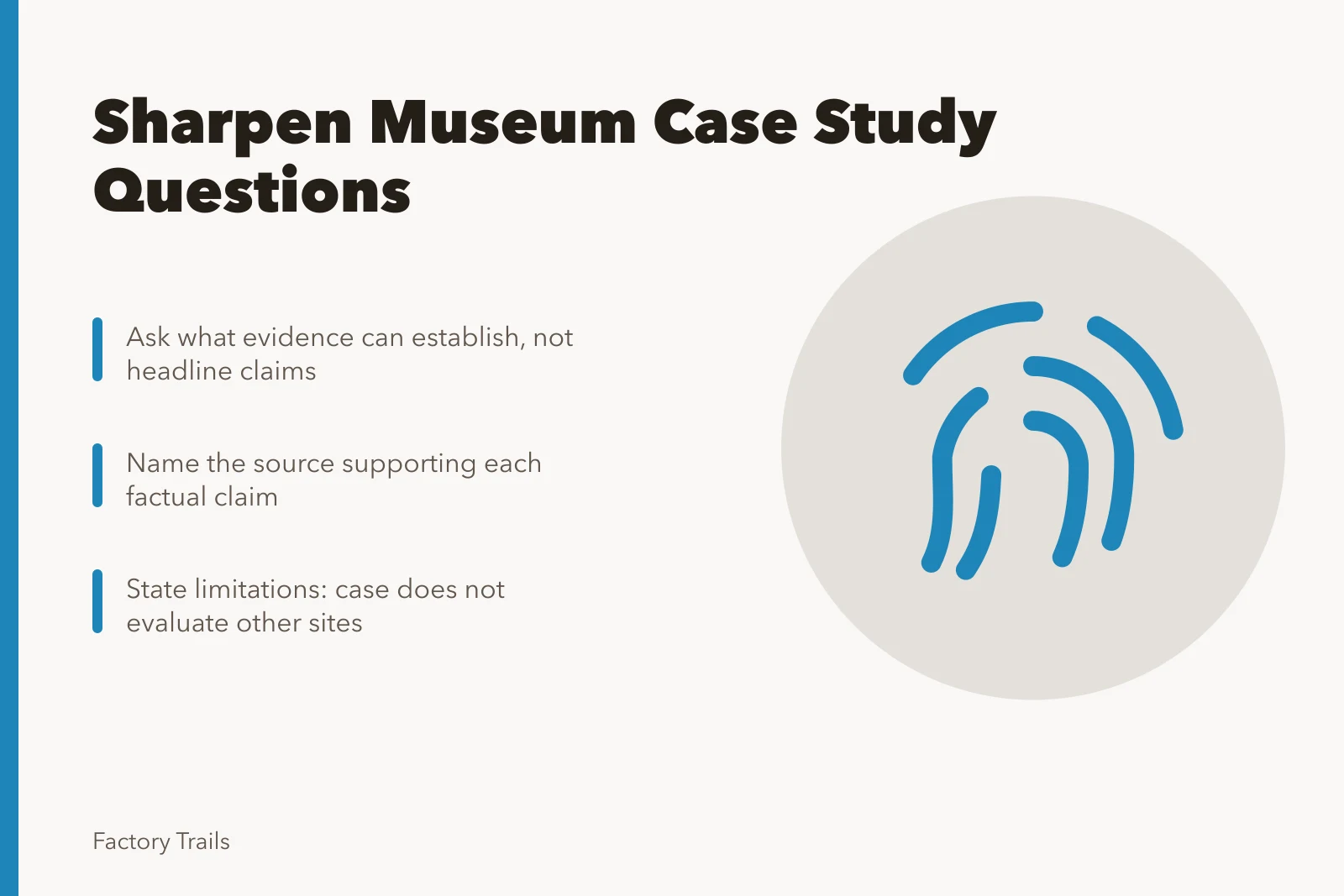
- Which source supports each factual claim?
- What changed during the documented work?
- What can readers verify today?
- What does the case not prove?
Case Study Question Checklist
- What exactly is the case examining?
- Which source supports each factual claim?
- What changed during the documented work?
- What can readers verify now?
- What does the case not prove?
The first two questions bound the subject and the evidence. The last three keep the conclusion inside the record. If a draft cannot answer the fifth, the case is not finished.
Example: from a wide question to a bounded one
A weak question reads: "How does Hershey run chocolate factory tours?" It fails twice. It assumes a factory tour exists, and it asks about a company rather than a site. Chocolate World is a visitor center, and the working plant is not open to public tours (Hershey's Chocolate World).
A better question reads: "What does Chocolate World present about chocolate production, and which parts of the plant stay closed to visitors?" The rewrite names the site, names the claim and points to a record a reader can check.
A question you cannot answer from a named source is not a question yet. It is a topic.
Match each claim to a source type
| Claim in the draft | Source that can carry it | What it cannot prove |
|---|---|---|
| Visitor access today | Current operator page or dated staff statement | Whether access differed a decade ago |
| Production method | Plant document or named staff interview | Output for the whole company |
| Historical operation | Dated institutional report or collection record | Current practice |
| Safety requirement on a tour | Regulation text or written site procedure | What visitors actually experienced |
Canada works as a second market. The Royal Canadian Mint runs production tours in Winnipeg and a boutique mint in Ottawa (visit the Mint). A case study that says "the Mint tour" without naming the facility has already broken the rule.
Collections guidance from the Smithsonian Museum Conservation Institute and the NPS Museum Handbook treats documentation and accountability as the center of the work. That practice supports one editorial test: can a later reader locate the record behind the conclusion?
Finding those sources takes time that belongs in the plan, so read our case study budget notes before you commit to a scope.
Write a conditional conclusion
A conditional conclusion states what the record supports and stops there.
The record documents this decision within this scope. The current operator states this visitor condition. The case does not evaluate other sites.
Record the method, not only the result. A later reader should see how the evidence was developed. When an answer depends on a missing report or an uncertain date, mark the limitation or narrow the case.
Britannia Mine Museum publishes tour and booking details for its underground route (Britannia Mine Museum). That material answers what the operator states today. It does not answer what a miner experienced in 1930. Our Britannia underground tour booking guide sets out what visitors can reserve and what the museum states about the route.
A published case should also carry the date each source was checked. That line lets a reader tell a current operator statement from a historical report.
Test the ledger against the conclusion
At the final edit, read the conclusion and check each sentence against a question in the ledger. If the conclusion answers something no question investigated, cut it or reopen the research.
Archive the ledger with the published version so later updates start from evidence rather than memory. Two editors reading the same ledger should arrive at the same limits. Where they disagree, the question set is the problem, not the prose.
Name the editor and the review date on the published version, and keep the limitation in the body text rather than a footnote.
The same discipline applies to the visits the case describes. Our notes on common factory visit mistakes cover what goes wrong on site.