Reviews
Part of How an industrial site interpretation maintenance plan keeps visitor media accurate
Industrial site interpretation maintenance plan comparison questions to ask before you act
Compare four maintenance plan options for industrial site interpretation, from in-house cycles to specialist conservation contracts, before you commit.
Four maintenance routes cover almost every industrial site: a staff-run condition cycle, a conservation contract for the physical fabric, a records and content revision service, and full replacement of the asset. Each answers a different failure. Pick the one that matches the failure you actually have.
What to take away
- A condition cycle detects decay and logs it with dated photographs.
- Conservation contracts price the object, not the message printed on it.
- Records services fix accuracy across every channel that repeats a claim.
- Replacement is the only option that resets format, location and content at once.
- Name the failure before you name the option, or you will buy the wrong one.
The four options, compared
| Option | What it covers | Who runs it | Pricing model | Typical cost or effort | Fails when |
|---|---|---|---|---|---|
| Condition cycle | Inspection, cleaning, minor repair, photo record | Site staff or volunteers | Staff hours per cycle | No cash outlay. Typical planning figure: two to six staff hours per asset per cycle | The message is wrong but the panel is sound |
| Conservation contract | Surface, substrate, fixings, mounting, graffiti removal | Conservation-trained contractor | Per object, quoted after survey | Typical planning range: several hundred to several thousand US dollars per panel, set by substrate, access and fixings | Access, route or wording is the real problem |
| Records and content revision | Wording, dates, credits, source files, channel sync | In-house editor or records consultant | Day rate, or per item revised | Typical planning range: 500 to 1,200 US dollars per day, or a per-item fee | The format itself no longer works |
| Replacement | New panel, sign, audio or digital asset | Fabricator plus interpretive designer | Per unit plus design fee | Typical planning range: 2,000 to 15,000 US dollars per asset, with audio and digital priced separately | No owner, no source, no public purpose left |
The condition cycle is the cheapest to run and the easiest to justify, because it produces a dated photograph of every asset each round. A legible panel carrying a closed meeting point passes every condition check and still sends visitors to the wrong gate.
Four maintenance options compared
Condition cycle
- Covers
- Inspection, cleaning, repair
- Who runs it
- Site staff or volunteers
- Pricing
- Staff hours per cycle
- Fails when
- Message wrong, panel sound
Conservation contract
- Covers
- Surface, fixings, graffiti
- Who runs it
- Conservation contractor
- Pricing
- Per object after survey
- Fails when
- Access or wording problem
Records revision
- Covers
- Wording, dates, credits
- Who runs it
- Editor or consultant
- Pricing
- Day rate or per item
- Fails when
- Format no longer works
Replacement
- Covers
- New panel or asset
- Who runs it
- Fabricator plus designer
- Pricing
- Per unit plus design fee
- Fails when
- No owner or purpose left
Ranges above are indicative planning figures for United States sites, not quotes. Labour rates, access equipment, permits and substrate condition set the final price. Sites in Canada should add cross-border travel and currency conversion.
This article names no vendors and gives no endorsements. For conservation, the American Institute for Conservation publishes a Find a Conservator directory.
For records work, the National Association of Government Archives and Records Administrators lists members. For fabrication, the National Park Service Harpers Ferry Center publishes wayside exhibit guidelines, and the Society for Experiential Graphic Design lists member firms.
Ask before you buy
Question / Option it points to
- Is the surface failing, or the message?
- Conservation or records revision
- Does the claim appear in print, web and host script?
- Records revision
- Is the location still correct for the route?
- Replacement or repositioning
- Is the panel sound, the message true and only the location wrong?
- Repositioning
- Is there a named owner and a current source file?
- Any option; without these, retire
- Does the format still serve visitors at all?
- Replacement, or retirement
Answer these together. A faded panel with a correct message is a conservation job. A sound panel with an obsolete date is a records job, and the print guide needs the same edit on the same day.
What each authority actually decides
The NPS wayside interpretation training sets upkeep against weathering and vandalism, which is the case for a condition cycle. It does not settle whether the text is still true.
The NPS wayside exhibit evaluation checklist separates accuracy, legibility, interpretive clarity, visitor response and site condition. Score each separately before you choose. A panel can pass four and fail accuracy, and accuracy is the one that ends up in a complaint.
The National Archives web-records guidance covers version control and logs for web content. Any records revision option you buy should name the old version, the new version, the approver and the date, so a corrected web page does not leave a stale printed guide in the rack.
The U.S. Access Board signs guide sets sign requirements in covered settings. It cannot judge one panel's condition. Route format questions to a qualified reviewer rather than treating a walk-past as an accessibility finding.
Decision record template
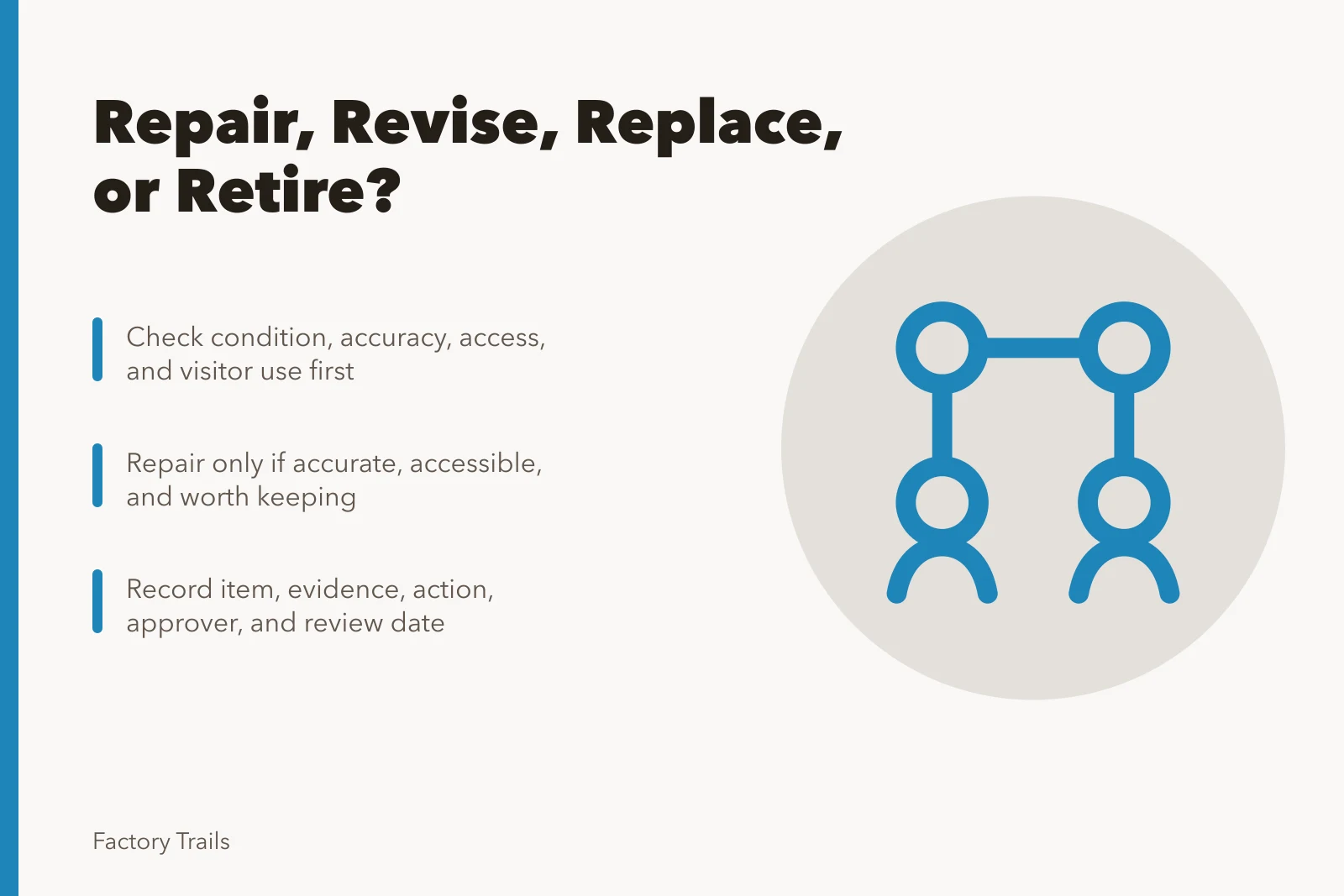
Write one page per asset. Item name and location. Visitor problem in one sentence. Evidence checked, with dates. Option selected from the four above. Approver and date. Next review date. Channels that repeat the affected message.
Worked example, filled in the same order:
- Item name and locationNumber 3 furnace charging floor panel, stop 4 on the walking route.
- Visitor problemthe panel sends visitors to the north gate, closed since the route changed.
- Evidence checkedroute map, 12 May 2027; host script, 3 June 2027; web page, 9 June 2027.
- Option selectedrecords and content revision.
- Approver and datesite manager, 14 June 2027.
- Next review dateJune 2028.
- Channels that repeat the affected messageprint guide, web page, host script.
Keep that page with the current source files. It is the only thing that tells the next reviewer why the site looks the way it does.
When replacement is justified
Replacement resets format, location and wording at once, which is why it gets chosen too early. Test the failure first.
Replace when no source file exists and the message cannot be checked, when the format no longer serves visitors, or when the asset has no owner and no public purpose.
Reposition when the panel is sound, the message is true and only the setting is wrong. Conserve when the fabric is failing and the message holds.
If neither route fits, retire the affected instruction or post a narrow temporary notice. Do not leave a known-wrong sign in service while a new one is specified.
The industrial site interpretation maintenance plan sets the review cycle that decides when this question comes back around. The owning authority sets that cycle length, usually from how fast the source material changes and how many visitor complaints the asset draws.
Common questions
Which option is cheapest?
Condition cycles, because they use staff hours you already fund. Typical planning figure: two to six staff hours per asset per cycle. See the comparison table for the other three.
Can I run two options at once?
Yes, and often should. A conservation contract on the fabric plus a records revision on the wording is normal for a panel that is both fading and out of date.
Who signs off on a replacement?
The site authority that owns the asset, with the interpretive lead confirming the source. Confirm the current approval route with them, not from a template.
What if no option fits?
Retire the asset. If no owner, source or public purpose remains, no maintenance route will hold it in service.