Guides
Part of How an industrial site interpretation maintenance plan keeps visitor media accurate
How industrial site owners keep interpretation maintenance records that last
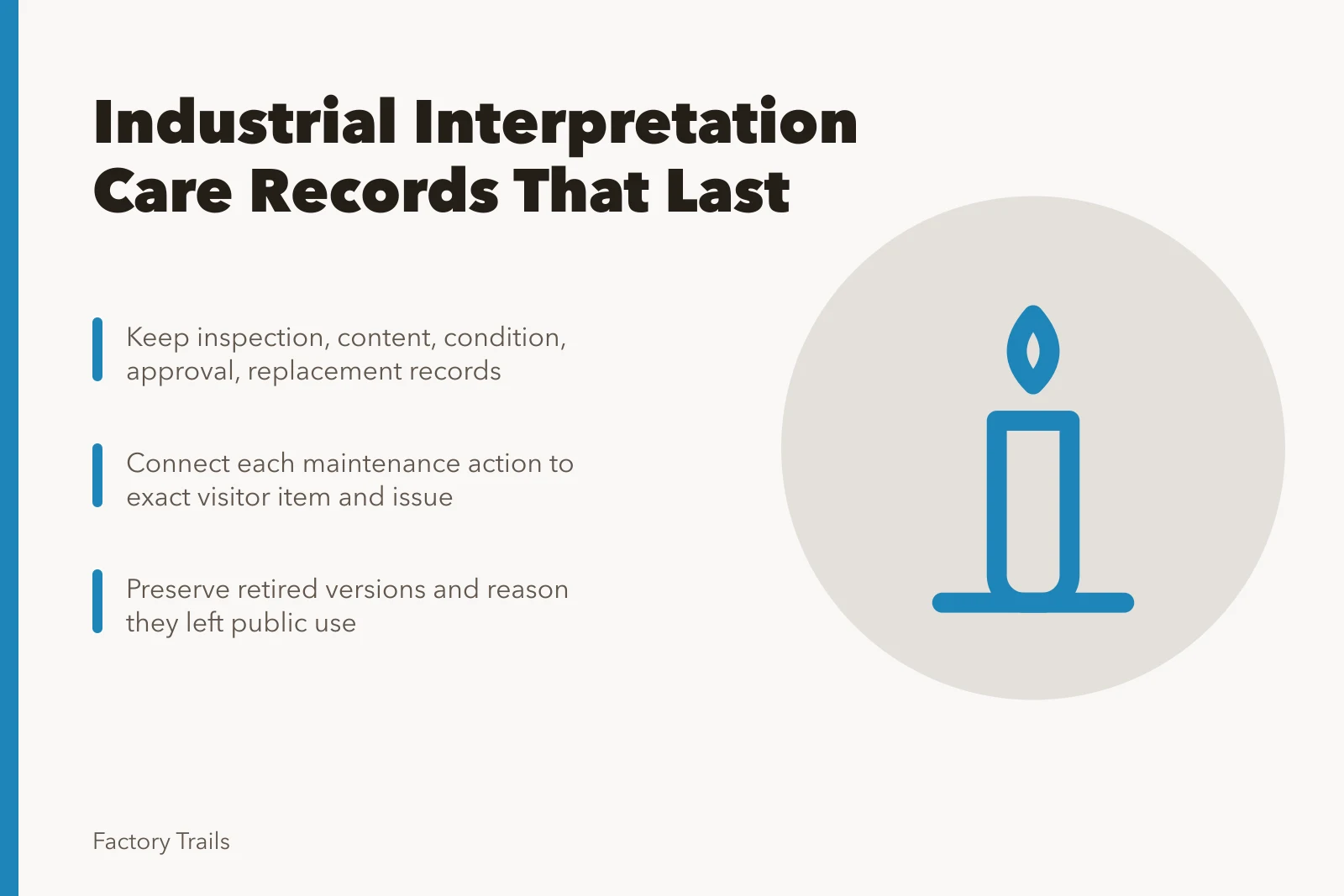
Interpretation maintenance records track condition inspections, repairs, replacement files, and retirement decisions for every visitor item a site keeps on display.
What to take away
- Maintenance records show what a visitor item was, what changed, and why.
- Every visitor item needs one stable identifiera panel number, route-stop code, or page slug.
- Log the follow-up check after a repair, not just the repair itself.
- Keep the public version, the revised version, and the approval source for digital items.
- Sign and accessibility decisions belong in the record with the reviewer's name.
- Retire an item by keeping its last public version and the reason it left.
Fields that survive a change of owner
A record is only as good as the fields you fill in before you need them. Six fields carry the weight: identifier, current owner, version and date, approval source, follow-up check, and retention decision.
Six record types and fields
- Item profiletitle, location, purpose, version, owner
- Condition inspectiondate, condition, content, access
- Repair or revisionissue, action, approval
- Replacement fileartwork, text, credit, supplier
- Follow-up checkdate, evidence, related items, limit
- Retirement notereason, date, guidance, retained version
The six fields, each with a one-line example:
- Identifierone code that never changes, such as panel-12-furnace-walk.
- Current ownerthe visitor-program owner plus a named backup.
- Version and datethe public version and the revised version, such as public v3, revised 2026-04-02.
- Approval sourcewho signed the wording off, and the date.
- Follow-up checkthe date checked, the evidence reviewed, and the related items examined.
- Retention decisionwhat to keep, such as change notes for the life of the item plus ten years.
A filled record for one item looks like this:
Field / Filled example
- Identifier
- panel-12-furnace-walk
- Version
- public v3, revised 2026-04-02
- Reviewer
- visitor-program owner, signed 2026-04-03
- Follow-up date
- 2026-04-05, sign and guide checked
Use stable filenames and version dates. Never overwrite an approved record after a change. Save the revised version beside it and note what moved. That keeps a rushed emergency correction from being read later as the fully reviewed public item.
NARA's records scheduling guide covers developing, implementing, and updating disposition practices, which is the source for the retention decision field. A visitor program needs a smaller local version: clear descriptions, known locations, current ownership, and a retention decision made when the item changes.
The follow-up check is the record most sites skip
After a significant repair, rewrite, or removal, log the date checked. Also log the evidence reviewed and the related public items examined. If an access instruction changed, note whether the visit page, guide, host brief, and physical sign were all checked. That line is what lets the next reviewer confirm a correction reached the whole visitor experience.
Record where archived versions and replacement files live. Without that path, an old public copy becomes the accidental source for the next repair.
Use the NPS wayside exhibit evaluation checklist to define inspection fields rather than writing that an item looked fine. That checklist is the source for the inspection fields kept in the follow-up check. Its questions separate accuracy, legibility, visitor response, site conditions, and accessibility concerns. Mirror those categories locally and keep the evidence for whichever field triggered the correction.
Version trail for digital materials
Digital items change without a physical trace, so the trail has to be deliberate. The National Archives web-records guidance discusses reliability, authenticity, integrity, and usability, and how to track web changes. It is the source for the version, approval source, and change date fields.
A small program can keep this practical. Preserve the public version, the revised version, the approval source, and the change date. Also preserve the pages, maps, or files checked after the edit. Five fields, one folder per item.
Sign and accessibility review
Document sign and format decisions with the responsible reviewer named. The U.S. Access Board signs guide is federal guidance for signs in covered settings. It is the source for the sign review field in the record.
Do not copy a general rule into an item record as proof that a particular site is accessible. Record the review that happened, the approved alternate information, and any open question for the responsible authority. Accessibility statements and clearance questions go to the site's own office, not to a maintenance log.
Handoff, retirement, and the seasonal review
Group each item under its stable identifier. Inspection, approved wording, sources, photos, and repair notes all sit there. Credits and the retirement decision also sit there. A new owner should find the current item and its history without comparing folders or phoning a former staff member.
When an item is retired, keep the last public version and the reason. Say whether visitors were sent to another item, a current contact, or nothing. That is the editorial trail explaining why the public record changed, and it stops a retired file returning as current.
Review the record after each seasonal inspection or material correction. Confirm the profile still names these details:
- the current owner
- active version
- route or permalink
- source baseline
- credits
- next review date
Assign any gap before the item becomes hard to manage. The aim is not a large archive.
It is enough traceable information for a future reviewer to see what visitors meet now and how it got there.
Common questions
How long should care records be retained?
Keep them while the item is public. A working example keeps change and retirement notes for the life of the item plus ten years. The organization's records schedule sets the exact period. Retirement and change notes should outlive the item long enough to explain the current version.
Who maintains the record file?
Assign the visitor-program owner with a named backup. Contributors add findings; one person keeps the current record straight.
Are photos useful in a care record?
Yes. A dated photo stored with the inspection note documents condition, installation, or damage better than a written description alone.