Guides
Part of How to build an industrial heritage travel case study method that holds up
How industrial heritage case study records work for owners and publishers
Industrial heritage case study records for 2027 help U.S. publishers track sources, claim limits, public access checks, image credits, and corrections.
A compact evidence record lets a future editor see why every important case-study claim belongs in the article.
What to take away
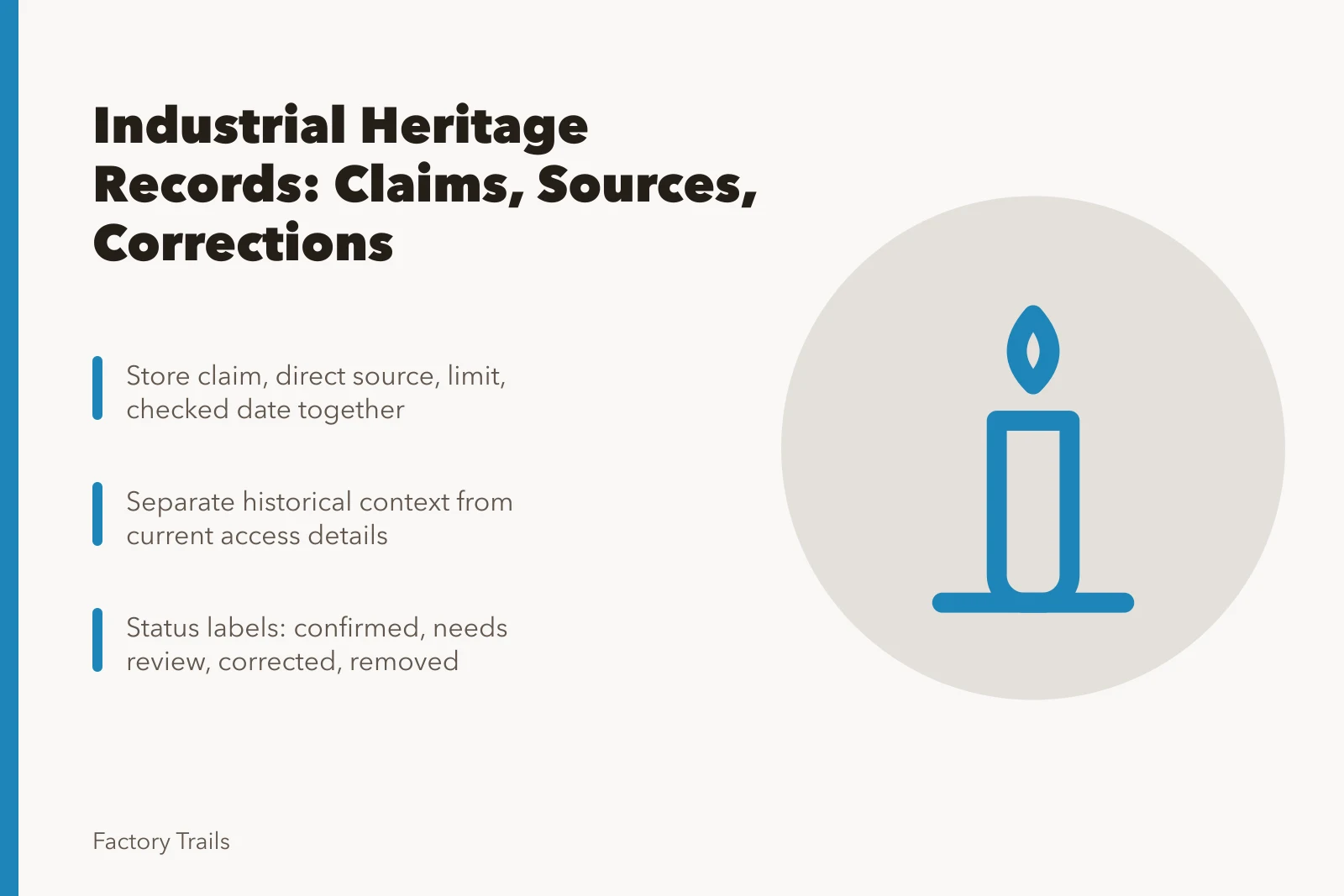
- Store claims, sources, limits, and review dates together.
- Keep historical context separate from current access details.
- Credit images with the record that actually identifies them.
- Document corrections rather than silently changing a recommendation.
Use a claim record
Field / Purpose
- Claim
- The exact sentence or fact in the article
- Direct source
- The specific page that supports it
- Source role
- Historical context, live access, or media credit
- Limit
- What the source does not establish
- Checked date
- When a current source was reviewed
- Revision
- What changed and why
Here is the same record filled in for one live claim about a closed steel plant.
| Field | Worked entry |
|---|---|
| Claim | The Hoover-Mason Trestle at the former Bethlehem Steel plant in Bethlehem, Pennsylvania is open, and site tours run on a seasonal schedule. |
| Direct source | The operator's own tour page for the site. |
| Source role | Live access. |
| Limit | The page lists the current season only. It does not promise the same days next year or step-free access at every stop. |
| Checked date | 2026-04-01. Illustrative. Use the date you ran the check. |
| Revision | First entry. No correction logged. |
| Status | Confirmed. |
| Owner | The assigned editor for this article. |
In a shared spreadsheet, those fields become columns: claim, source_url, source_role, limit, checked_date, revision, status, owner. Copy that line into the header row of a new sheet, one row per claim. A CMS can hold the same row in one custom field named claim_record.
What is specific to 2027
The year marks a review cycle, not a rule. Nothing in the record format changes.
What changes is staleness. A claim checked in an earlier cycle no longer counts as current, so a 2027 record means the source was read again in that cycle. A site that changes operator needs the owner field updated at the same time.
The National Park Service documentation guidelines and resources describe program guidance for quality, content, and archival stability. An editorial record need not imitate a formal survey, but it should preserve the same discipline: do not let a source support a claim beyond its actual scope.
Claim Record Fields
- Claimexact sentence or fact
- Direct sourcespecific supporting page
- Source rolecontext, access, or credit
- Limitwhat source does not establish
- Checked datewhen source was reviewed
- Revisionwhat changed and why
Make corrections useful
When a reader, organization, or business requests a correction, ask for the direct source. Compare it with the sentence, revise the claim when warranted, and record the date. Do not turn a correction into a paid placement or an unsupported endorsement. This keeps the article accurate while making the editorial process fair.
Worked correction: a reader writes that the trestle is fenced off for winter. You check the operator page, find a closure notice, and rewrite the claim with the closure date. The revision entry names the reader, the page you checked, the date, and the new wording.
Use a separate status for each item: confirmed, needs review, corrected, or removed.
Store the record with the article, in a shared spreadsheet tab or the claim_record field, so the next editor finds the evidence without an inbox search.
Use the record to protect source boundaries
Give every live claim a dated source. The National Park Service visitor conditions guidance is a useful model for separating changing operational information from permanent background. An archival document can be strong historical evidence without confirming a tour, admission rule, or public route today.
The National Archives describes basic records-management concepts. That guidance covers retention and the audit trail: how long a record is kept and who can trace a change. It does not settle whether a claim belongs in the article.
The National Park Service Museum Handbook supports careful treatment of object and collection records. It does not establish current public access. State that limit in the record rather than letting an image or artifact caption do more work than it can support.
Record why a claim belongs
For each material claim, record why it belongs in the article. A source can be accurate but irrelevant to the reader's question. Note the claim, source role, date, limit, and editorial decision in one place. This gives an editor a way to see why a sentence stayed, changed, or was removed.
Use simple status labels. Confirmed means the current source supports the live claim. Historical means the source explains earlier context. Observation means a writer recorded something on a particular date. Needs review means the statement cannot be repeated until it is checked again.
Review the record before republishing or accepting a correction. If the supporting page has changed, update the article to match it. A clean record does not make research automatic, but it makes every revision more transparent and easier to audit.
Keep one dated review note after each update. It should name the claims checked, the source changes found, and any language removed because the evidence no longer supported it.
Who maintains the record
One named editor owns the record for each article. That person updates the checked_date, status, and revision columns after every review.
When the editor changes, the outgoing editor writes a handover note in the revision field. It names the claims due for a re-check and the sources last used.
If the site owner or the publisher changes, the record stays with the article. Editorial judgment does not transfer with the property or the masthead. A new editor re-checks each live claim before the next publication.
Common questions
What is the most useful record field?
The source limit. It prevents a later editor from using historical context as proof of current visitor access.
Should correction requests be saved?
Yes. Save the supporting source and the change so future reviews can follow the decision.
How often should records be reviewed?
Review them when the article changes and before publishing any live visitor claim.