Guides
Part of How to build an industrial heritage travel case study method that holds up
How to build an industrial heritage travel case study checklist that holds up
A working checklist for industrial heritage case studies: set the public boundary, map evidence, date every live claim, and review the reader path.
A case study about a shut blast furnace or a working mine tour fails for one reason: it promises access nobody confirmed. This checklist builds the file so every live claim has a source, a date and a named public anchor.
What to take away
- One question, one confirmed public anchor. Everything else is context.
- Historical, current and visual evidence each do a different job. Never swap them.
- Every live detail carries a source and a review date in the file.
- A field note records one dated observation, not a standing fact.
- If a sentence could send a reader past a fence, cut it.
Set the scope
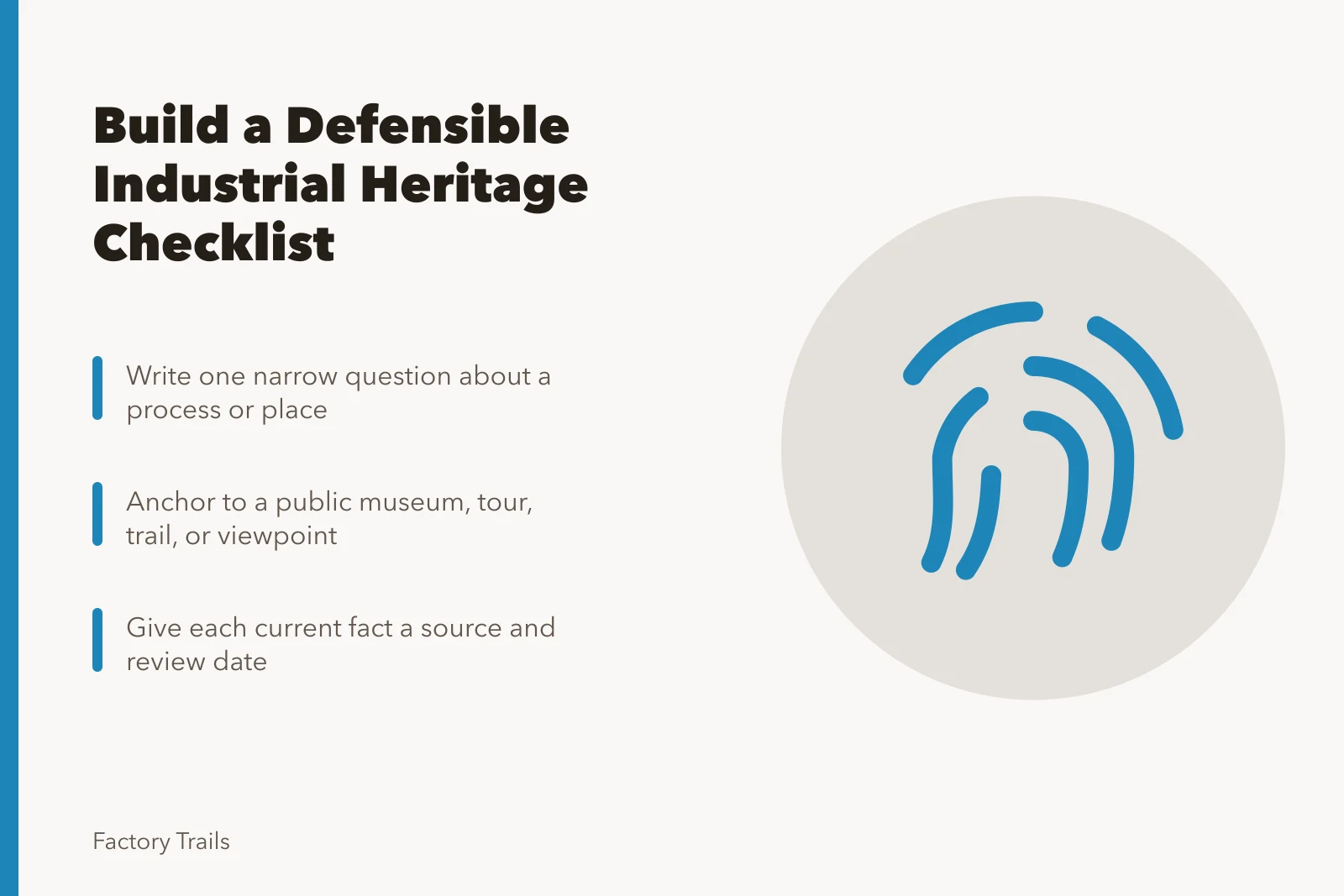
- Write one question about a process, a place, a route or a public interpretation.
- Name the public anchora museum, a scheduled tour, a trail, an exhibit or a designated viewpoint.
- State the geographic and time boundaries of the piece.
- List the sites that stay context only, because access is not confirmed.
- Name who signs off on the live details before publication.
The National Park Service Heritage Documentation Programs overview describes measured drawings, large-format photographs and historical reports made for public documentation. Borrow the labelling habit, not the access. A historical report can carry interpretation. It cannot tell a reader whether a gate opens on Saturday.
Map the evidence before you write
| Evidence | Use it for | Never use it for |
|---|---|---|
| Historical record | Process, significance, chronology | Current hours or entry |
| Current visitor page | Hours, tickets, rules, closures | Site history |
| Image or archive record | Visual credit, period context | Present-day operations |
| Field note | One dated observation | A permanent claim |
| Operator statement | Access, escort, PPE rules | Historical interpretation |
Give each row one owner in the file. When a claim has no row, the claim does not ship.
Evidence types and their proper use
Evidence
- Historical record
- Process, significance, chronology
- Current visitor page
- Hours, tickets, rules, closures
- Image or archive record
- Visual credit, period context
- Field note
- One dated observation
- Operator statement
- Access, escort, PPE rules
Use it for
- Historical record
- Current hours or entry
- Current visitor page
- Site history
- Image or archive record
- Present-day operations
- Field note
- A permanent claim
- Operator statement
- Historical interpretation
Never use it for
- Historical record
- Current visitor page
- Image or archive record
- Field note
- Operator statement
Date every live claim
A public-access statement needs two things: the source and the date you checked it. The National Park Service visitor conditions guidance shows why operational information gets its own review. A historic district boundary description cannot confirm today's tour, route or entry point.
The National Archives sets out basic records-management concepts. Keep the source, the review date, the exact claim and any correction note in one line. An editor can then test a statement without guessing how it entered the draft.
For objects and archival material, stay inside the documentation. The National Park Service Museum Handbook covers careful treatment of collection records. It is not evidence that an object sits on display.
Worked example: a December shutdown
Say the question is how a preserved ironworks handled its last cast. The anchor is a site with published winter hours. The shutdown calendar, the furnace records and the crew roster are context.
Check the arithmetic yourself: open days per month, times the published tour capacity, minus the days the site lists as closed. Substitute the site's own numbers. Nothing here is a figure you can borrow from another plant.
If the site's calendar says maintenance closure and your draft says daily tours, the draft is wrong. Fix the draft, not the calendar.
Review the reader path
- Does the piece name a designated public start point?
- Could any phrase push a reader toward private or restricted ground?
- Does each current fact point to a responsible source?
- Is there a correction route for readers and for the site?
- Would a site officer recognise their own published rules in your wording?
Read the checklist in the order a visitor would act on it. The reader should find the anchor, understand why it matters, and see which detail needs a current check. Any step resting on an assumption about entry or ownership comes out of the route and stays as sourced history.
Keep the file
Store the finished checklist beside the draft. A future editor then has a starting point when a site page, program or route changes. That is the whole value: the next revision takes an hour, not a week.
Common questions
What makes a good case-study anchor?
A confirmed public experience that answers the article's question directly. If you cannot point to published visitor information for it, it is context, not an anchor.
Why keep evidence types apart?
It stops a historical source or an archive image from being stretched into a current access claim. Each type answers one question and no more.
When should the piece be reviewed?
Before publication, and again whenever the live visitor information may have changed. Shutdown calendars, ticket rules and escort requirements move with the season.
What if a site will not confirm access?
Write the history and name the public viewpoint instead. The case study question set covers how to test a claim before you commit to it.