Reviews
Part of How an industrial heritage maintenance plan for 2027 keeps records and reviews on track
Industrial heritage maintenance plan comparison: 5 options and questions before 2027 work
Five maintenance plan options for industrial heritage sites plus key questions owners must settle before 2027 work is authorized under preservation easements.
What to take away
- Five plan types cover most 2027 workcyclical maintenance, conditions assessment, historic structure report, CMMS preventive maintenance, and a records and emergency plan.
- Only one of the five schedules work orders. The other four produce documents, tasks or evidence.
- A historic structure report is a planning document, not a substitute for a current assessment by a qualified professional.
- Every unknown gets a date and a named reviewer, or it will be re-argued next budget cycle.
Five options, five different jobs
A maintenance plan is not one product. The five below cover most of what a 2027 program needs, and they are not alternatives to each other. Most sites end up running two or three at once.
Five maintenance plan options
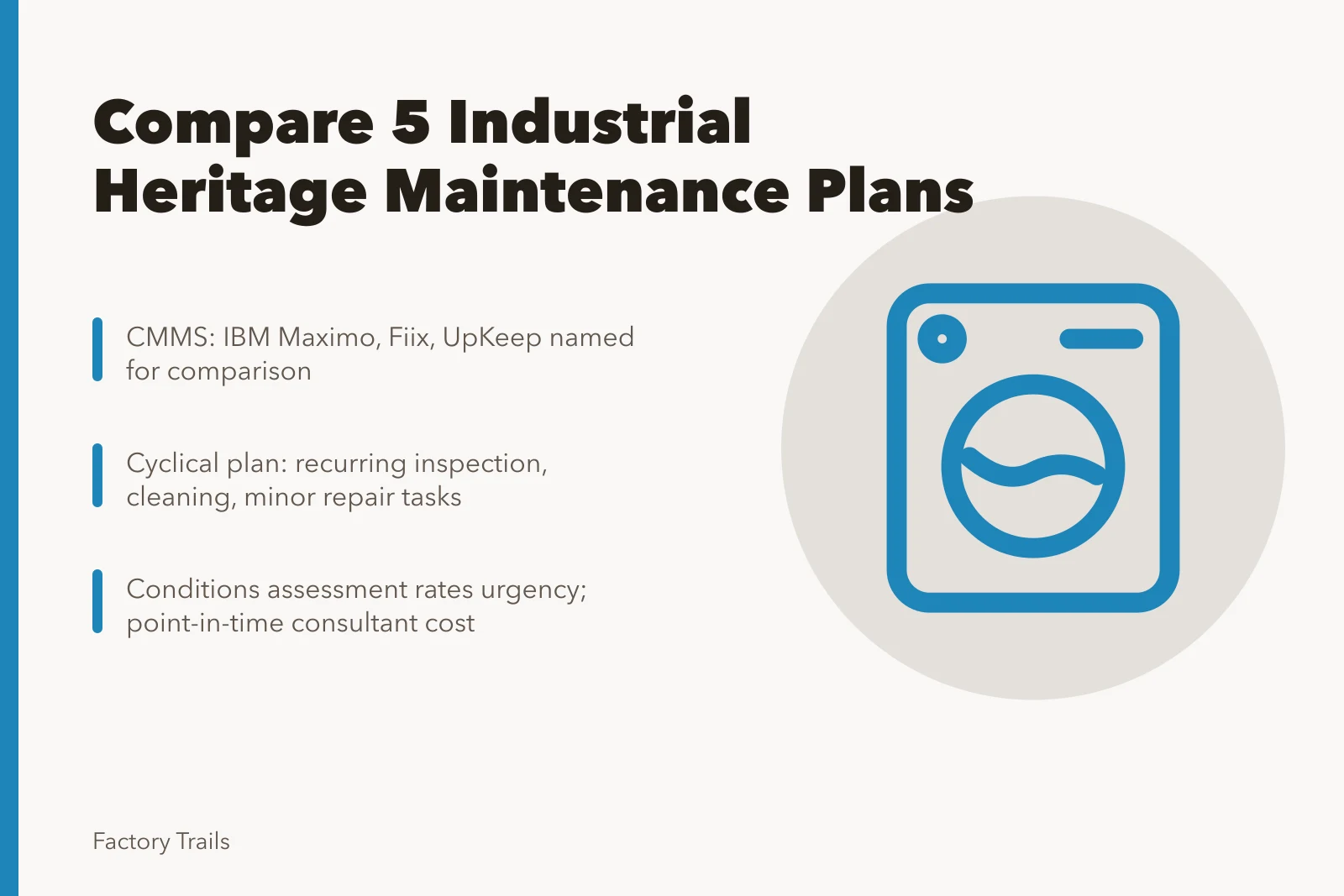
Cyclical maintenance
- What it does
- Recurring inspection, cleaning, minor repair
- Who it suits
- Small sites with steady staff
- Cost or limit
- Staff time; no license fee
Conditions assessment
- What it does
- Rates condition and urgency
- Who it suits
- Sites facing repair decision
- Cost or limit
- Consultant cost; one-date snapshot
Historic structure report
- What it does
- Documents significance and treatment
- Who it suits
- Complex, designated, grant-funded sites
- Cost or limit
- Consultant cost; planning document
CMMS preventive maintenance
- What it does
- Schedules work orders against assets
- Who it suits
- Sites with plant and maintenance staff
- Cost or limit
- Subscription or license; setup time
What it does
- Cyclical maintenance plan
- Recurring inspection, cleaning and minor repair tasks on a calendar
- Conditions assessment
- Rates current condition and urgency, element by element
- Historic structure report
- Documents significance, history and treatment guidance
- CMMS preventive maintenance
- Schedules work orders against assets and parts
- Records and emergency plan
- Logs evidence, contacts, access steps and review dates
Who it suits
- Cyclical maintenance plan
- Small sites with steady staff or volunteers
- Conditions assessment
- Sites facing a repair or funding decision
- Historic structure report
- Complex, designated or grant-funded sites
- CMMS preventive maintenance
- Sites with plant, equipment and maintenance staff
- Records and emergency plan
- Public, regulated or high-visitor sites
Cost or limit
- Cyclical maintenance plan
- Staff time; no license fee
- Conditions assessment
- Consultant cost; a snapshot on one date
- Historic structure report
- Consultant cost; a planning document
- CMMS preventive maintenance
- Subscription or license; setup time
- Records and emergency plan
- Staff time; needs review on a fixed cycle
The National Park Service historic structure reports overview treats these reports as planning documents. Related guidance can carry maintenance information. Neither replaces site-specific authority or a current assessment.
Named tools and providers
Five CMMS products are named here because most industrial sites end up comparing them. IBM Maximo Application Suite is an enterprise asset management platform with preventive maintenance and work orders; it fits large portfolios and prices by quote.
Fiix by Rockwell Automation handles asset hierarchy, work order tracking and preventive maintenance triggers on subscription tiers. UpKeep is a mobile CMMS for maintenance teams, with work orders and preventive schedules on per-user pricing.
Brightly Asset Essentials is a facilities CMMS with preventive calendars and work order tools, priced by quote. eMaint by Fluke links condition monitoring to asset records, also priced by quote.
For the paper side, the National Park Service Museum Handbook covers documented material and suits sites with collections or archives. An archival photograph can raise a history question. It cannot settle a present treatment or public-access question.
The National Archives sets out records-management basics. A question log should keep its source and date so a later decision can be checked, corrected or explained. The National Park Service visitor conditions guidance is the live public record, which is separate from the historic one. That gap matters when work touches routes, programs or a visitor notice.
Questions before authorizing 2027 work
Ask whether the work sits inside the owner's authority. Ask whether it could change a character-defining feature. Ask whether permits or public review apply. Ask whether qualified expertise is needed. Any unknown answer gets logged as a gap and escalated rather than guessed.
Run the list again when a report lands. Compare the new information with the original observation, then label what is confirmed, what is still unknown, and who owns the next decision. Do not quote a professional opinion past its stated scope. A narrow, accurate limit is more useful than a broad conclusion.
On a public property, check whether an answer changes visitor messaging. If a route, program or area has to change, publish only what the responsible operator currently supports. Significance explains why a feature matters. It does not stand in for a current operating notice.
Keep the answer proportionate to the evidence. A short note naming the source and its limit gives the next reviewer a starting point. A polished explanation that hides what was never assessed gives them nothing.
Date the remaining unknowns and set a review point for each. An open question is still manageable when the record says who will pursue it and what information is needed. The industrial heritage care checklist is the place to hold those dates against the rest of the season's work.
Common questions
Is a crack an emergency?
That cannot be judged from a general article. Record it safely and follow the site's own safety and escalation process, which its safety officer maintains.
Can a volunteer make a condition diagnosis?
A volunteer can record observations. Diagnosis, treatment and safety decisions follow the responsible authority and the site's qualified-review process.
Why write down uncertainty?
It stops a later reader from mistaking an incomplete observation for a confirmed conclusion. It also shows the next reviewer where to start.
Does a CMMS replace a conditions assessment?
No. A CMMS schedules work against assets you have already decided to maintain. It does not tell you what condition those assets are in or what treatment they need.