Guides
Factory tour maintenance plan scope checklist for U.S. sites
Factory tour care checklist for U.S. sites in 2027 covers visitor-route checks, approved housekeeping, public notices, seasonal readiness, and clear escalation.
This checklist separates daily public-facing care from preservation work that needs professional direction. Use the site's approved procedures and do not ask visitors to touch, clean, or repair historic resources.
What to take away
- Check the visitor route before opening.
- Follow written methods for any routine housekeeping.
- Log changes and assign follow-up.
- Escalate resource and safety concerns promptly.
Before opening
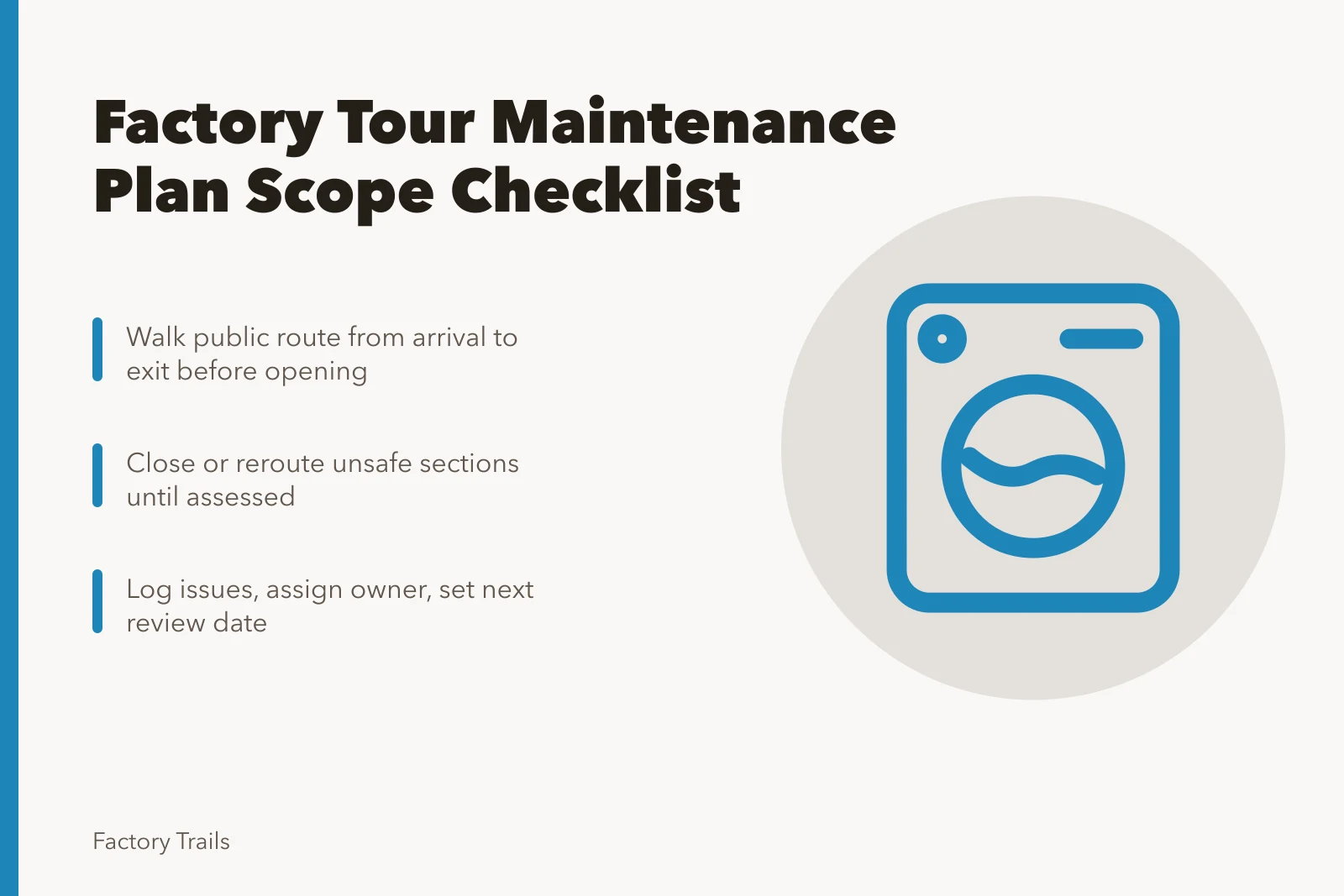
- Walk the public route from arrival to exit.
- Check barriers, railings, signs, lighting, and surface conditions.
- Confirm that the public map and access notice match the open route.
- Check weather-related hazards and any restricted area.
- Confirm who is the escalation contact for the day.
If a condition affects safety or access, close or reroute the affected section until the responsible person assesses it.
During operations
| Observe | Action |
|---|---|
| A visitor cannot follow a sign or route | Correct the immediate confusion and report the gap |
| A barrier shifts or a surface changes | Restrict access and notify the designated lead |
| A guide hears a recurring question | Add it to the interpretation review log |
| An object, machine, or structure appears changed | Do not touch it; document and escalate |
The National Park Service describes preventive care as including appropriate handling, security, environmental controls, housekeeping, and planned collection care. Its conservators develop plans and provide training because these tasks need site-specific procedures. See the National Park Service conservation-services guidance for the direct context.
At closing
- Record newly observed route, resource, or information issues.
- Note what temporary action protected visitors or resources.
- Assign a next review date and owner.
- Check that tools, supplies, and visitor materials are stored according to site rules.
- Update the next shift if an area remains restricted.
Seasonal readiness
Before a heavy visitor season or known weather change, review drainage, exterior signs, route surfaces, emergency contacts, public notices, and any demonstration or exhibit component affected by conditions. Recheck the visitor experience after reopening rather than assuming the previous season's plan still works.
Add a route-access check to the opening list. The U.S. Access Board's accessible-route guide identifies walking surfaces, doors, ramps, curb ramps, elevators, and permitted lifts as route components. It provides practical items for observation. A local review still determines how a historic property should address a condition.
The checklist needs a response for urgent situations as well as routine care. OSHA's emergency action plan guidance describes reporting, evacuation procedures, and assigned duties for employees. Use the host site's actual plan to identify who closes a route, moves visitors, accounts for a group, and meets responders.
Keep the daily log short enough to be used. The National Archives' records-management FAQ describes systematic control of record creation, maintenance, use, and disposition. A private site should use its own retention schedule, but every checklist entry should still have a clear operational purpose and owner.
At the end of a week, scan the completed forms for a repeated location or condition. A moved barrier, recurring wet step, or same visitor question can reveal a weak routine before it becomes a closure. The check-in staff and guides often see different parts of that pattern, so include both perspectives in the review.
Do not turn the checklist into a substitute for professional judgment. Its purpose is to give staff a consistent way to find, record, and protect against a problem while the right person decides what work belongs in the next maintenance or preservation step.
The same discipline applies to public messages. If a path is closed, the booking page, arrival notice, and on-site sign should point to the same alternate route. If the alternate cannot deliver the promised experience, staff should say so before guests arrive and follow the site's rescheduling or refund policy.
Keep a printed copy where the opening team can reach it. A perfectly written checklist does not help if the current version is locked in a system that a guide cannot access while visitors are waiting at the entrance.
Common questions
Can a volunteer clean a historic object?
Only if the site has approved the task, method, training, and supervision. When uncertain, leave the object alone and notify staff.
What should be logged every day?
Record route issues, barriers, closures, public-information changes, and any condition that needs follow-up.
What is an escalation trigger?
A new safety hazard, water or pest evidence, damage, unstable condition, electrical concern, or change to a historic resource.