Guides
Part of How an industrial heritage maintenance plan for 2027 keeps records and reviews on track
Industrial heritage owner records: what to track before 2027
Industrial heritage care records for 2027 help U.S. owners and stewards preserve observations, source limits, approvals, work history, and monitoring dates.
A care record lets future stewards see what was observed, what evidence supported a decision, and what happened afterward. It should be clear enough that a new staff member or consultant can distinguish historical context from current condition and completed work from a proposed idea.
The 2027 date in the title is a planning horizon, not a legal deadline. No U.S. law takes effect in 2027 for industrial heritage care records. What the date marks is the owner's first full review cycle. A site that standardizes its records in 2026 can compare a year of entries by 2027.
What to take away
- Keep a dated record for every observation and decision.
- Label source limits so historic evidence is not mistaken for current access or condition.
- Store approvals, work records, and monitoring notes together.
- Preserve uncertainty instead of inventing a conclusion.
The core record fields
| Field | What to retain |
|---|---|
| Location and feature | Exact area, component, or site feature |
| Observation | Direct description, date, observer, and authorized images |
| Source | Record title, direct URL or file location, and scope |
| Decision | Responsible authority, date, and reason |
| Work or follow-up | What occurred, who performed it, and next review date |
| Limit | What remains unknown or needs qualified assessment |
Copy the field table above into your file as the blank template.
Field / Example entry
- Location and feature
- Building 12, north wall, brick pier at door 3
- Observation
- Spalling brick, noted 2026-05-04 by site steward; photo IMG-221
- Source
- 1985 HAER photograph, sheet 4, shows original mortar joint
- Decision
- Head of preservation, 2026-05-10, schedule mason inspection
- Work or follow-up
- Mason inspected 2026-06-01; repoint planned; next review 2027-06-01
- Limit
- Cause of spalling not determined; no structural assessment done
This is an illustrative entry, not a real site record.
The National Park Service rehabilitation guidelines describe planning that begins with protection and maintenance of important historic materials and features. A site record supports that work by preserving the evidence and decisions behind it; it does not replace the approvals or expertise needed for a specific project.
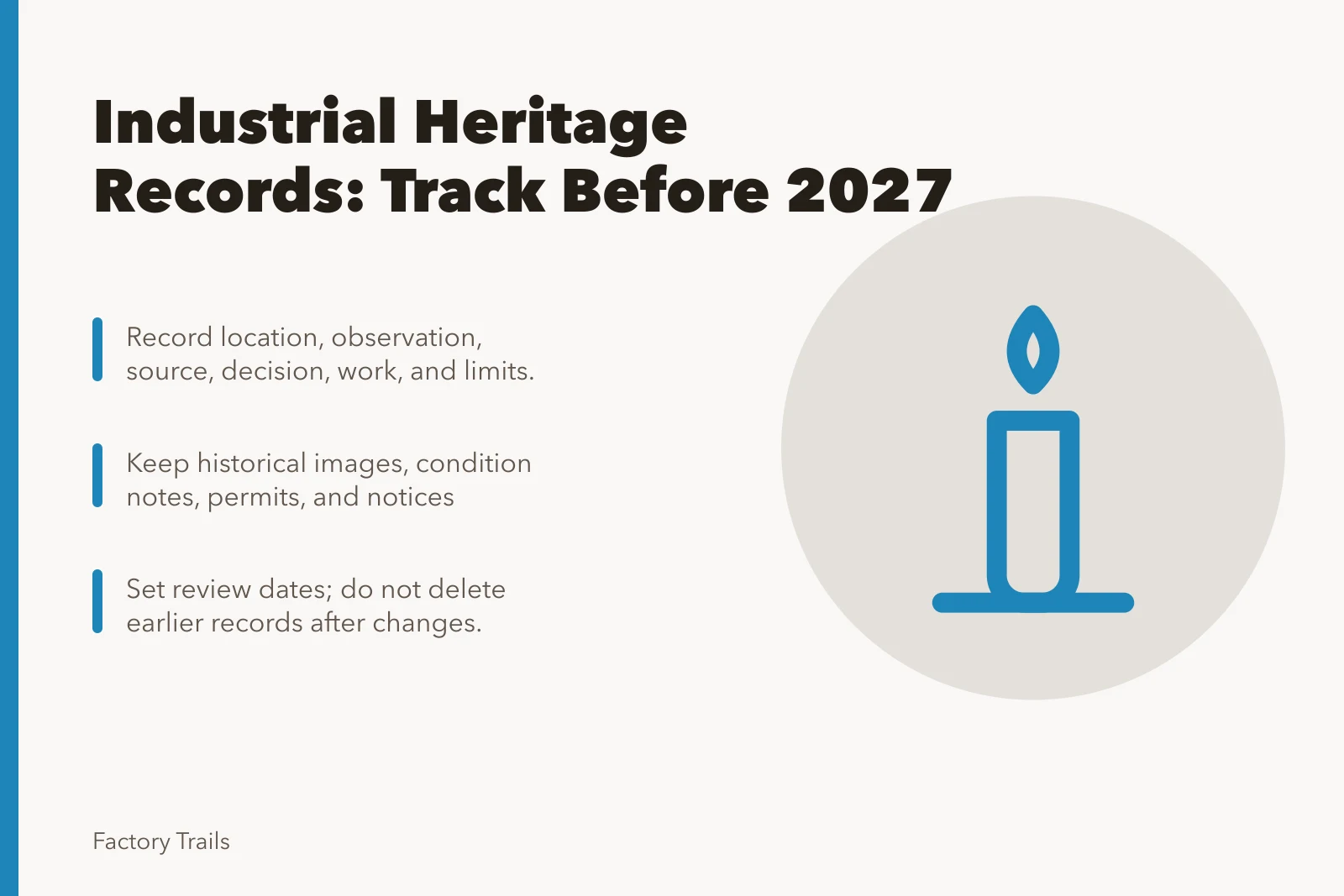
Core Record Fields
- Location and featureexact area or component
- Observationdescription, date, observer, authorized images
- Sourcetitle, URL or file location, scope
- Decisionresponsible authority, date, reason
- Work or follow-upwhat occurred, who, next review
- Limitwhat remains unknown or needs assessment
Separate record types
Keep historical images, condition observations, correspondence, permits, contractor records, and public visitor notices in separate sections. They can all matter, but they answer different questions. An archival photograph may establish past appearance. A current operator notice may establish today's access. A professional report may inform a treatment scope. Combining them without labels causes errors later.
Review and retain
Set a review date for each unresolved observation. After authorized work, update the record with the date, scope, any new photographs, and the monitoring plan. Do not delete earlier records simply because a condition has changed. They help explain why a decision was made and may reveal patterns over time.
For most private owners this is a voluntary practice. No U.S. law requires a care record of this kind, and no federal retention schedule applies to a privately held site file. Federal agencies and projects with federal permits or funding may face separate obligations under Section 106 of the National Historic Preservation Act.
Set a standard field order and review calendar
Use the field order in the table above for every entry. Add the review date and the responsible authority. Keep personal impressions separate from observed facts.
The National Park Service visitor conditions guidance points to the need for current public information. If a record mentions visitor access, attach the responsible current source.
The National Archives outlines basic records-management concepts. A clear record retains its evidence and change history, making it possible to understand why an earlier decision was revised.
The National Park Service Museum Handbook supports documenting collection context. Retain a historic image as its own record type.
Before a new person uses the file, ask them to locate one observation, its evidence, its decision, and its follow-up date. If that path is hard to trace, simplify the record labels. A care record earns its value when it supports a clear next step without relying on the memory of its original writer.
Keep the review calendar visible to the people responsible for records, operations, and stewardship. A typical cycle is annual for active sites and every three years for stable sites.
Common questions
What is the most important field in a care record?
The source and date. Together they show what the record supports and when it was true.
Should a record include unresolved questions?
Yes. Naming an unknown condition prevents it from becoming an unsupported assumption.
Who should see the record?
Access should follow the owner's policies, privacy needs, and any legal or safety constraints, while preserving a useful decision trail for authorized stewards.