Guides
How to keep factory visit care records working in 2027
Care records keep a factory visit honest: the guest message version, the material check, the session note, and the change log that explains each correction.
A care record is the file that holds what a visitor was told. It is not a maintenance log, a safety file or a personnel record. It answers one question: what did this group hear, and was it true on the day.
What to take away
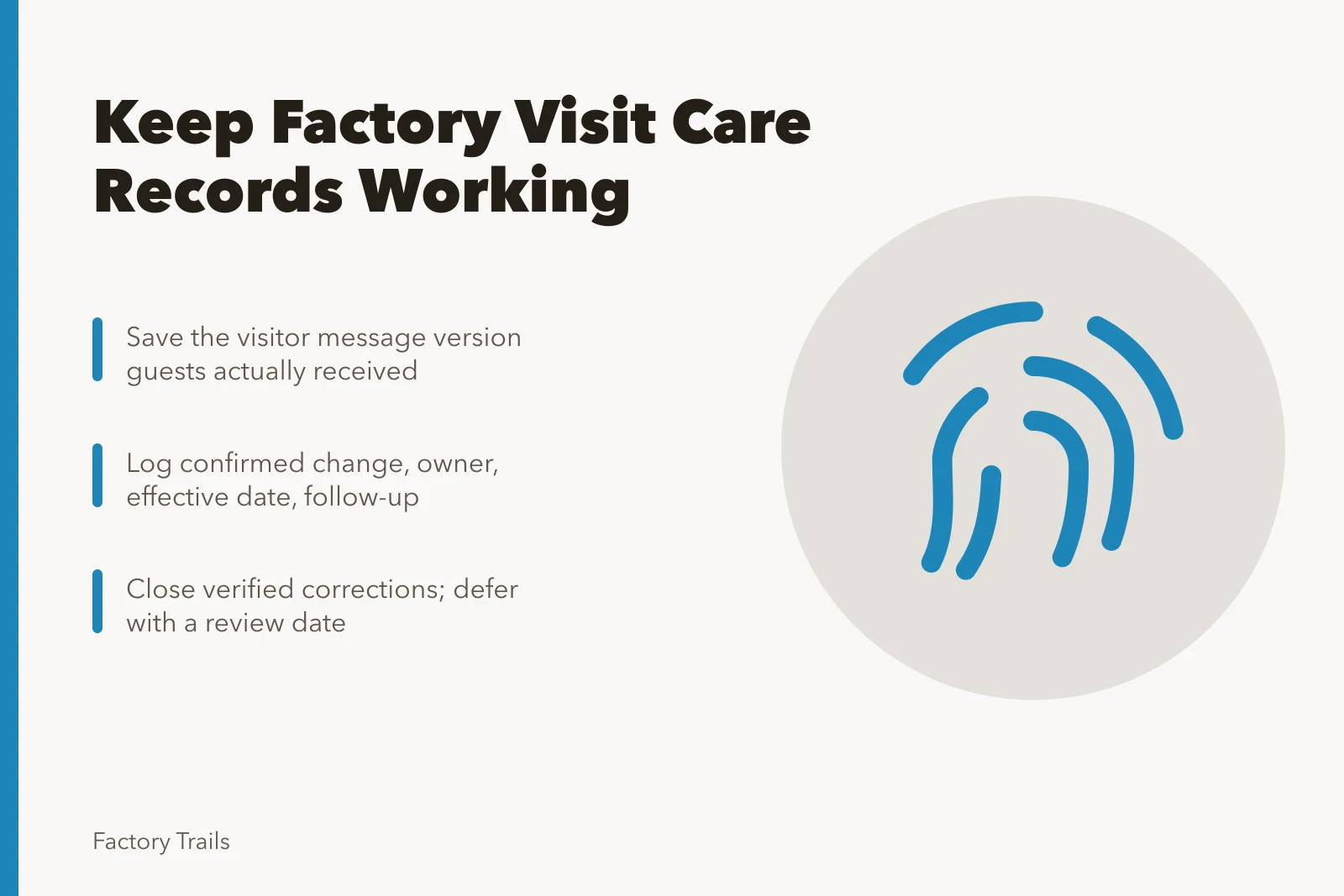
- Save the guest message exactly as the booked group received it, with its version date.
- Log the visitor-facing effect of every change, never the internal reason behind it.
- Keep the care file free of security, injury, repair and employee detail.
- Close each correction as reported, confirmed, updated, checked or deferred.
- Give the file one named owner who can confirm facts with the plant.
- Date every entry and name the person who confirmed it.
Build the care file around five entries
Start with what belongs in each entry. The filled example below shows one October session end to end.
Five care file entries
- Guest message versionsend date, route, requirements
- Material checkitem, condition, action
- Session noteformat, correction, open question
- Change logchange, owner, date, follow-up
- Review listissue, correction, next review
| Entry | What goes in it |
|---|---|
| Guest message version | Send date, route and entry point, stated requirements, contact for changes |
| Material check | Item reviewed, condition a visitor would see, action needed |
| Session note | Format actually run, material corrected on the day, open question |
| Change log | Confirmed change, owner, effective date, follow-up |
| Review list | Repeated issue, proposed correction, next review date |
A filled example, using one October session:
| Entry | Filled example, October 4 session |
|---|---|
| Guest message version | Version 3 sent October 2 to the 14 booked visitors; west gate entry; no stairs; program lead named as the contact for changes |
| Material check | Line 4 handout photo still showed the old conveyor guard; replacement photo approved October 3 |
| Session note | Briefing run as booked; guide corrected the guard photo before the 9 a.m. group; open question on how many printed handouts are still in circulation |
| Change log | Guard photo replaced; owner: program lead; effective October 4; follow-up at the November review |
| Review list | Printed handouts may still carry the old photo; proposed correction is a reprint; next review November 12 |
National Archives records-management guidance sets out identifying, capturing, organizing and controlling records over time. The principle that applies here is findability: a later host can produce the version a booked group actually received. It does not prescribe a visitor file for a plant, which is why this one stays small.
Version control for a message that repeats
Every recurring message and host brief carries a version number and a date. When a fact changes, save the new version with a one-line note on what changed and why the visitor sees it differently.
Version history does not need every draft. It needs enough for a host in March to know which message a February group received. The October example above is a complete change log entry: confirmed change, owner, effective date, follow-up.
Close corrections instead of archiving them
An open correction carries a status: reported, confirmed, updated, checked or deferred. At review, close what has been verified and carry forward only what still needs a decision.
A deferred item states why it was deferred and the date it comes back. Without that, the file fills with old problems and stops being read.
A closed correction reads: "Reported October 5: printed handout carried the old guard photo. Confirmed October 6 against the approved file. Updated October 7, reprint ordered and the booking confirmation reissued. Checked October 9 with the west gate guides. Closed."
Keep the care file in its lane
Security concerns, employee matters, injury detail, technical repairs and confidential operations belong in their own systems. If a host needs a controlled facility document, record the responsible contact rather than copying the document into the visitor folder.
The National Archives records-management fundamentals set out inventories, schedules and file plans. The principle that fits a care file is that a listed record needs a named owner and a review date before anyone can rely on it. It should not duplicate controlled maintenance or safety records.
A mixed file is harder to hand over and harder to release when someone outside the program asks a question.
Record a change to public information
When a visitor asset changes, note the date, the former version, the approved replacement and where the new one was distributed. That is what lets you explain a correction months later without relying on memory.
The National Archives web-records guidance describes managing web information across its life cycle. The principle here is that a tour page, a booking confirmation and a printed handout all need the same version discipline.
Retain permissions with the media
The U.S. Copyright Office fair-use FAQ explains that fair use is fact-specific, not a general licence to reuse material found online. Keep the source, the licence or permission, the credit text and the published placement with every image.
A source that supports a statement may not authorise reuse of its photograph. Those are two separate checks.
Plan the handoff as a review
Before a new owner takes over, open the active files together and agree which version is current and what triggers the next review. Save a dated handoff note naming the program owner and any visitor-facing update still awaiting confirmation.
Seasonal timing drives most of those triggers. A shutdown, a maintenance window or a weather pattern can change a route, and the best seasons to plan a factory tour is where that calendar belongs.
Common questions
What should a session note avoid?
Avoid sensitive operations, personal data and technical findings that belong in another system.
Who owns the care record?
Assign one program owner who can request confirmation from the facility role responsible for each underlying fact. Ownership without that route produces a file nobody can verify.
When can an old version be removed?
The National Archives General Records Schedules bind federal agencies, not a private plant, so the period is the operator's to set. One workable example: keep the current version and the two prior versions for three years, then review.
Keep enough history to explain the current message and the material decisions behind it. If the current version is challenged, the file should answer without a search.
Does a small tour need this?
Yes, at the smallest useful size. One page per session and one change log covers most programs. The care records guide lists the same five entries, the version rule and a handoff note, for programs that outgrow a single page.