Guides
Factory tours safety checklist: 6 questions to ask before you book for 2027
Factory tour safety questions for 2027 help U.S. visitors assess public access, site conditions, group needs, travel timing, and safe fallback choices.
Ask these questions before choosing between two public industrial experiences. This factory tours safety checklist covers six questions to ask before you book for 2027.
The checklist itself does not change for 2027; each operator's season, booking window and posted rules do, so confirm the answers for your date. The answers show whether a visit is suitable for the group, not whether a site is historically important.
What to take away
- Before booking, ask six questionsconfirmed public activity, conditions affecting participation, accessibility details, arrival and departure, behavior boundaries, and program changes.
- Compare public access and current conditions before travel appeal.
- Treat an unclear answer as a reason to choose another option.
Six useful questions
What is the confirmed public activity?
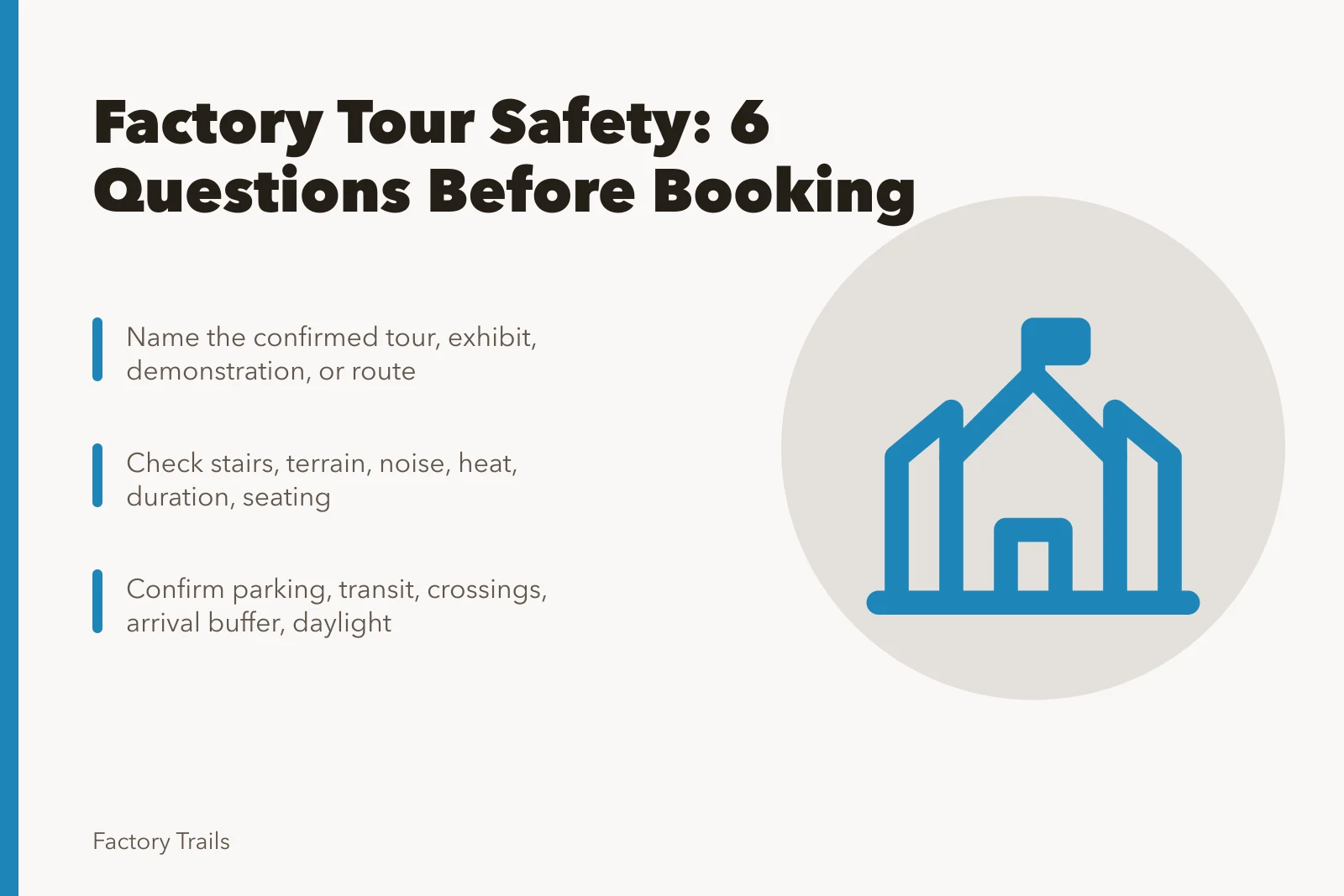
Name the tour, exhibit, demonstration, or route. A visible factory or industrial district is not automatically a visitor program. The Ford Rouge Factory Tour in Dearborn, Michigan and the Louisville Slugger Museum & Factory in Louisville, Kentucky both run public programs with their own booking pages and posted rules.
Factory Tour Safety Questions
- What is the confirmed public activity?
- What conditions affect participation?
- How will the group arrive and leave?
- What are the behavior boundaries?
- What happens if the program changes?
What conditions affect participation?
Check stairs, terrain, noise, heat, weather exposure, duration, seating, and age guidance. Ask about specific accommodations early. Open-air industrial heritage sites, such as Sloss Furnaces in Birmingham, Alabama and SteelStacks in Bethlehem, Pennsylvania, run on their own calendars, so check the current page for your date.
What accessibility details must be confirmed?
Ask for four things in writing: a step-free route from parking to the end of the tour, seating at each stop, the noise level beside running equipment, and the operator's advance notice period. A reply that names a route and a notice period is usable; a general promise is not.
How will the group arrive and leave?
Compare designated parking, transit, crossings, arrival buffer, daylight, and the return trip. A short tour can still involve a long, tiring day.
What are the behavior boundaries?
Find rules on barriers, equipment, photography, drones, food, service areas, and children. These are part of the experience, not optional restrictions.
What happens if the program changes?
Use a separately confirmed public fallback. Never substitute informal access to an active or private site.
| Question | Strong answer |
|---|---|
| Where does the public begin? | A current visitor source names the entrance or check-in point |
| What must the group follow? | Staff instructions, posted signs, and designated public routes |
| What if conditions change? | A confirmed backup or a decision to leave |
Check the operator's own current page for the date you want, and the park page for a park unit. These references are background only: CDC summer travel guidance, visitor conditions guidance, records-management fundamentals, Museum Handbook.
Common questions
Is a guided visit safer than a self-guided route?
It may provide clearer boundaries, but each option must be checked for its actual conditions and instructions.
Should I bring children to a demonstration?
Follow the stated age guidance and keep children with an adult at all times.
What should I ask about accessibility?
Ask when you book, not on arrival. Some operators need advance notice for a step-free route or extra staff.
Should a group separate to see more?
Only when every person understands the public boundary and a meeting plan. For most short visits, staying together is simpler and safer.
When answers are vague, choose the option with clearer current visitor information. Good safety planning is often a decision to prefer certainty over novelty.