Guides
Factory tours regional checklist: what to verify before you budget for 2027
Factory tour regional checklist for 2027 helps U.S. operators check arrival, route, access, seasonal conditions, group demand, local staffing, and communication.
Use this checklist before introducing a new factory-tour location, seasonal version, or region-specific itinerary. It is a pre-budget verification step. Confirm the journey, the access, and the local calendar before any 2027 cost figure goes into a plan. It keeps regional planning focused on actual visitor and operating conditions.
What to take away
- Check the journey to the tour, not just the tour route.
- Treat accessibility and local weather as main planning inputs.
- Capture the authority and fallback for every regional change.
- Start the pre-season review at least eight weeks before the first 2027 session goes on sale.
- Price staffing and the alternate route before you commit to a seasonal version.
Regional readiness checklist
| Area | Check | Record |
|---|---|---|
| Arrival | Entrance, parking, transit, passenger drop-off, and late-arrival instructions are current. | Booking language and map owner |
| Route | The approved route matches the building, production, and seasonal conditions. | Route version and review date |
| Access | Route characteristics and approved access options are clear. | Responsible site contact |
| Calendar | Weather, events, shutdowns, school periods, and peak demand are known. | Seasonal triggers |
| Group mix | Typical group size, age range, language needs, and chaperone pattern are understood. | Capacity and host plan |
| Staffing | Hosts and facility contacts can support the version being sold. | Backup role and escalation path |
| Fallback | A change to route or timing has an approved alternative. | Guest-notice template |
The U.S. Access Board's accessible-routes guide explains how accessible routes connect site arrival points, entrances, and accessible spaces under the ADA Standards. Use the site team's approved information when describing access. A marketing or tour team should not independently certify technical compliance.
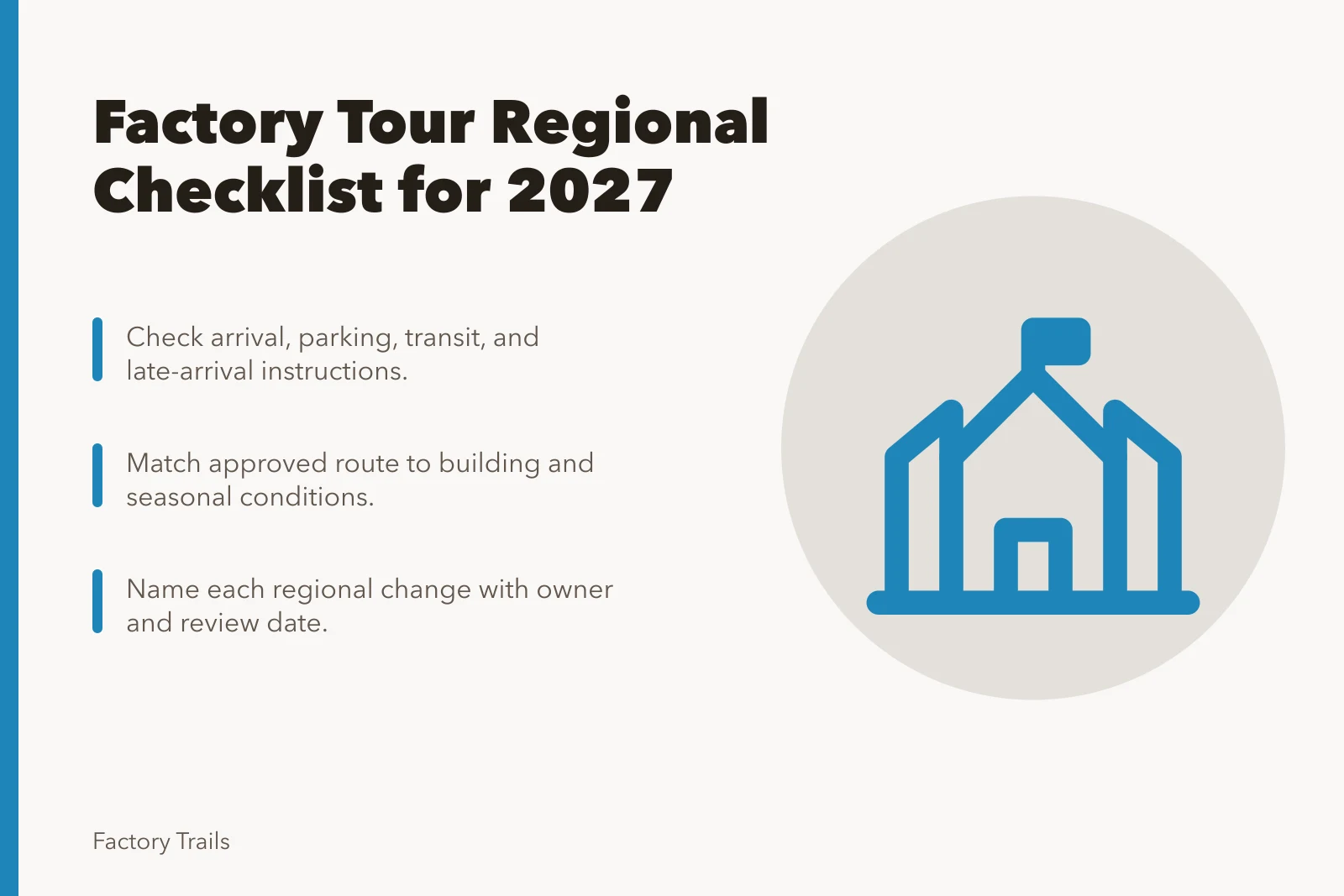
Regional Readiness Checklist
- Arrivalentrance, parking, transit, drop-off
- Routematches building and season
- Accessroute and options clear
- Calendarweather, events, shutdowns, demand
- Group mixsize, age, language, chaperones
- Staffinghosts and backup escalation path
- Fallbackapproved alternative and notice template
What drives 2027 cost
Three line items move a 2027 regional budget: staffing, alternate routes, and seasonal versions.
Staffing is a per-session cost. One extra host for a 90-minute tour typically adds $30 to $60 in wages and overhead at U.S. rates. A second route that needs its own greeter doubles that line.
Alternate routes carry one-time costs. A revised map, alternate-format directions, and host training for a single site typically run $500 to $2,000. Print volume and whether signage changes drive the spread.
Seasonal versions swing widest. A winter arrival with a covered meeting point and lighting costs more than the summer version.
Regional calendars change the total. In southeast Michigan, U.S. automakers typically idle assembly plants for a summer shutdown in early July, so a July itinerary needs an approved alternative route. Gulf Coast itineraries need a contingency for the Atlantic hurricane season, which runs June 1 to November 30.
Arrival logistics carry cost too. Hershey's Chocolate World in Hershey, Pennsylvania sits off US Route 422 with no passenger rail stop, so the plan assumes car and coach drop-off rather than transit.
The same checklist applies to a museum and factory site such as the Louisville Slugger Museum & Factory in Louisville, Kentucky.
Ask for observable evidence
The National Park Service interpretive-planning program describes planning around intended visitor outcomes and audiences. For a regional factory-tour program, begin with the outcome, then confirm which local route or format can deliver it in the current season. This is not an approval for a site. It prevents an appealing regional description from becoming a promise the facility cannot keep.
The Department of Justice effective-communication guidance explains that communication choices depend on nature, length, complexity, and context. Use that principle to check whether local arrival directions, schedule changes, and alternate-format information are understandable before a visitor travels to the site.
The National Archives web-records guidance explains that online content can document official business. Save the dated regional page and organizer message with the checklist result.
Check the regional details at the real decision point: the arrival route, meeting area, season, and planned group format. A general statement about a city or region does not substitute for a current visitor-facing confirmation.
Run the checklist close to each regional session, especially when a local calendar, weather pattern, parking arrangement, or staffing plan changes.
At the end of the season, compare repeated checklist changes. If the same local issue appears in several sessions, make it part of the next season's normal planning rather than relying on a last-minute correction.
Include a short review of the guest message in every close-out. Check that the stated meeting point, expected duration, restrictions, and alternate option matched the session actually delivered. If the answer is no, identify which message needs correction. This review keeps regional learning tied to the visitor's experience instead of a general note about weather, demand, or location.
"Visitors probably find the entrance" is not evidence. "Three first-time guests used the current directions during the same arrival window" is a useful test.
Keep regional changes visible
Give each change a name, an owner, and a review date. For example: "Winter arrival version, owner: visitor operations, review: March 15." This avoids a quiet seasonal workaround becoming an undocumented permanent process.
Date the close-out and retain it with the current regional plan. Record the next session's use of the reviewed version before tickets for that session go on sale.
Common questions
What makes a change regional rather than site-specific?
The practical distinction is not important. Use whichever label helps the team identify a recurring condition and prepare a reliable response.
Who approves access language?
Use the responsible facility, access, or compliance role. Tour staff can make the language clearer but should not broaden an approved claim.
When should this checklist be repeated?
Repeat it before a new season, major event, route revision, or material change in the visitor mix.