Guides
Factory tour warning signs U.S. sites should catch before 2027
Staff workload hides most factory tour warning signs, so the fix starts with what guides carry, repeat and cover up on a normal operating day.
What to take away
- A guide who carries a barrier, repeats a briefing or covers two roles is absorbing a design fault the manager never sees.
- Ask staff what they do that is not in the written plan. That list is your next round of corrections.
- Boundary crossings, lost sightlines, unprepared guests, skipped checks and fresh wear on a feature each point at a different fix.
- Log the condition, location, group size and response, so a repeat is visible instead of remembered.
- Tell the team what changed after they report something, or the reporting stops.
The warning sign is usually a person, not a thing
Most plant tours do not fail loudly. They fail quietly, and the failure is carried by whoever is on shift. A guide lifts a barrier back into place at the third stop.
A volunteer repeats the same stair warning to every group. Someone walks a visitor the long way round because the marked alternate entrance is not where the map says it is.
Group size shows it first. Typical guided industrial tours run 15 to 25 visitors per guide, and that is a working range, not a standard. What sets your number is the largest group your guide can still see end to end from the stop.
What changes for U.S. sites before 2027
No new federal rule sets a 2027 deadline for guided factory tours.
What changes is older and duller. The 2010 ADA Standards for Accessible Design apply now. Barrier removal under Title III, 28 CFR 36.304, is continuous rather than dated.
Public sites update an ADA transition plan under 28 CFR 35.150. OSHA requires walking-working surfaces to be inspected regularly under 29 CFR 1910.22(d). That requirement puts the date on your own schedule.
Three dates are already in your calendar. Insurance renewal, when the carrier asks for inspection records. The budget round, when barrier, signage and surface work needs a line item. The pre-season walk, when the route is checked before the first coach arrives.
Cost is set by linear feet of barrier, whether posts are fixed or portable, whether the change touches a listed structure, and whether your crew or a contractor does the work. Get three quotes before you promise a date.
Ask what staff do that is not in the plan
Put the question plainly to guides, front desk and maintenance: what do you do on a normal day that nobody wrote down? The answers sort themselves into fixes. A sign in the wrong place. A group limit set before the mezzanine viewing rail went in. A route check that happens after the first coach arrives instead of before.
Six signals and what each one actually means
| Signal | What it reveals | First action |
|---|---|---|
| Visitors cross a boundary | The barrier, route or briefing is weak | Reset the boundary, then review the layout |
| A guide loses sight of guests | Capacity or stop spacing is too demanding | Cut the group or add coverage |
| The same route closes | A condition is being managed, not repaired | Use the alternate and open a repair request |
| Guests arrive unprepared | Booking copy does not match the experience | Revise the event page and confirmation |
| Staff skip a check | The routine is vague, long or unowned | Simplify it and name the role |
| A feature shows new wear | Public use is exposing something avoidable | Isolate, document, consult the site lead |
Two rows deserve more than a glance. A route that closes on the same schedule every month is not a maintenance problem, it is a decision nobody has made. And a skipped check is rarely laziness; it is usually a checklist written by someone who never walked the route at pace.
Six tour warning signals
- Visitors cross a boundaryreset boundary, review layout
- Guide loses sight of guestscut group or add coverage
- Same route closesuse alternate, open repair request
- Guests arrive unpreparedrevise event page and confirmation
- Staff skip a checksimplify routine, name the role
- Feature shows new wearisolate, document, consult site lead
Respond at three levels
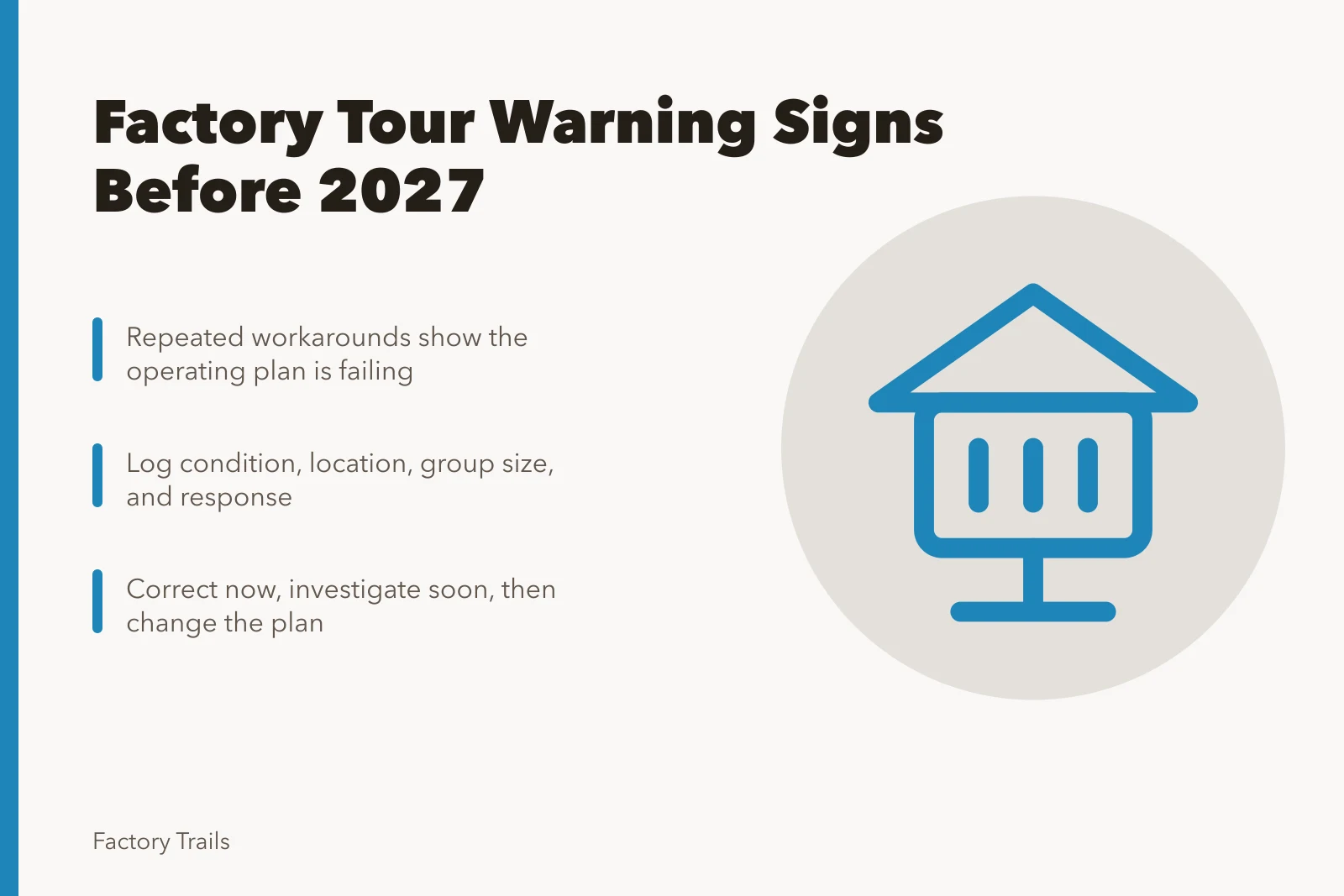
- Correct nowstop the activity, reset the barrier, move the group, use the prepared alternate.
- Investigate soonread the similar entries, inspect the location, ask staff why the workaround exists.
- Change the planadjust route, capacity, staffing, information, equipment or maintenance scope once the condition repeats.
Do not jump from a small signal to a capital project. Verify the pattern first. Equally, do not let a temporary fix run for two years and call it the program.
Stop spacing has no federal number. What sets it is sightline: a guide should see every visitor and the nearest exit without leaving the stop.
A walking surface is a technical condition, not a service complaint
When the signal involves the ground itself, treat it as an engineering question. The U.S. Access Board's floor and ground-surface guide sets out that accessible surfaces must be stable, firm and slip resistant. That wording comes from section 302.1 of the 2010 ADA Standards for Accessible Design, issued under 36 CFR part 1191.
Three numbers turn it into a work order. A change in level up to 1/4 inch may be vertical. Between 1/4 inch and 1/2 inch it must be beveled at 1:2 or flatter. Above 1/2 inch it needs a ramp. All three come from section 303.2.
Openings in the surface may not pass a 1/2 inch sphere (section 302.3). Where visitors stand above a lower level, fall protection starts at 4 feet (29 CFR 1910.28(b)(1)), and a guardrail top rail sits at 42 inches, plus or minus 3 (29 CFR 1910.29(b)(1)).
Set a wear inspection interval and keep it. Weekly through peak season and monthly off season is common practice. 29 CFR 1910.22(d) requires surfaces to be inspected regularly and as necessary, so the interval is yours to set and to defend.
That is the reference for the condition. What you do about it at a 1900s foundry floor is a local call, made with the site's own safety officer and published visitor rules.
Separate use data from a complaint list
One complaint is a preference. The same question asked at check-in three Saturdays running is data. Record the condition, the location, the group size and what you did. A notebook is enough, as long as someone reads it.
The NPS visitor-use monitoring guidebook makes the distinction that matters here: consistent observation separates environmental change from visitor-caused degradation. You cannot tell which one you have until you have watched the same spot for a while.
Three-level response
- Correct nowstop activity, reset barrier, move group
- Investigate soonread entries, inspect, ask staff
- Change the planadjust route, capacity, staffing, information
When a feature shows new wear
Repeated contact with a fragile feature usually means the path, the viewing distance or the supervision is wrong, not the visitors. National Park Service stewardship guidance notes that access vulnerable to damage from human use can be limited, monitored or controlled. That guidance sits under NPS Director's Order 28, Cultural Resource Management.
On a tour that translates to moving the rope line, widening the standoff or stationing someone at the pinch point.
Close the loop where staff can see it
When a report leads to a repair, a closure or a revised route, say so out loud at the next briefing.
A guide who flagged a recurring trip point and then watched nothing happen will stop flagging.
Review active warning signs monthly through peak season, and carry anything unresolved into the maintenance calendar with a named owner and a date.
Some signals cannot wait for the monthly review. OSHA's emergency action plan guidance covers employee reporting, evacuation and assigned duties. The rule behind it is 29 CFR 1910.38, which requires a written plan, reporting procedures and named duties. The host site's own plan is what says who may stop a tour, move a group or call emergency services.
Common questions
How many reports make a warning sign?
One serious event can be enough on its own. Smaller issues earn the label when they repeat, cluster at one location, or quietly add work to somebody's shift.
Should visitor wear always mean the tour is at fault?
Not always, but it always deserves a look. Compare the wear against normal conditions, visitor flow, barrier placement and maintenance records before deciding what to change.
Who should see the warning log?
The program lead, the facilities contact, safety staff and anyone holding a follow-up action. Access should be wide enough that a repeat is spotted by more than one person.
What if the fix costs money we do not have this year?
Log it, name the owner, and put it in next year's planning round with the evidence attached. An unresolved item with a date on it is a decision. An unresolved item in someone's memory is not.