Guides
Factory tour mistakes: how to budget fixes for U.S. sites in 2027
2027 factory tour budget guide with dollar ranges for safety fixes, barriers, signs, radios, training, access repairs, and contingency funds at U.S. sites.
What to take away
- Use operating evidence to fund prevention before a repeated problem becomes an incident.
- Separate urgent corrections, recurring operating needs, and durable improvements.
- For 2027, plan line items from $300 for a barrier to $25,000 for an accessibility surface repair.
- A small documented repair can protect safety, access, and historic fabric at the same time.
Fund the error before it repeats
Tour budgets often describe programs, not conditions. A 2027 request should attach a dollar figure to a specific defect. Start with evidence from route checks, visitor questions, near misses, closures, and work orders.
2027 Budget Categories and Ranges
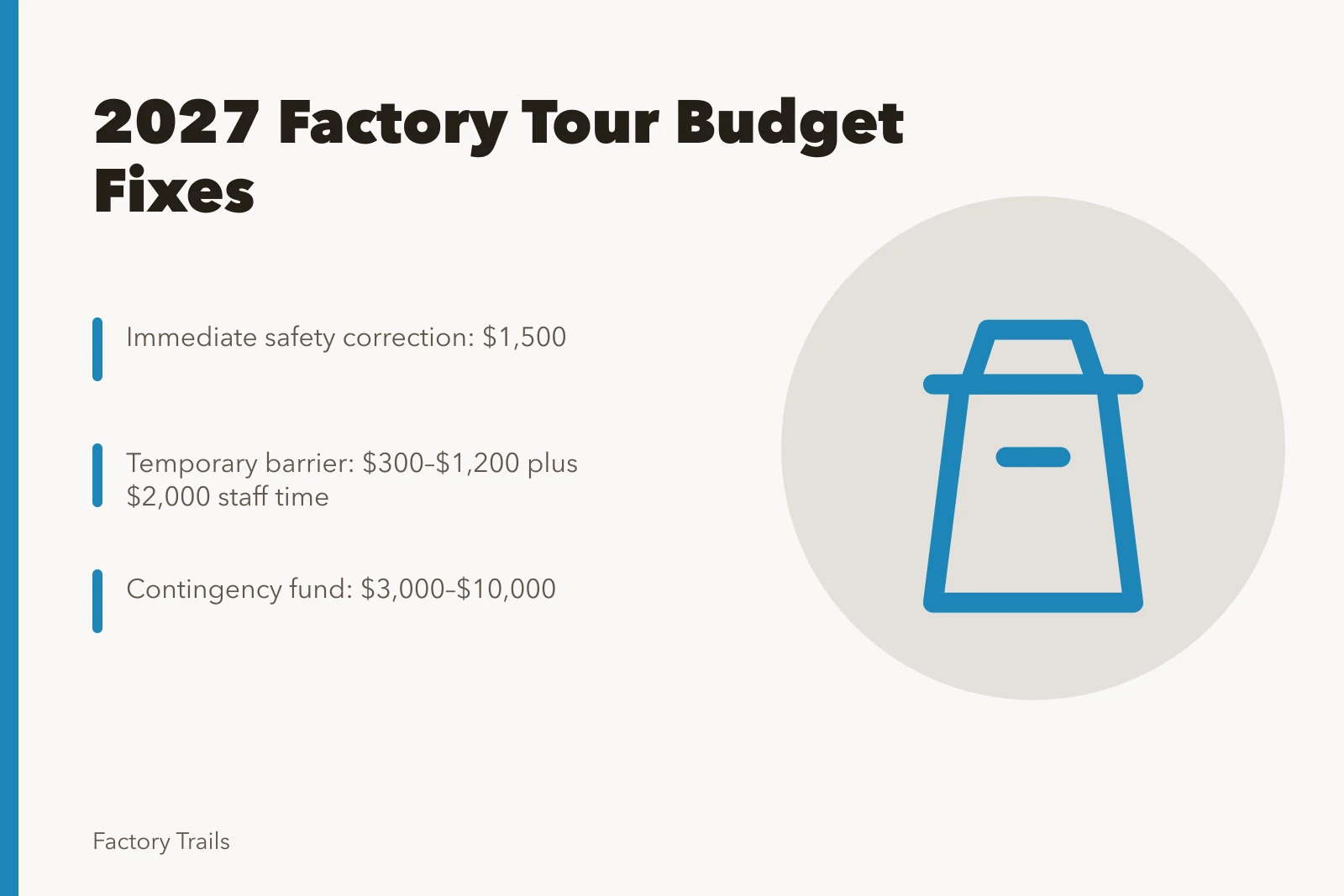
- $1,500–$12,000Immediate safety correction
- $300–$1,200 per spotTemporary control
- $150–$600 per signWayfinding and rules
- $250–$600 per radioCommunications
- $1,000–$5,000 per siteStaff coverage and training
- $4,000–$25,000Accessible surface repair
- $3,000–$10,000 or 10–15%Contingency
Use these 2027 budget categories for U.S. factory tour sites:
| 2027 category | Typical range | What it pays for |
|---|---|---|
| Immediate safety correction | $1,500 to $12,000 | Handrail repair, exit clearance, failed radio replacement |
| Temporary control | $300 to $1,200 per spot | Cones, retractable belt barriers, portable signs |
| Wayfinding and rules | $150 to $600 per sign | Stock or custom signs, map boards, floor decals |
| Communications | $250 to $600 per radio | Business radios, chargers, earpieces |
| Staff coverage and training | $1,000 to $5,000 per site | Extra guide hours, safety drills, accessibility training |
| Accessible surface repair | $4,000 to $25,000 | Stable, firm, slip resistant path fixes |
| Contingency | $3,000 to $10,000 or 10% to 15% | Storm damage, urgent repairs, replacement parts |
For 2027, add 3% to 5% for material and labor inflation if your finance office does not already apply an index.
The Interagency Visitor Use Management Framework calls for strategies that maintain desired resource conditions and visitor experiences, followed by monitoring and adjustment. State what a funded change prevents, then check the result.
Price the operational consequence
Do not price only the repair. A temporary barrier may cost $300 to $1,200, but staff time to reset it can add $2,000 or more over a season. A permanent guardrail or better fixture may run $2,500 to $15,000 and reduce that recurring cost.
Temporary vs Permanent Barrier Costs
Temporary barrier
- Initial cost
- $300–$1,200
- Recurring staff cost
- $2,000+ per season
Permanent guardrail
- Initial cost
- $2,500–$15,000
- Recurring staff cost
- Reduced
OSHA explains that a consultation can help identify hazards, provide a written report, and support an effective safety and health program. Its on-site consultation overview also describes the need to eliminate or control serious hazards through a reasonable plan and schedule. OSHA On-Site Consultation is free and confidential for small businesses. Use it to document the problem, set an owner, and fund a realistic correction.
Do not confuse a temporary supply with a solution
Supplies are necessary: Uline 28-inch traffic cones commonly list from $14 to $20 each, and Rubbermaid Commercial wet floor signs often run $20 to $45 each. But supplies do not solve every underlying mistake. If rain repeatedly makes an area unsafe, more cones are not a route strategy.
Use this test before approving a recurring expense:
- Does it reduce the exposure at the source?
- Can staff use it consistently during a busy tour?
- Does it preserve an accessible and meaningful visitor experience?
- Will it still work after weather, crowding, or a staff change?
If not, record a larger project for the next budget cycle.
For queue control, Tensator retractable belt barriers are a common option. A four-post set often prices between $600 and $1,500. For radios, Motorola Solutions business models are sold through dealers; budget $250 to $600 per radio. For signs, Brady Corporation makes custom facility signs, and Grainger stocks modular guardrail, signs, and cones for quick purchase. Get site-specific design and preservation advice before work begins.
Route work may also affect accessibility. The U.S. Access Board's floor and ground-surface guide explains that accessible surfaces must be stable, firm, and slip resistant. Bring that reference to the conversation when a project affects a walking surface.
Reserve a correction fund
Keep a 2027 contingency of $3,000 to $10,000 for conditions that cannot wait: a damaged rail, a failed communication device, storm debris, or an urgent sign replacement. Define who can authorize its use and require a short follow-up note. The note should state what happened, what was purchased or repaired, and whether the condition needs a longer-term solution.
This avoids a common mistake: reopening a route because no routine budget line can pay for the immediate correction.
For historic fabric, the work scope matters as much as the budget amount. The National Park Service's treatment guidance outlines preservation, rehabilitation, restoration, and reconstruction approaches. Ask whether a proposed fix respects the property's documented treatment approach.
Close the budget loop
After the season, compare the planned budget with actual modifications and repairs. Did a $1,000 training expense reduce route errors? Did a $2,500 barrier eliminate a recurring reset? Did an alternate program reduce cancellations? Keep the answers with the next budget request. Specific results make prevention easier to fund than a general request for "more safety."
Common questions
What should be funded first?
Fund conditions that could stop safe public operation: emergency access, route hazards, critical barriers, staff coverage, and communication.
Can visitor feedback support a budget request?
Yes. Combine it with route logs, staff observations, and closure data to show how a condition affects the experience and operation.
Who owns the correction budget?
The program lead, facilities contact, and budget owner should agree on the approval process and review recurring issues together.