Guides
What to keep in factory tour hiring records at U.S. sites going forward
Factory tour hiring records guide for U.S. sites in 2027 explains what to retain from scopes, proposals, qualifications, changes, site work, handover, and follow-up.
What to take away
- Provider records should show what was requested, who was selected, what changed, and how work was completed.
- Keep technical decisions, public-operation controls, and maintenance instructions with the final project record.
- Good records make future repairs, audits, and staff handoffs much easier.
Build one complete provider file
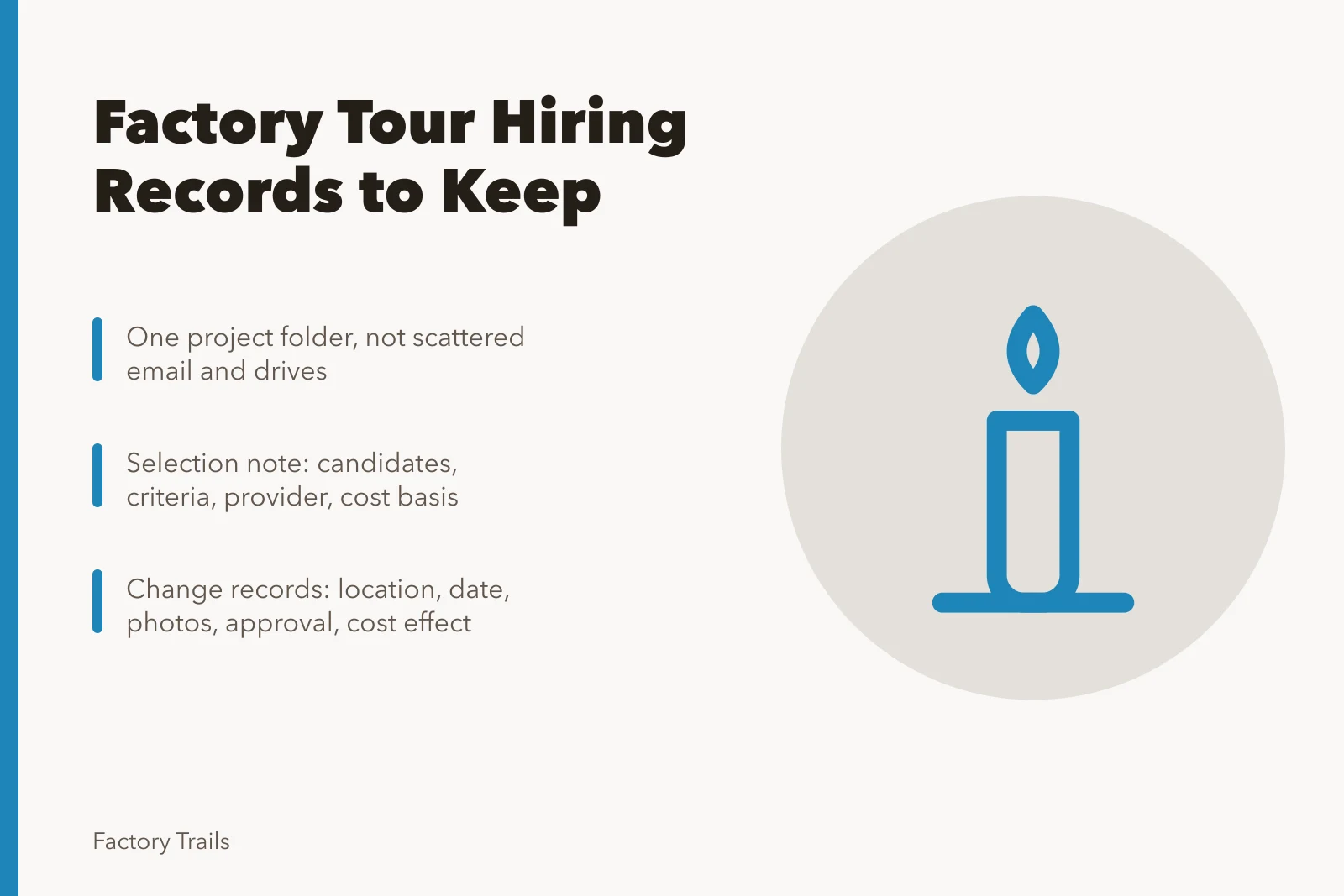
Do not scatter provider records across email, a shared drive, a work-order system, and individual phones. Create one project folder with a consistent name and list the documents required before work begins. The goal is not paperwork for its own sake. It is a reliable account of why the site made a decision and what future staff need to know.
Provider File Records
- Scope and conditionmaps, photos, reports
- Provider evaluationproposals, score sheet, references
- Agreement and insurancesigned scope, licenses
- Site controlsroute plan, barriers, notices
- Change recordcondition, options, approval, cost
- Completion recordphotos, warranties, open items
| Record | Keep | Use later for |
|---|---|---|
| Scope and condition | Maps, photos, reports, objective, public constraints | Comparing proposals and future maintenance |
| Provider evaluation | Proposals, score sheet, references, qualifications | Explaining the selection decision |
| Agreement and insurance | Signed scope, schedule, licenses, coverage | Confirming responsibilities |
| Site controls | Route plan, barriers, visitor notices, contacts | Managing public work safely |
| Change record | Condition found, options, approval, cost and schedule | Preventing scope disputes |
| Completion record | Photos, materials, warranties, care guidance, open items | Long-term stewardship |
Record the decision before the work starts
Write a short selection note that names the candidates considered, criteria used, relevant references, final provider, cost basis, and any conditions of award. If a specialized provider was selected because of historic material, public access, or a complex method, say so clearly. That note helps a future manager understand why a lower price was not necessarily the right choice.
Selection Note Contents
- Candidates considered
- Criteria used
- Relevant references
- Final provider
- Cost basis
- Conditions of award
The National Park Service's training on preservation certification applications emphasizes documentation requirements for drawings, photographs, conditions, and completed work. Its preservation-training resource reinforces a useful project rule: documentation should be gathered through the work, not reconstructed after it is over.
The National Archives records-management FAQ index offers general information about records that remain identifiable and manageable over time. It is not a construction filing system, but it supports giving each scope, change decision, final record, and contact a clear date, owner, and version.
Keep change records factual
Historic work can uncover conditions that the original scope could not see. When that happens, record the location, date, photographs, observed condition, options, recommendation, price or time effect, person approving the change, and any public-route effect. Do not rely on a phone call or a verbal "go ahead" for a material change.
This record protects the site and provider. It also becomes essential when a future repair encounters the same area and staff need to know what was found previously.
Document public-operation controls
If work overlaps with visitors, retain the route map, closure periods, alternate experience, signs or messages used, incident notes, and any access modifications. These documents show whether the project controlled the public impact as promised. They also help the next provider plan around the site without repeating a disruptive mistake.
Keep the current route-control instruction with the project record. The Occupational Safety and Health Administration exit-route guidance says exit routes in covered workplaces must remain free and unobstructed. Visitor movement follows the site's procedure, but the project file should show who could approve a barrier or alternate route and what was communicated to staff.
Close out with a usable handover
Before final payment, confirm that the provider has supplied required deliverables. Walk the finished work with facilities and program staff. Test a visitor route, new sign, barrier, or equipment in the way it will actually be used. Record remaining items and a due date.
Store care guidance where the person responsible for daily operation can find it. A material data sheet hidden in an old email is not a maintenance plan.
The National Park Service's architectural-preservation quality-assurance checklist includes condition, treatment, technical, and contract records. It is not a substitute for the site's contract. It gives a useful closeout test: can a later manager find what was observed, what was done, what material was used, and what care remains?
Review the record before final payment
Open the scope, approved changes, route controls, final photos, warranties, and care information together. Confirm that the agreement's record requirements are complete and assign any unresolved item to a named person and date. A final payment review should close the work without losing the facts future staff need.
Use a stable file name for each final item and record the version date in the file itself. For example, label a final route map differently from a sketch prepared during the bid stage. This avoids a common handover failure: staff later find several similar files but cannot tell which one reflects the completed work or current operating instruction.
Common questions
Who should own the provider record?
The role that manages the agreement should maintain the official file, with access for facilities, preservation, safety, and program staff who need project information.
Should routine small work be documented too?
Yes, at a level that matches risk. A small repair still needs a work order, location, method, and completion note when it affects a visitor route or historic material.
When is a project file complete?
It is complete after final work, records, training, maintenance instructions, warranties, and unresolved follow-up items are confirmed and stored.