Reviews
Part of Factory tour cost planning for U.S. visitors: what to confirm before booking a 2027 trip
Factory tour cost questions U.S. visitors should ask before booking 2027
Factory tour cost questions for U.S. visitors in 2027 compare cheap and low-risk plans, explain payment terms, and show what needs a current operator answer.
Cost questions are useful when they reveal a decision, not when they chase the lowest number. Start with the prices a site publishes for the date you want, then ask which numbers move when group size, the season, or the arrival time changes.
What to take away
- A lower ticket price may create higher transport or time costs.
- Payment terms can matter more than a small price difference.
- Ask an operator about the exact program, not a general site visit.
- Compare the certainty of a plan as well as its total.
- Published rates run from free tours to roughly $10 to $30 per adult, a typical range.
- Deposits and group minimums often decide the final bill.
Ask these questions before choosing
Question / Why it matters
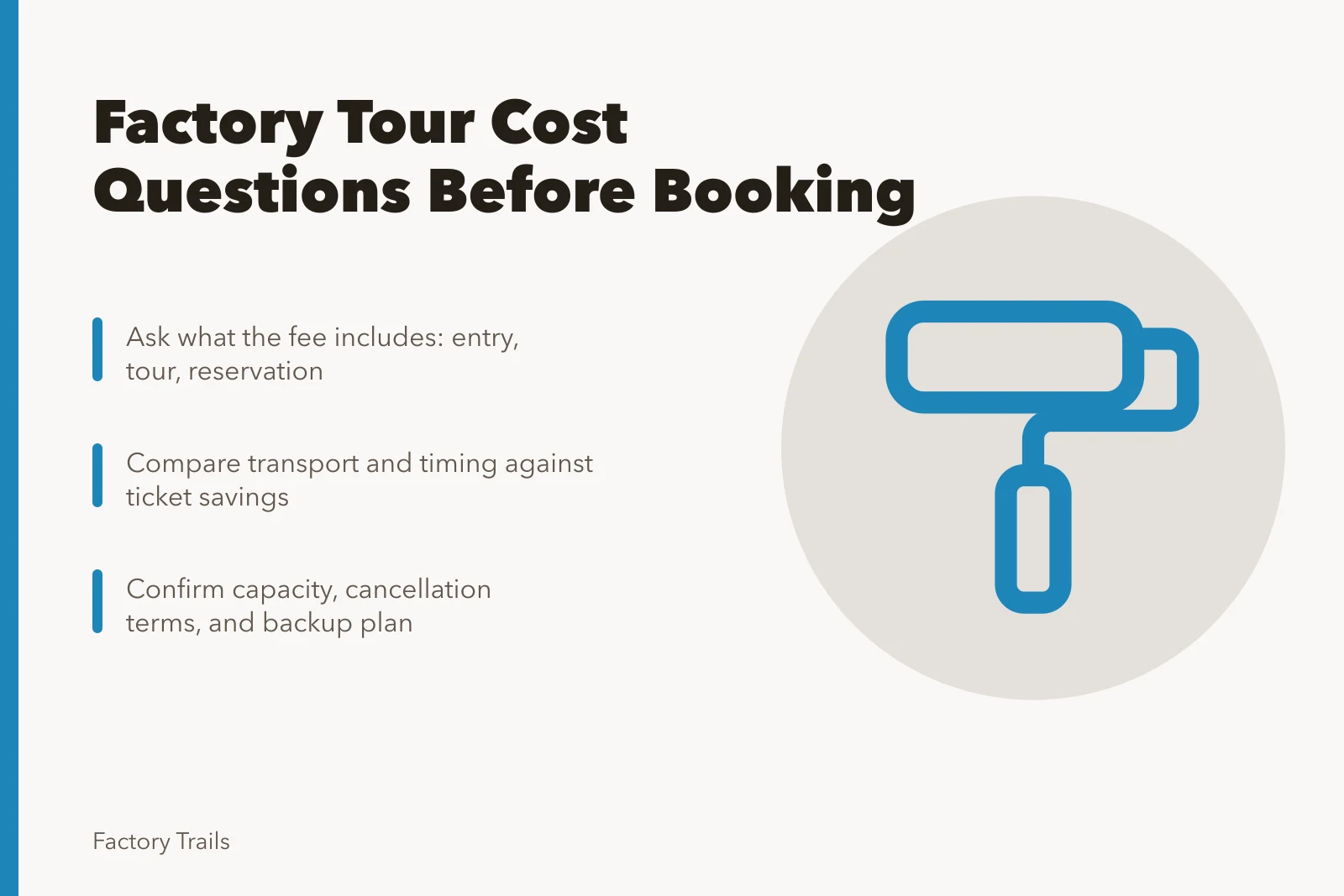
- What does this fee include?
- Entry, a tour, and a reservation may be separate
- What does the group pay beyond admission?
- Transport and timing can outweigh a ticket saving
- What deposit is due, and when is it refundable?
- A rigid booking has a cost when plans shift
- What is capacity on the chosen date?
- A low price is useless if the program is full
- What is the backup plan?
- A realistic alternative keeps costs controlled
The best answer is often specific to one site, date, and group size. Do not expect an average cost from another attraction to settle it.
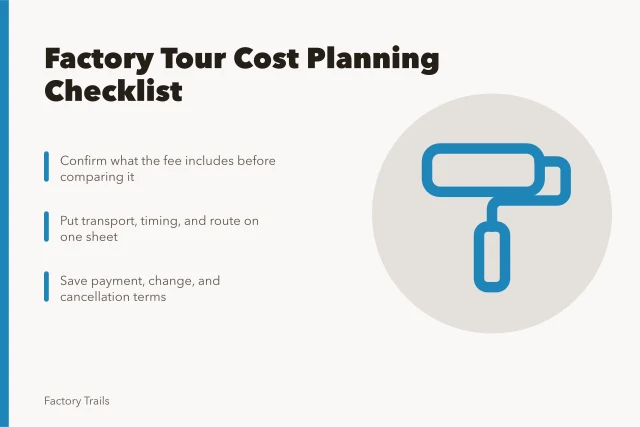
Pre-booking questions to ask
- What does this fee include?
- What does the group pay beyond admission?
- Can the group change or cancel?
- What is capacity on the chosen date?
- What is the backup plan?
What U.S. factory tours charge
The Jelly Belly Visitor Center in Fairfield, California runs free tours and takes no deposit.
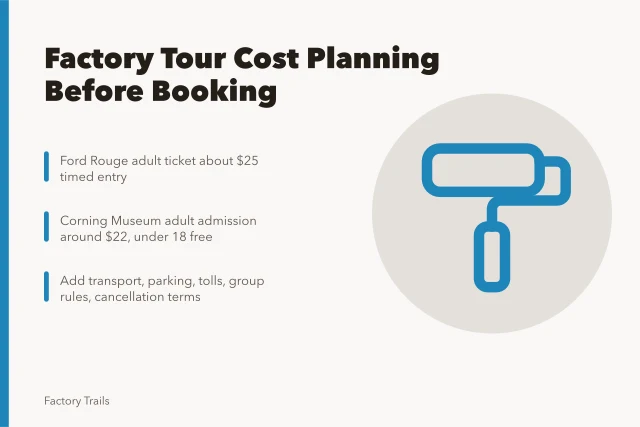
The Ford Rouge Factory Tour in Dearborn, Michigan sells timed entries at a per-person rate and can sell out on peak dates. The Louisville Slugger Museum & Factory in Louisville, Kentucky folds its factory tour into museum admission.
Typical paid factory tours run from about $10 to $30 per adult, with child tickets often near half price and group minimums commonly at 10 to 15 people.
Deposits for U.S. factory tours usually run between 25 and 50 percent of the total at booking. The final headcount is typically due 7 to 14 days before the date, and refunds typically require a cancellation notice of 14 to 30 days.
Compare a cheap plan with a low-risk plan
| Cheap plan | Low-risk plan |
|---|---|
| Lowest listed ticket price | Clear program terms and confirmed capacity |
| Tight arrival window | Buffer for parking and check-in |
| One weather-sensitive activity | A named alternate activity |
| No stated transport option | Confirmed drop-off or parking arrangement |
| Assumes every visitor uses the same route | Plans for known access needs |
Neither column is always better. A small family can choose a flexible low-cost plan. A large group may spend more to reduce the risk of a missed entry or unsuitable route. The point is to make the tradeoff visible before money changes hands.
Policy wording decides what a group can recover. The Smithsonian Environmental Research Center states that its group-trip deposits are non-refundable except in specified circumstances and that a request does not itself constitute an agreed booking.
That is not a rule for factory tours. It illustrates two questions worth asking any operator: when does a request become confirmed, and what payment can be recovered if the plan changes? See the Smithsonian group-trip information for the direct policy example.
Ask about the conditions behind the price
If a tour is cheaper at a certain time, ask what differs. Is the route shorter, is a guide unavailable, or does weather make a feature uncertain? If a group rate is offered, ask the minimum, payment deadline, and what happens if the final count changes.
Handling fees, bus parking charges, and timed-entry surcharges are separate line items at many sites. Ask for each one by name before the group pays a deposit.
Ask about the route that comes with the price. The U.S. Access Board's accessible-route guide identifies walking surfaces, doors, ramps, curb ramps, elevators, and permitted lifts as route components.
It gives a group practical terms for asking whether a different route, arrival point, or transport need could change the full plan. It does not determine a historic site's access policy.
Ask which action the operator takes if the program must stop or change. OSHA's emergency action plan guidance covers employee reporting, evacuation procedures, and assigned duties.
Visitors should follow the host site's instructions, but the question remains relevant to cost: will the group be offered a delayed program, an indoor option, a reschedule, or a stated refund path?
Ask for the current policy page, not a summary from another visitor. The National Archives research-room guidance advises visitors to verify local hours, procedures, and availability with the relevant facility. A specific official page supports a better comparison of fees and terms than a search result or an old review.
Ask who confirms the final headcount. Group rates, deposits, and transport depend on it. A leader should know the date the count becomes fixed and who accepts later changes.
What changes for 2027
Booking windows have stretched. Many U.S. factory tours open timed slots 60 to 90 days ahead, and school groups claim spring weekday mornings by early fall. A group that waits can pay more for a worse slot.
Dynamic pricing is spreading. Some sites charge more on weekends, holidays, and peak summer weeks. The gap between a Tuesday morning and a Saturday afternoon can reach 20 to 30 percent, a typical range.
Group minimums are enforced more tightly. A minimum of 10 to 15 people is common, and many operators bill the minimum even if fewer arrive. Confirm the count date, the deposit deadline, and the cancellation window in writing.
Ask for the 2027 rate sheet, not last year's. Seasonal price changes are usually announced with the new calendar.
Common questions
Is the cheapest tour usually the best value?
No. Value depends on what the fee includes, the travel burden, timing, and certainty that the visit fits the group.
When should I ask about refunds?
Before payment. Get the exact cancellation and change terms for the planned date and program.
What should a group leader compare first?
Compare current program capacity, transport, total time, route fit, and cancellation terms before comparing ticket prices.