Reviews
Factory tour cost questions to ask before you compare 2027 prices
Factory tour cost questions for 2027 help U.S. visitors compare public programs without confusing ticket price, access terms, travel, and value.
Comparing two factory-tour options is more useful when the questions are the same. A published ticket price, a glowing review, or a famous name cannot by itself tell you which public experience fits a group.
What to take away
- Compare confirmed public programs, not industrial buildings in general.
- Ask what the ticket includes, what the trip adds, and what happens when plans change.
- Value depends on the visitor's purpose, access needs, and time, not price alone.
- Keep each answer tied to a current responsible source.
Six questions that create a fair comparison
1. What exactly is open to the public?
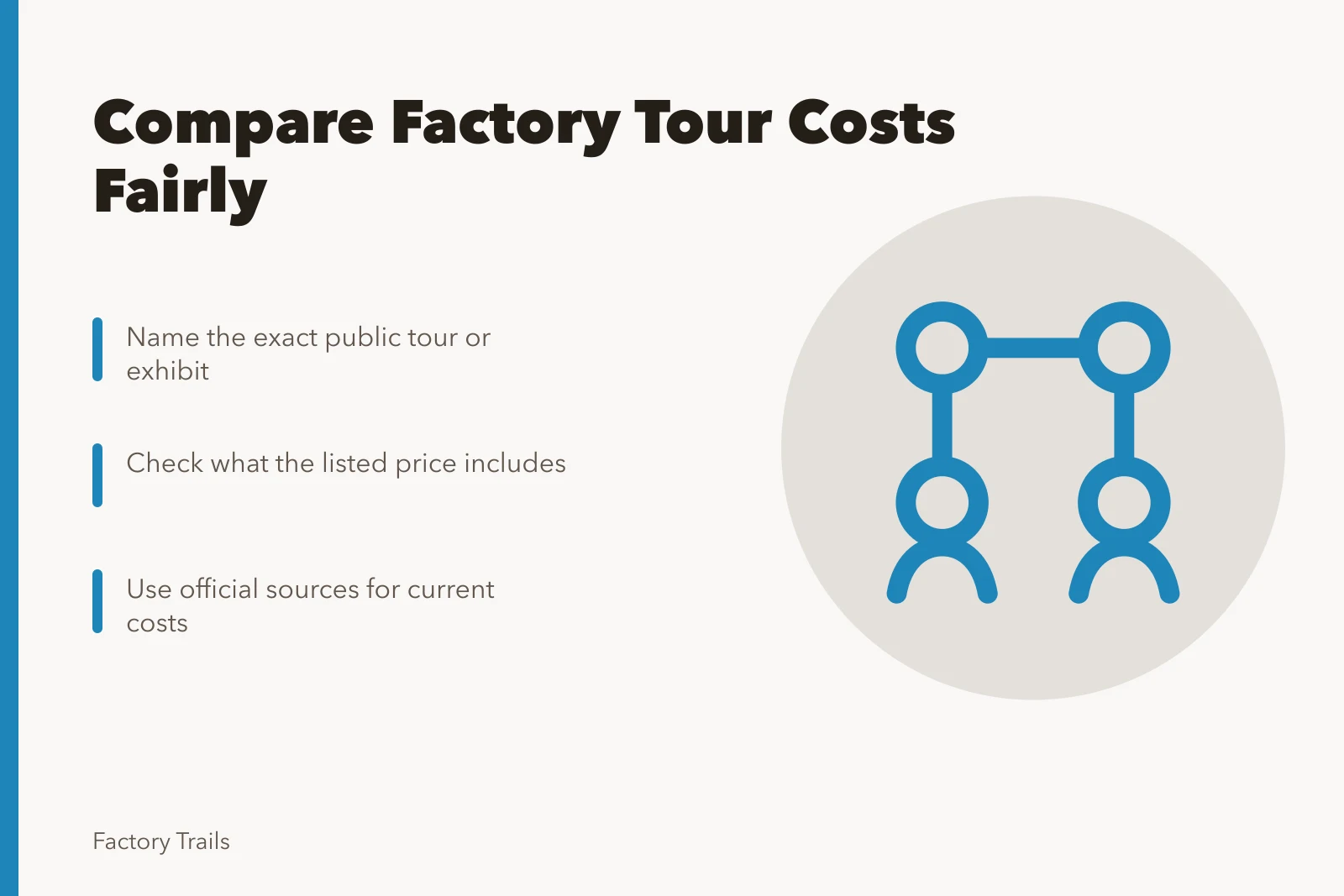
Start with the name of the guided tour, exhibit, public route, or visitor-center activity. One option may be a guided experience; another may be a self-guided historic district. Neither is automatically better, but they should not be described as interchangeable.
Six Fair-Comparison Questions
- Name the exact public experience
- List what the price includes
- Check booking and confirmation rules
- Add route, transit, and time
- Match group access and participation
- Confirm a public backup
2. What does the listed price include?
Ask whether the amount covers admission, a timed tour, a pass, parking, a shuttle, or only one element. If the terms are unclear, do not fill the gap with an assumption.
3. What must be booked or confirmed first?
Some programs require a reservation even if the entry cost is low or zero. Others have a flexible arrival process but limited seasonal hours. Compare the effort and risk of each option, not just the cost.
The National Park Service's Steamtown permits and reservations page shows why this question matters. It separates reservation and permit information by activity. That organization-specific structure is a reminder to check the terms for the exact activity rather than assuming one rule covers every visit.
4. What will the route add?
Calculate transit, fuel, parking, tolls, transfers, and the time needed to arrive for a fixed start. A nearby option with a higher admission price can be less costly in total than a distant option that requires a hotel or a full day of driving.
5. Can every member of the group use it comfortably?
Compare stated access information, terrain, duration, seating, age terms, sensory conditions, and the venue's accommodation contact. A program is not a good value if a visitor cannot participate as intended.
6. What is the fallback?
An option with a clear public backup may be more practical than one with no alternative if a reservation changes. The backup must be confirmed separately and should answer a related question, not send visitors toward private or active space.
A comparison table you can fill in
Option A
- Exact public experience
- Current entry and reservation terms
- Door-to-door travel cost and time
- Group access and participation fit
- What the experience explains
- Confirmed public backup
Option B
- Exact public experience
- Current entry and reservation terms
- Door-to-door travel cost and time
- Group access and participation fit
- What the experience explains
- Confirmed public backup
Choose the option with the clearer fit for your purpose. A guide explaining a manufacturing process might be worth more than a cheaper stop with no interpretation. A no-cost public route might be the wiser choice for a flexible afternoon. State the basis of the comparison so readers can disagree intelligently.
Ask for evidence, not estimates
A comparison needs a responsible source for each current cost claim. National Park Service visitor conditions guidance separates live operating information from general background. Use the same habit for prices, reservations, and closures.
Record the answer so it can be checked later. The National Archives describes basic records-management concepts that fit an editorial comparison: identify the record, organize it, and preserve what it supports. A source date makes an old answer easier to recognize.
The National Park Service Museum Handbook also supports careful language around historical collections. It does not establish a visitor program, so confirm that part separately.
Use the completed answers to explain the decision, not to manufacture a winner. One option may cost more but answer the group's purpose directly. Another may offer a stronger backup. The fair conclusion is the one that states those tradeoffs plainly and leaves unsupported fields out of the comparison.
Common questions
Is the cheapest factory tour always the best value?
No. Compare the total trip, the learning value, the schedule, and whether the experience works for the whole group.
Can I compare a guided tour with a self-guided route?
Yes, if you name the difference clearly. Compare what each public experience actually offers rather than pretending they are the same product.
Should a listicle rank sites only by admission price?
No. Explain the criteria and use current official sources for live terms. Price alone can be misleading.